

Last update April 3, 2026
Overview
Selling across multiple marketplaces is now a strategic imperative for ecommerce businesses that pursue sustainable growth and operational precision.
Amazon is widely recognized as the world’s most trafficked ecommerce platform, capturing a significant share of U.S. online retail sales and providing access to hundreds of millions of global shoppers. Its scale and fulfillment infrastructure empower sellers to reach a broad customer base beyond typical niche segments.
Conversely, Etsy occupies a distinct segment of the ecommerce ecosystem, dedicated primarily to handcrafted, vintage, and artisan products. With a community of millions of active buyers specifically seeking unique and creative items, Etsy offers a marketplace curated around differentiated goods and consumer intent.
Because these platforms serve different buyer behaviours and product categories, managing listings and inventory separately often leads to operational friction and inconsistent experiences. This creates a clear demand for integration tools that deliver accurate synchronisation and dependable multichannel management without manual overhead.
Is it more profitable to sell on Etsy or Amazon?
Determining which marketplace yields higher profitability is not straightforward: Amazon and Etsy serve fundamentally different seller archetypes and buyer expectations.
Amazon’s marketplace advantage is its breadth and scale. As a generalist marketplace with global reach, it delivers unparalleled visibility and customer traffic. The platform’s FBA ecosystem can boost conversion through Prime eligibility, particularly valuable for goods that fit standardized logistics, while seller success depends on meeting rigorous performance metrics.
Etsy, in contrast, specializes in handcrafted and artisan products where buyers value uniqueness and narrative over commoditized offerings. Its listing fees and commission model are transparent, but Etsy’s focused customer base can translate into strong demand for niche products that align with its catalogue.
Industry analyses highlight that the choice between these marketplaces should reflect a seller’s product category, target audience, and operational strategy rather than a single “more profitable” metric. Sellers of bespoke or creative goods frequently report stronger margin sustainability on Etsy due to buyer willingness to pay premium prices for uniqueness, while Amazon’s volume‑driven environment can generate higher total sales but demands tight cost and fulfillment management.
Many merchants adopt a hybrid approach: leveraging Etsy’s niche audience for specialized items while using Amazon’s scale for broader product lines, thereby balancing pricing dynamics, fulfillment reliability, and revenue diversification.
Is it cheaper to sell on Etsy or Amazon?
Platform fees are a critical factor when evaluating the true cost of selling on Amazon versus Etsy. Each marketplace applies its own sructure, which can influence pricing strategies, profit margins, and overall operational efficiency.
Amazon fees
Amazon offers two primary seller plans:
- Individual plan: $0.99 per item sold, no monthly subscription.
- Professional plan: $39.99 per month, regardless of sales volume.
In addition, Amazon charges a referral fee on each sale, typically ranging from 8% to 15% depending on the product category. Sellers using Fulfillment by Amazon (FBA) incur extra fees for storage, picking, packing, and shipping, which vary based on product dimensions and weight. For a detailed comparison of FBA and Multi-Channel Fulfillment (MCF) costs, you can refer to this article.
Etsy fees
Etsy relies primarily on listing and transaction fees:
- Listing fee: $0.20 per item, valid for four months
- Transaction fee: 6.5% of the total order value, including shipping and gift wrapping.
Optional fees, such as payment processing costs or advertising through Offsite Ads, may also apply, depending on how sellers promote and process transactions.
Can you connect Amazon to Etsy?
Direct integration between Amazon and Etsy is not natively supported by either marketplace’s platform APIs. Amazon and Etsy operate independently with distinct technical standards and listing frameworks.
However, third‑party integration tools have emerged that bridge these ecosystems, enabling sellers to synchronise product data, inventory levels, and orders across channels.
A reliable integration typically focuses on three key operational areas:
- Inventory synchronization
When products are sold on one marketplace, stock levels are automatically updated across all connected channels. This synchronization helps maintain accurate inventory records and prevents overselling. - Listing management
Instead of recreating listings manually on each marketplace, integration tools allow sellers to import products in bulk from one platform and publish them on another. Product data, including titles, descriptions, images, SKUs, and pricing, can be transferred and adapted to meet each marketplace’s requirements. - Centralized product editing
Product information can be updated from a single management dashboard. This centralized control allows sellers to maintain consistent pricing, descriptions, and inventory information without needing to edit each platform separately.
How to import Amazon listings to Etsy
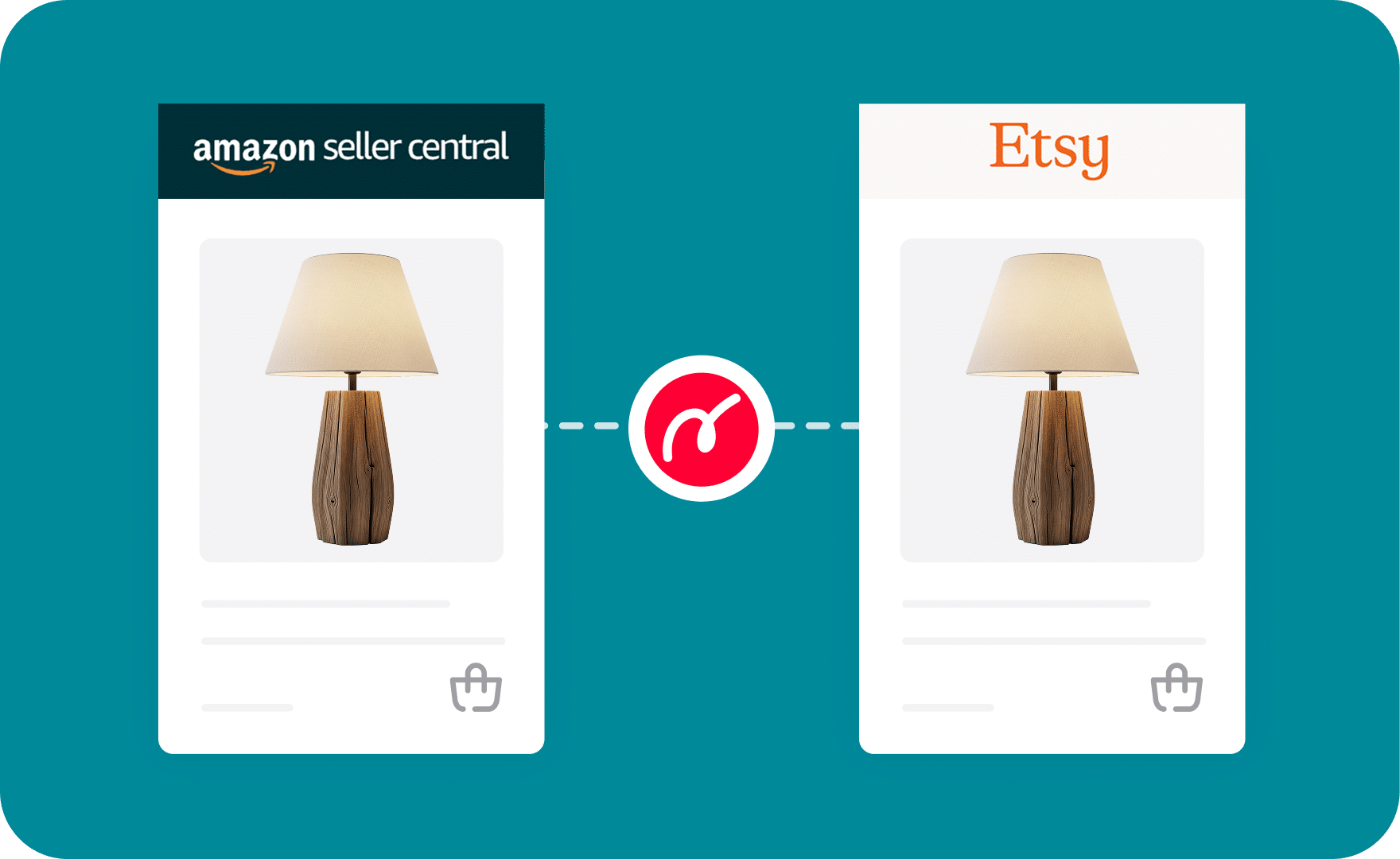
Building on the integration capabilities highlighted earlier, a third-party app like Nembol unifies inventory synchronization, listing management, and centralized editing into a single platform, providing a cohesive workflow for moving products from Amazon to Etsy.
This approach allows sellers to manage their multichannel catalog with precision and operational clarity, without the need to navigate multiple systems.
Through Nembol, Amazon listings can be imported and adapted to Etsy’s format at scale, while stock levels and product information remain synchronized across both marketplaces. All edits, whether updates to product contents, pricing or inventory, are applied from a single interface, giving sellers comprehensive control and oversight of their listings.
How to connect Amazon to Etsy in Nembol
Transferring your Amazon products to Etsy through Nembol is handled through a structured workflow that keeps your catalog consistent and fully controlled across both marketplaces.
Follow these steps to ensure a smooth and compliant transfer of your products:
- Log into your Nembol account
- Connect your Amazon Professional Seller account. Once connected, Nembol automatically imports your Amazon products, which you can view in the Products tab
- Connect your Etsy store to Nembol and configure all required settings in the Channels tab
- Bulk select the products you wish to publish on Etsy
- Click the Publish button, review your settings, and confirm the transfer to Etsy
- Monitor progress in the Activities tab, which provides real-time updates on each listing’s status
- Once the process is complete, your products will display an Etsy icon in Nembol. Click the preview icon to verify that listings appear correctly on Etsy, with accurate descriptions, images, and inventory.
Note: It is also possible to publish your products from Etsy into Amazon. To do so, each item must already exist in Amazon’s catalog and include a valid barcode, as Nembol does not currently support barcode exemptions.
How to sync Amazon and Etsy with Nembol
With Nembol, keeping your Amazon and Etsy inventory aligned is both precise and consistent. Any updates to stock on one platform are automatically reflected on the other, ensuring accurate availability without the need for manual adjustments.
To set up inventory synchronization effectively:
- Maintain active connections – Ensure both your Amazon and Etsy accounts are properly linked to Nembol.
- Link or list products on both platforms – Only items that exist on both Amazon and Etsy can be synchronized.
- Enable stock synchronization in Nembol – Turn on the “Sync stock quantity to Nembol” option for both marketplaces within your Nembol dashboard.
- Let Nembol manage updates automatically – Once configured, Nembol continuously keeps your inventory aligned across both channels, reducing the risk of overselling and minimizing administrative effort.
Nembol also provides real-time notifications to keep you informed about stock levels. If a product runs out of stock, you will receive an alert with all relevant details, so you can restock promptly and maintain operational control.
How to bulk edit Amazon and Etsy products in Nembol
Nembol allows sellers to edit multiple products across Amazon and Etsy directly from a single platform, streamlining catalog management and maintaining data consistency. Whether you need to adjust prices, quantities, or full product details, Nembol provides flexible options to suit different operational needs.
For straightforward updates, Nembol supports bulk editing of price and quantity through the dashboard, making routine adjustments faster and minimizing the risk of errors.
For more comprehensive edits, sellers can use the CSV file:
CSV Full Edit – ideal for complete product updates, allowing you to modify all attributes in one file.
CSV Light Edit – especially convenient for large catalogs. This method enables quick updates to essential fields such as ASIN, barcode, price, and quantity without overwriting the full product data.
CSV Light Edit workflow is particularly valuable for sellers managing extensive Amazon and Etsy inventories, as it combines speed with precision, allowing catalog-wide updates while keeping critical product identifiers intact.