

Nembol vs CedCommerce: Multichannel Listing Software Compared (2026)
Nembol is one platform on one subscription. CedCommerce is a catalog of products: more than fifty marketplace connectors sold individually, a separately priced unified platform called UniCon, and a managed services arm on top. The choice comes down to whether you need breadth of marketplaces or simplicity of operation — and whether you would rather try software yourself or be guided through it.
15 min read • Last update September 4, 2026
The quick verdict
Choose Nembol if you want one unified platform to manage your products, inventory, orders, customers, promotions, and multiple sales channels from a single dashboard. Nembol includes all supported channels in every plan, real-time inventory synchronization, bidirectional sync on supported channels, automated pricing rules, social media publishing, Storefront, catalog quality tools, multi-account support, and catalog backup.
Choose CedCommerce if you need access to a specific marketplace that Nembol does not support, such as Walmart, Newegg, Wish, Rakuten, Shopee, or other niche and regional marketplaces. CedCommerce offers extensive marketplace coverage, though most of it arrives through individual integrations, each with its own app, setup and subscription. Its unified UniCon platform covers a smaller set of channels and is priced separately again, starting at $99 per month for two.
What Is Nembol?
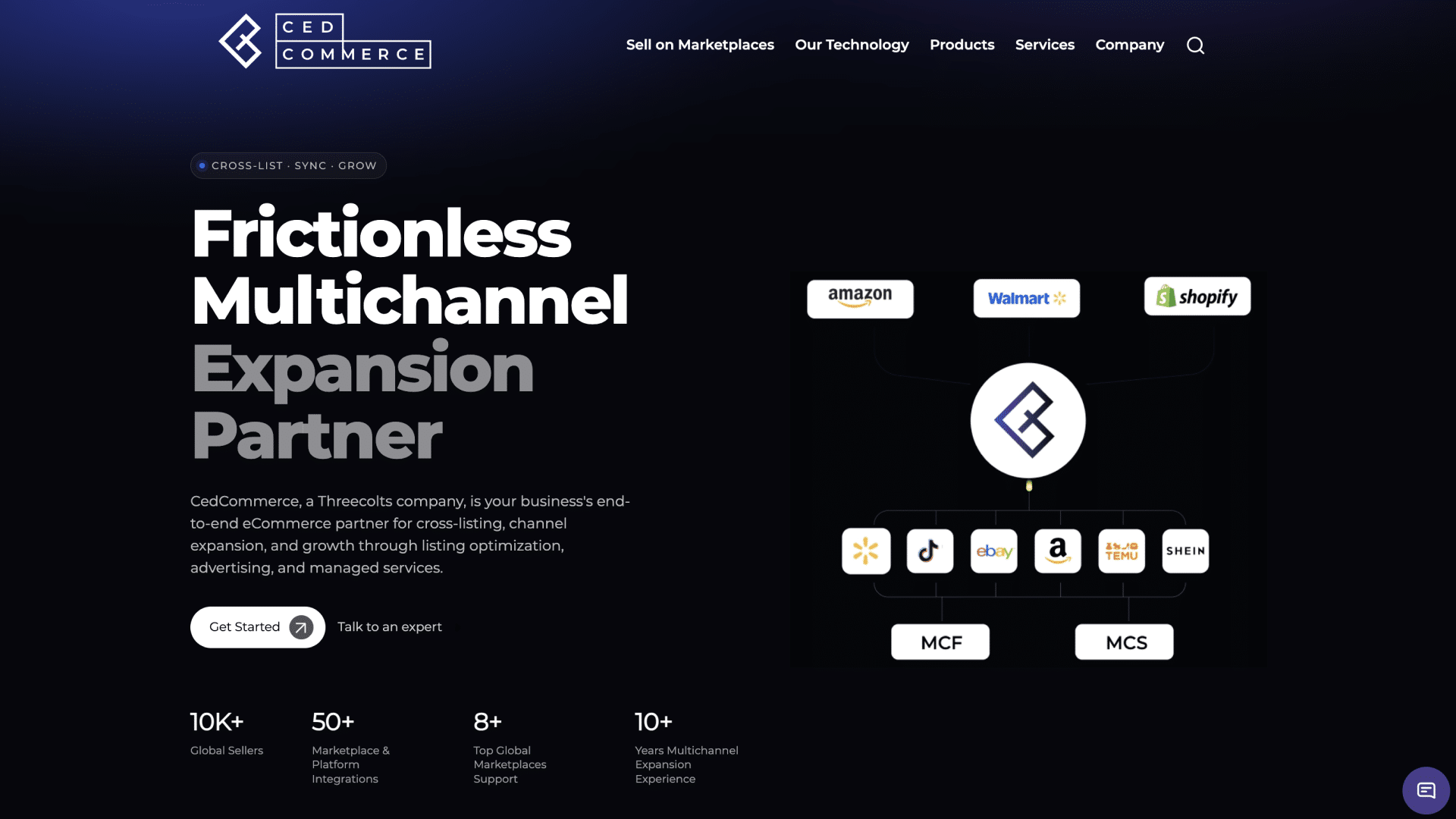
Nembol is a multichannel ecommerce management platform designed for retailers, brands, and businesses selling stocked products across marketplaces, ecommerce platforms, and social channels. Founded in 2014, Nembol enables sellers to manage products, inventory, orders, customers, promotions, and sales channels from one centralized platform.
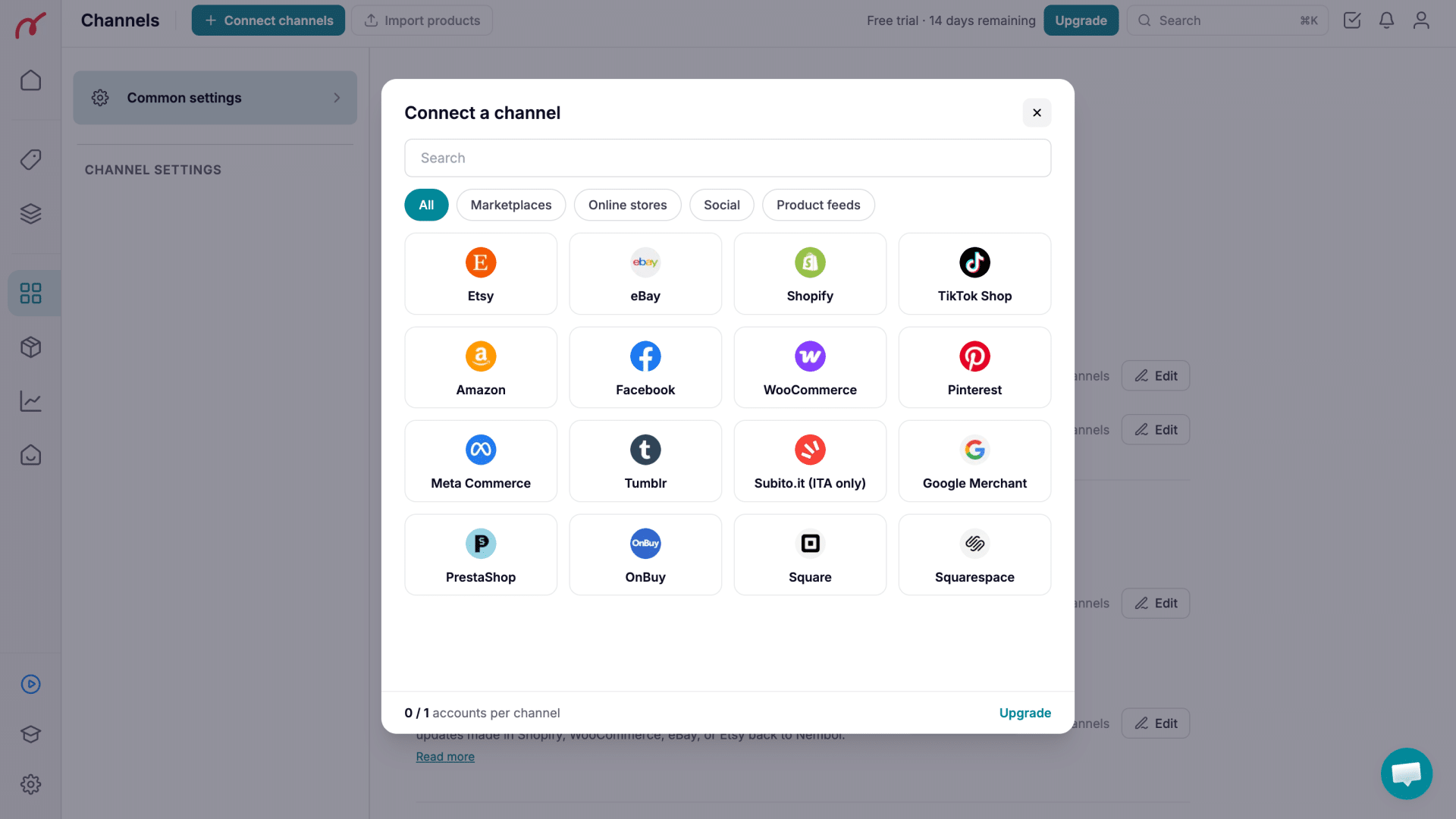
Nembol supports Amazon, eBay, Etsy, TikTok Shop, Shopify, WooCommerce, Wix, Square, Squarespace, OnBuy, PrestaShop, Subito.it, Google Merchant Center, Meta Commerce, Pinterest, and Tumblr.
Beyond listing and inventory synchronization, Nembol includes bidirectional sync on supported channels, automated pricing rules, Nembol Link for connecting existing listings, Nembol Checkup for monitoring product data quality, social media publishing, multi-account support, catalog backup, and Storefront — a built-in ecommerce website for selling directly from your Nembol catalog.
What is CedCommerce?
CedCommerce is an ecommerce integration provider that connects online stores with a wide range of marketplaces. It sells two things in parallel: marketplace-specific integrations for host platforms such as Shopify, WooCommerce, BigCommerce, Magento and PrestaShop, and UniCon, a unified dashboard covering a smaller set of channels on its own pricing.
Its main advantage is marketplace coverage. CedCommerce supports a large number of global, regional, and niche marketplaces, including Walmart, Newegg, Wish, Rakuten, Shopee, AliExpress, and others that are not currently available through Nembol.
This approach can be useful when a business needs a specific marketplace integration. However, sellers managing several channels may need to configure and maintain multiple integrations rather than managing everything through one centralized multichannel platform.
Supported sales channels
Channel coverage is one of the main differences between Nembol and CedCommerce. Nembol focuses on providing a centralized ecosystem of marketplaces, ecommerce platforms, social commerce, and direct-to-consumer channels. CedCommerce offers a much broader number of marketplace integrations, but these are provided through individual marketplace-specific apps.
Nembol Supported Channels
- Amazon
- eBay
- Etsy
- Shopify
- Wix
- WooCommerce
- TikTok Shop
- Square
- Squarespace
- Google Merchant Center
- OnBuy
- PrestaShop
- Subito.it
- Meta Commerce (Facebook Shops / Instagram Shopping)
- Tumblr
The main advantage of Nembol is that these channels are managed from one centralized platform. Sellers can connect multiple channels, synchronize inventory, manage products and orders, apply pricing rules, and coordinate their multichannel catalog without installing a separate connector for each marketplace.
CedCommerce Supported Channels
CedCommerce takes a different approach. Most of its coverage comes through individual connectors for different ecommerce platforms and marketplaces, with its unified UniCon dashboard spanning only part of the range. Its main ecommerce platform connectors include:
- Shopify
- WooCommerce
- Magento 2 (Adobe Commerce)
- BigCommerce
- PrestaShop
- OpenCart
- Amazon.
Beyond these core connectors, CedCommerce supports more than 50 marketplace and channel integrations, including eBay, Etsy, Walmart, Wish, Newegg, Bonanza, Sears, Best Buy, Rakuten, Shopee, AliExpress, Tophatter, Fruugo, OnBuy, and Catch.
This extensive marketplace coverage is CedCommerce’s biggest advantage over Nembol. However, its integrations are marketplace-specific, meaning sellers managing several channels may need to install and configure multiple apps rather than using one centralized multichannel platform.
Onboarding & Overall Experience
Nembol and CedCommerce are shaped by different ideas of what multichannel software is. Nembol is one platform you sign up for and use. CedCommerce is a set of marketplace-specific connectors, each installed separately into the store you already run, backed by a services business that will do the work for you. That difference decides how you start, what you end up managing, and how much of it you do yourself.
Onboarding
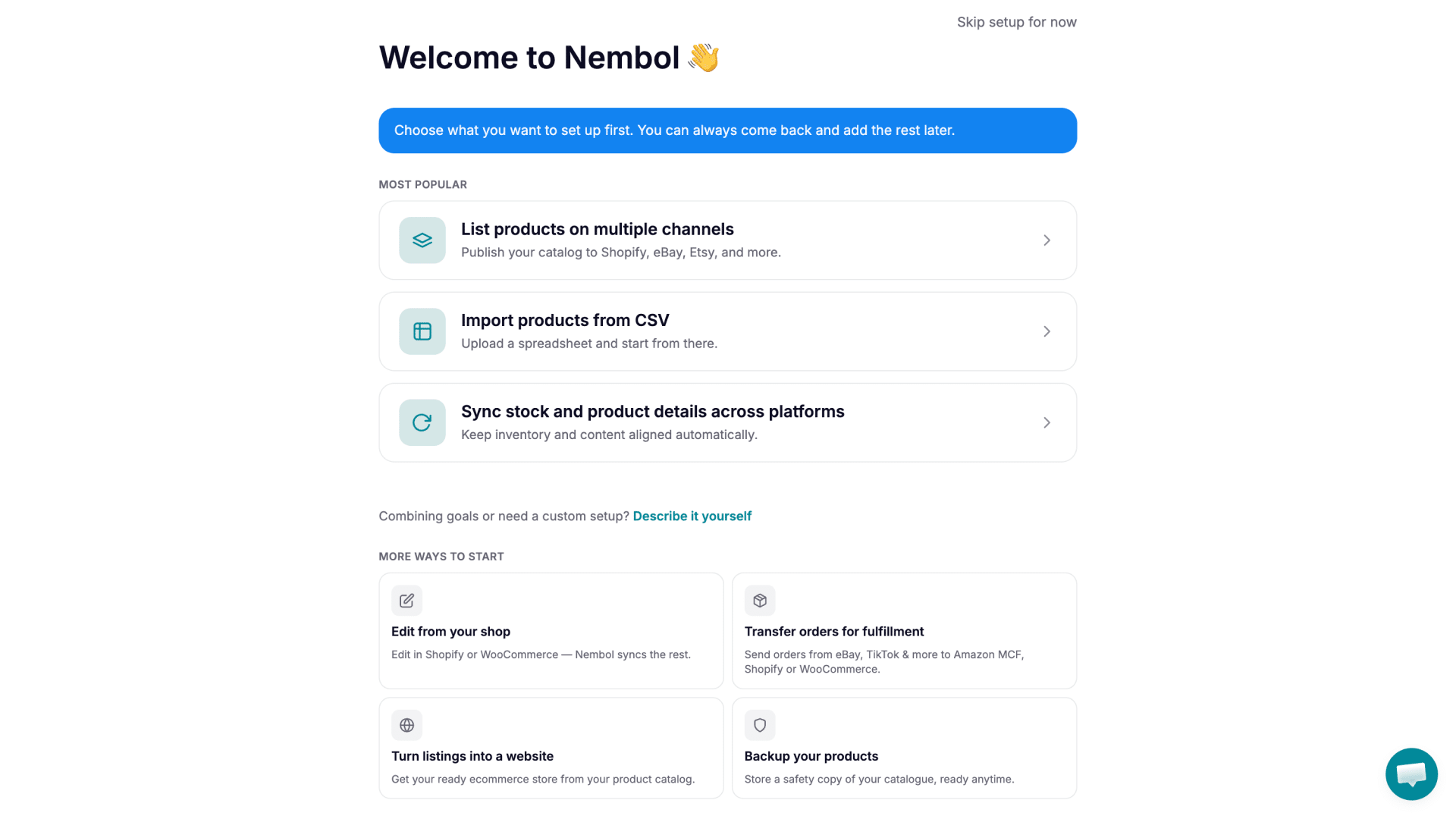
Nembol gives you a 14-day trial with every feature and no credit card, opening on a setup page that asks what you want to accomplish and offers preconfigured routes: listing across channels, importing a catalog from CSV, syncing stock, editing from an existing shop, routing orders, or building a storefront. You can describe your own goal instead, or skip setup and work directly in the app.
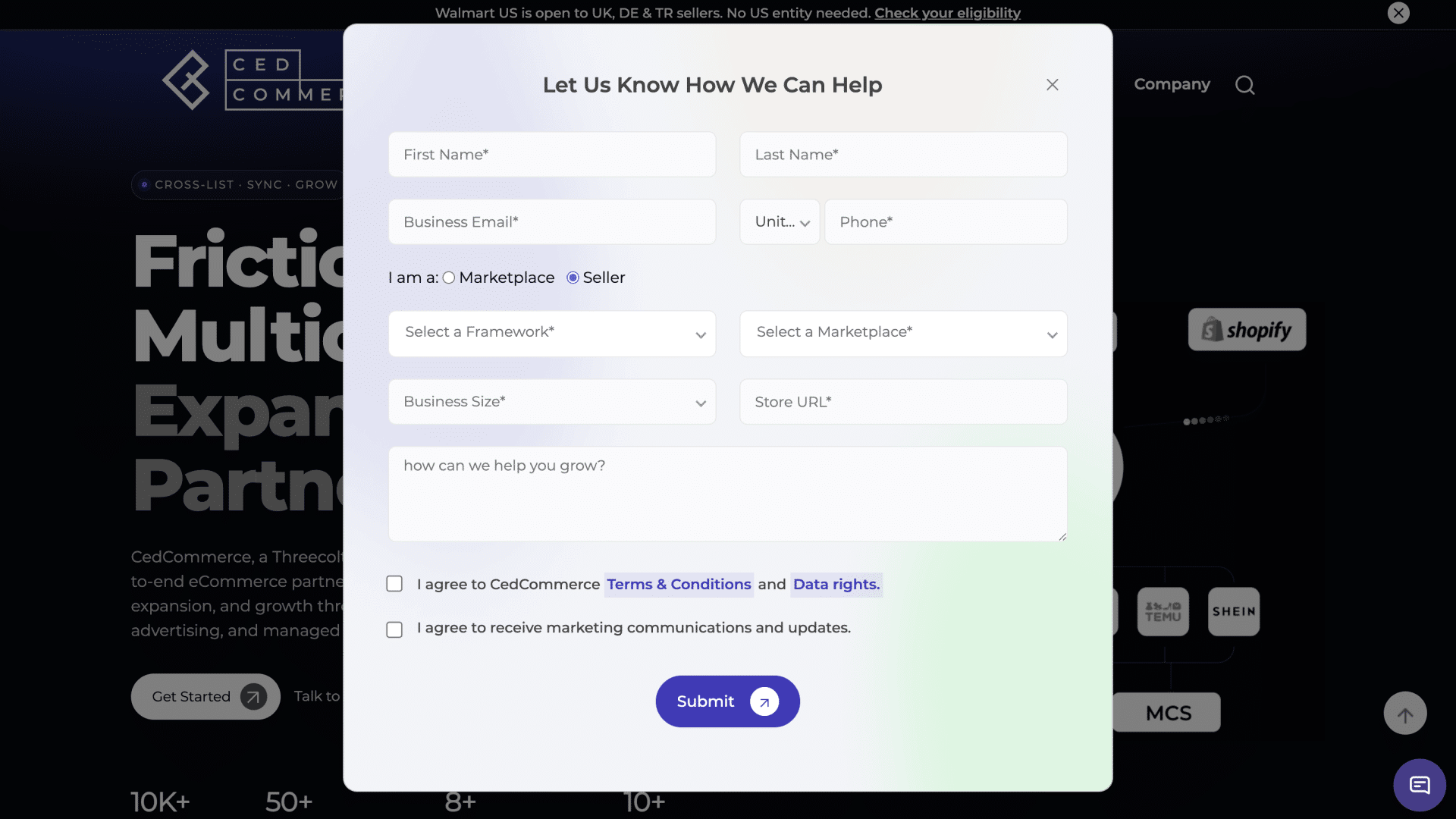
CedCommerce has no self-serve trial of the platform. The Get Started button on its website opens a qualification form: first and last name, business email, phone number, business size, store URL, which framework you use and which marketplace you want. Someone contacts you afterwards. You can bypass this by installing one of its marketplace apps directly from the Shopify App Store, several of which do offer a free plan or a free trial, but then you are trialling a single connector rather than the platform.
What you actually buy
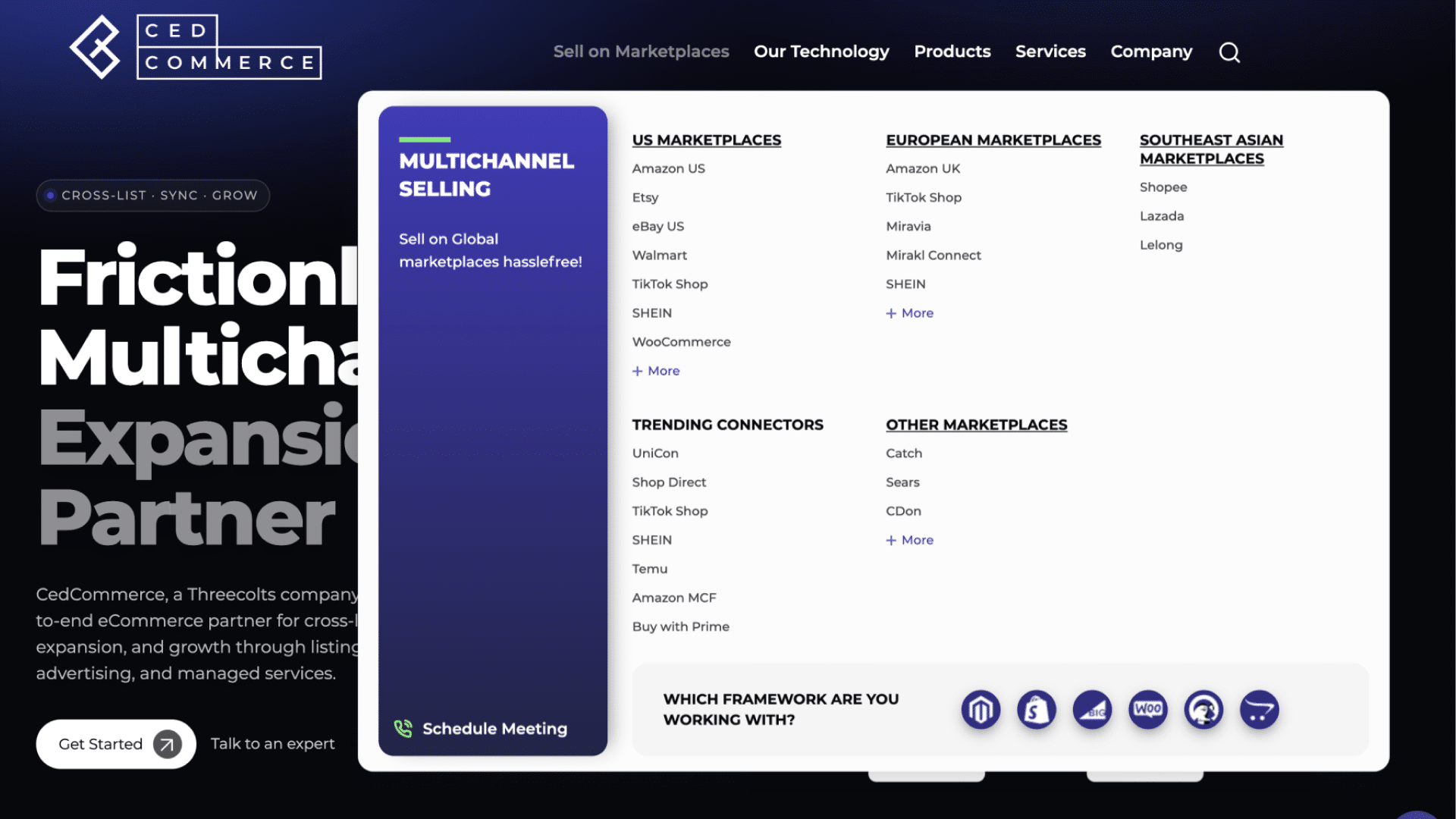
CedCommerce is not one product. On the Shopify App Store alone it lists thirteen separate apps, each dedicated to a single marketplace: Amazon, eBay, Etsy, Walmart, Walmart Canada, TikTok Shop, Temu, OnBuy, Kaufland, Fruugo and Google Shopping among them, with parallel connector ranges for WooCommerce, Magento, BigCommerce, PrestaShop and OpenCart.
Each connector is its own product. Open the Kaufland app and the header is co-branded CedCommerce and Kaufland, while the left-hand menu carries its own settings, its own error log, its own help section and, tellingly, its own Pricing Plans entry. A seller who reaches three marketplaces by this route is running three apps, maintaining three sets of sync rules and paying three subscriptions.
There is also a second route. UniCon is CedCommerce’s unified platform, a single dashboard covering Amazon, Walmart, eBay, Shopify, TikTok Shop, SHEIN, Temu and Target+, with fulfillment through Amazon MCF and Walmart WFS, and it is priced and sold separately from the connectors rather than replacing them. Which of the two routes a seller needs is not obvious from the outside, and it is easiest to get wrong at the start, when installing one connector to try one marketplace looks like the natural first step.
Both routes sit inside a company that sells services as much as software: listing optimization, advertising, storefront design and fully managed channel operations, with the website steering firmly towards a conversation through a form asking for business email, phone number, business size and store URL. For a seller who wants that guidance, or who would rather hand the channel to a managed team, this is a genuine advantage that Nembol does not offer.
Working out which of those you need is a research project. There are more than fifty connectors spread across six host platforms, each with its own plans and its own feature set; UniCon sits alongside them with different channels and different pricing again; and managed services sit on top of both. Nothing on the site puts the options side by side, so a seller has to assemble the picture themselves before they can even price it. For a beginner, or for anyone who simply wants to know what this will cost, that is genuinely hard work. Booking the call is far easier, which is presumably the point.
Customer Support
Support is where CedCommerce is genuinely strong, and it is the reason the onboarding form exists. Every connector carries a Help section, a Contact Us entry and a live chat widget, and beyond the software the company sells listing optimization, advertising and fully managed services, with account teams that will run the channel for you. If you would rather hand the work to someone else, that is a real offer and Nembol does not make it.
Nembol answers inside the app instead. An AI assistant trained on Nembol’s own documentation is there at any hour, including weekends, and the Nembol team picks up the same conversation during CET business hours, with no ticket to open and nothing to explain twice. It is help for people doing the work themselves, rather than people delegating it.
Bottomline
CedCommerce suits established sellers who need a specific marketplace, particularly a regional or niche one, and who are comfortable installing and maintaining a dedicated connector for each, or would rather pay a team to run it. Its marketplace coverage is far wider than Nembol’s and its services arm has no equivalent here.
Nembol suits sellers who want one platform rather than a collection of them: one signup, one subscription, one interface, and one place where inventory, orders, customers and channels stay in step. If you can start a trial without talking to anyone and have products listed the same afternoon, that is the difference in a sentence.
Feature-by-Feature Comparison
Data gathered from each product’s public website and documentation as of August 2026.
| Feature | Nembol | CedCommerce |
|---|---|---|
| Listing & Catalog | ||
| Bulk product listing | ✓ | ✓ |
| Listing templates | ✕ | ✓ |
| CSV import / export | ✓ | ✓ |
| AI title generator | ✓ | ✕ |
| AI description generator | ✓ | ✕ |
| Variation / multi-SKU support | ✓ | ✓ |
| Variant images | ✓ | ✓ |
| Connect existing listings | ✓ | ✓ |
| Product data quality alerts | ✓ | ✓ |
| Catalog backup | ✓ | ✕ |
| Promotions | ✓ | ✓ |
| Inventory & Sync | ||
| Real-time inventory sync | ✓ | ✓ |
| Bidirectional sync | ✓ Supported channels | ✕ |
| Automated pricing rules | ✓ | ✓ |
| Orders & Fulfillment | ||
| Order management | ✓ | ✓ |
| Order transfer to fulfillment platforms | ✓ Supported channels | ✓ |
| Amazon MCF / fulfillment transfer | ✓ | ✓ |
| Tracking number sync | ✓ | ✓ |
| Customer management | ✓ | ✕ |
| Channel Coverage | ||
| Amazon | ✓ | ✓ Connector |
| eBay | ✓ | ✓ |
| Etsy | ✓ | ✓ |
| TikTok Shop | ✓ | ✓ |
| Shopify | ✓ | ✓ Connector |
| WooCommerce | ✓ | ✓ Connector |
| Wix | ✓ | ✕ |
| Square | ✓ | ✕ |
| Squarespace | ✓ | ✕ |
| PrestaShop | ✓ | ✓ Connector |
| OnBuy | ✓ | ✓ |
| Subito.it | ✓ | ✕ |
| Google Merchant Center | ✓ | ✓ |
| Meta Commerce | ✓ | ✓ |
| ✓ | ✕ | |
| Tumblr | ✓ | ✕ |
| Magento 2 (Adobe Commerce) | ✕ | ✓ Connector |
| BigCommerce | ✕ | ✓ Connector |
| OpenCart | ✕ | ✓ Connector |
| Walmart US | ✕ | ✓ |
| Walmart Canada | ✕ | ✓ |
| Wish | ✕ | ✓ |
| Newegg | ✕ | ✓ |
| Bonanza | ✕ | ✓ |
| Sears | ✕ | ✓ |
| Best Buy | ✕ | ✓ |
| Rakuten | ✕ | ✓ |
| Shopee | ✕ | ✓ |
| AliExpress | ✕ | ✓ |
| Tophatter | ✕ | ✓ |
| Fruugo | ✕ | ✓ |
| Catch | ✕ | ✓ |
| Other CedCommerce marketplace integrations | ✕ | ✓ 50+ connectors |
| Additional Features | ||
| Social media auto-posting | ✓ | ✕ |
| Website builder | ✓ Storefront | ✕ |
| Multi-account per channel | ✓ Plan dependent | ✓ Plan dependent |
| Multi-user seats | ✓ | ✓ |
| Catalog analytics | ✓ | ✓ |
| Public API | ✓ Yes, after approval | ✕ |
| Mobile app | ✕ | ✕ |
| All channels in one subscription | ✓ | ✕ UniCon covers a subset, priced separately |
| Free trial | ✓ 14 days, no credit card | ✓ 7–14 days on connectors; free tier on UniCon |
Pricing comparison
Nembol and CedCommerce use fundamentally different pricing models. Nembol charges a fixed monthly subscription based on the number of products in your catalog, with all supported channels included and unlimited orders. CedCommerce charges separately for each marketplace connector, with plans and limits varying by integration, and prices its unified platform, UniCon, separately again. A single connector can start below Nembol, but the cost rises with every channel added, and the unified route is priced well above Nembol at a comparable catalog size.
Nembol pricing
| Plan | Products | Seats | Accounts / Channel | Key Features Included | Price / Month |
|---|---|---|---|---|---|
| Basic | 200 | 1 | 1 | Inventory sync, Storefront, Social Posting | $39 |
| Pro | 2,000 | 1 | 2 | Nembol Link + Transfer Orders | $49 |
| Enterprise | 5,000 | 2 | 4 | Attributes Manager + Nembol Checkup | $79 |
| Enterprise+ | 15,000 | 5 | 10 | Nembol Checkup + AI Title & Description + API access (After approval) | $129 |
All plans include unlimited listings, orders, and variants. Annual billing saves 25%. The Idle Plan (catalog backup only, no active sync) is available at $9.99/mo.
CedCommerce pricing
CedCommerce pricing depends on the connector and ecommerce platform you use. Individual marketplace integrations can start at around $9/month, while broader or higher-volume plans cost more.
| Plan | Price / Month | Orders Included | Best For |
|---|---|---|---|
| Free | $0 | 0 | Exploring Amazon integration |
| Beginner | $19 | 100 | New Amazon sellers |
| Beginner | $49 | 500 | New Amazon sellers |
| Growth | $99 | 1,000 | Growing Amazon businesses |
| Growth | $249 | 2,500 | Growing Amazon businesses |
Example: The table above shows the CedCommerce Amazon Channel pricing. Other connectors have their own plans and pricing.
UniCon pricing (CedCommerce’s unified platform)
| Plan | Price / Month | Accounts | Channels | Listings |
|---|---|---|---|---|
| Free | $0 | 1 | — | 500 |
| Starter | $99 | 1 | 2 | 1,000 |
| Growth | $499 | 2 | All | 5,000 |
| Performance | $999 | 5 | All | 10,000 |
| Custom | On request | Unlimited | All | Unlimited |
Listings can also be published à la carte at $5 per listing, per channel. Note that UniCon caps the number of listings, so publishing one product to four channels consumes four of them, where every Nembol plan includes unlimited listings and counts only products. At a comparable catalog size the gap is wide: 5,000 listings on UniCon Growth costs $499 a month, against $79 for 5,000 products on Nembol with no listing limit.

Which pricing model works better for you?
CedCommerce can have a lower entry price when you only need one marketplace integration. However, each additional connector can require a separate subscription, and plans may also depend on order volume. Nembol includes all supported channels in one subscription, making costs easier to predict as your multichannel operation grows.
Take a concrete case: a Shopify seller with a catalog of 500 products who wants to list on Amazon and eBay.
On Nembol that is the $49 Pro plan. Five hundred products, both marketplaces, and every other supported channel included, with unlimited listings and unlimited orders.
On CedCommerce there are two routes and both cost more. Through UniCon, 500 products across two channels counts as 1,000 listings, which is exactly the ceiling of the $99 Starter plan; add a third channel and the same catalog becomes 1,500 listings, moving you to Growth at $499 a month. Through the individual connectors you install one app per marketplace, each with its own subscription and its own settings to maintain, and the Amazon connector alone is $49 a month at 500 orders.
The gap widens rather than narrows as you grow, because the two are counting different things. Nembol charges for the size of your catalog, so publishing the same 500 products to a fourth or fifth channel costs nothing extra. CedCommerce charges by listings or by orders, both of which rise every time you add a channel.
Strengths and Weaknesses
Nembol: Strengths
- One platform and subscription for all supported channels
- Real-time and bidirectional inventory synchronization
- Unlimited orders, listings, and variants
- Storefront and social media publishing
- Nembol Checkup for product data quality
- Customer management and centralized promotions
- Automated pricing rules
- Multi-account support
- Catalog backup with the Idle Plan
- 14-day free trial
- Public API access
Nembol: Weaknesses
- No Walmart or some niche marketplaces
- No Magento or BigCommerce integration
- No managed marketplace services
- No mobile app
CedCommerce: Strengths
- 50+ marketplace and ecommerce connectors
- Broad niche and regional marketplace coverage
- Shopify, WooCommerce, Magento 2, BigCommerce, PrestaShop and OpenCart connectors
- Walmart, Newegg, Wish, Rakuten, Shopee, and other marketplaces
- Marketplace-specific features
- Optional managed services
CedCommerce: Weaknesses
- Separate connectors and subscriptions
- Costs can increase as channels are added
- Unified dashboard (UniCon) covers only a subset of its integrations and is priced separately from the connectors
- No bidirectional synchronization
- No social media auto-posting
- No built-in website builder
- No catalog backup
- No public API
- Features vary between connectors
Final Comparison: Nembol vs CedCommerce
CedCommerce is a strong option when marketplace coverage is the main priority, particularly for sellers targeting niche or regional marketplaces. Its connector-based model can also make sense when you only need one specific integration.
For businesses managing multiple channels, however, Nembol offers a more complete and unified approach. One subscription combines channel management, real-time synchronization, catalog and customer tools, social commerce, automated pricing, and a built-in Storefront — a capability CedCommerce does not offer as part of its core platform. Included in all paid plans, Nembol Storefront provides a branded online store with checkout, payments, shipping options, promotions, bundles, analytics, and SEO- and GEO-optimized product pages. This gives businesses not only the tools to manage external marketplaces, but also a dedicated sales channel they fully control, all within the same platform.
Frequently Asked Questions
Is Nembol a good alternative to CedCommerce?
Yes. Nembol is a strong CedCommerce alternative for businesses that want one unified platform instead of separate marketplace connectors. It combines multichannel management, real-time sync, automated pricing, social commerce, promotions, customer management, and a built-in Storefront in one subscription.
Is Nembol cheaper than CedCommerce?
It depends on how many channels you need. CedCommerce can be cheaper when you only need one connector, but costs can increase as you add integrations. Nembol includes all supported channels in every paid plan, making costs more predictable for businesses selling across multiple channels.
Does Nembol have features that CedCommerce doesn't?
Yes. Nembol includes features such as bidirectional synchronization, social media auto-posting, Nembol Checkup, customer management, and Storefront. The Storefront is included in all paid plans and provides a branded ecommerce site with checkout, payments, promotions, bundles, analytics, and SEO/GEO optimization.
Which is better for multichannel listing, Nembol or CedCommerce?
It depends on whether you need breadth of marketplaces or simplicity of operation. CedCommerce is better if your business depends on a marketplace Nembol does not support, such as Walmart, Newegg, Wish, Rakuten or Shopee, and you are willing to run a dedicated connector for each one. Nembol is better if you want a single subscription covering every supported channel, with real-time and bidirectional inventory sync, order and customer management, automated pricing rules and a built-in Storefront, all managed from one dashboard. Nembol starts at $39 per month with unlimited listings and orders on every plan.
Can I sell on Walmart with Nembol or CedCommerce?
CedCommerce, not Nembol. Nembol does not currently integrate with Walmart US or Walmart Canada, and a Walmart seller is better served by CedCommerce, which offers dedicated Walmart connectors and includes Walmart in its UniCon platform, along with Walmart Fulfillment Services. Nembol’s marketplace coverage centers instead on Amazon, eBay, Etsy, TikTok Shop and OnBuy, alongside ecommerce platforms and social channels. If Walmart is central to your business, CedCommerce is the right choice of the two.
Do I need a separate app for each marketplace with CedCommerce?
On the connector route, yes. CedCommerce lists thirteen separate apps on the Shopify App Store alone, one per marketplace, and each has its own settings, its own error log and its own subscription, so selling on three marketplaces means running three apps and paying three times. Its UniCon platform is the alternative, covering Amazon, Walmart, eBay, Shopify, TikTok Shop, SHEIN, Temu and Target+ from a single dashboard, but it is priced separately again. With Nembol every supported channel is included in one subscription, and adding a channel is a connection rather than a purchase.
How much does CedCommerce cost?
There is no single price, because CedCommerce sells three things. Individual marketplace connectors start at roughly $9 per month and are priced per integration, with plans that often depend on order volume; its unified UniCon platform runs from a free tier through $99, $499 and $999 per month, capped by number of listings rather than products, with à la carte publishing at $5 per listing per channel; and managed services for listing optimization, advertising and design are charged on top. Nembol charges one subscription from $39 to $129 per month based on catalog size, with all supported channels, unlimited listings and unlimited orders included.
Does CedCommerce sync inventory across channels in real time?
Yes, within whichever product you are using, but the synchronisation is one-way. CedCommerce connectors and UniCon keep stock updated across the channels they cover, though changes made directly on a channel do not flow back. Nembol also syncs in real time and adds bidirectional sync on supported channels, so an edit made in Shopify, WooCommerce, Wix, Square, Squarespace, Etsy or eBay is pulled back into Nembol and propagated onwards, which matters when several people update listings in different places.
Is CedCommerce a good choice for a beginner?
Less so than Nembol, mainly because of how much you have to work out before you start. CedCommerce spans more than fifty connectors across six host platforms, a separately priced UniCon platform, and a managed services arm, and nothing puts those options side by side, so establishing what you need and what it will cost usually means booking a call. Nembol offers a 14-day trial with every feature and no credit card, opens on a setup page that asks what you want to accomplish, and can have products listed on several channels within the first session. If you want expert guidance and are happy to talk to a sales team, CedCommerce’s services model is a genuine strength.
Start your free trial with Nembol
Connect both platforms with Nembol and keep your products, inventory, and sales in sync.
14-day free trial | No credit card required