
Last update October 23, 2026
Overview
The Agentic Commerce Protocol is the open standard that lets an AI assistant read your catalog, price it correctly and know what is in stock. This is what it asks of you, and what changed in 2026.
In September 2026, three things happened within a week of each other. Amazon opened its advertising platform to ChatGPT. Shopify became OpenAI’s first ecommerce partner. And OpenAI’s advertising business, which did not exist in February, passed a $1 billion annualised run rate in under 200 days. By 5 October OpenAI was saying ChatGPT reaches 1.2 billion people a week.
Underneath all three sits a layer of plumbing almost nobody is talking about. There are in fact two competing standards for it, and the one built by OpenAI is the Agentic Commerce Protocol. It is the reason an AI assistant can show your product, price it correctly, know whether it is in stock, and in some cases take the payment — without you doing anything, or with you doing quite a lot, depending on how you sell.
This is what the Agentic Commerce Protocol is, how it works, and what it actually asks of you.
What is the Agentic Commerce Protocol? In simple words.
The Agentic Commerce Protocol — ACP — is an open standard for how AI agents, buyers and merchants talk to each other during a purchase.
That is the whole idea. Until now, buying online assumed a person with a browser. People searched, clicked, read, added to cart, filled in a form. Every part of that flow was designed for eyes and a mouse.
An AI agent has neither. When someone asks an assistant “find me a waterproof jacket under $120 that ships to Ireland by Friday”, the assistant needs to do things a web page was never built to answer: read a structured catalog rather than a rendered page, confirm live price and stock rather than a cached number, check whether this seller ships to that country, calculate tax and shipping for that specific basket, hand over payment securely without ever holding the card, and tell the merchant an order exists so it can be fulfilled.
ACP is the agreed vocabulary for those steps. It covers checkout, payments, fraud signals and fulfilment notifications, and it is published as an open specification, with OpenAI’s implementation documented in its developer commerce docs.
Two facts about it matter more than the technical detail.
- It is open. Building with ACP is available to anyone. It is not an OpenAI-only club, and other assistants can adopt the same standard. That is deliberate — a payment standard that only works with one buyer is not a standard.
- Implementing it is not the same as being featured. Anyone can build to the spec. Being surfaced inside ChatGPT is a separate matter, decided by OpenAI and by whichever platform holds your catalog. Do not confuse the two.
- And the checkout half of the story has already changed once. ACP launched in September 2025 powering Instant Checkout, which let buyers pay inside ChatGPT. OpenAI retired Instant Checkout in March 2026, roughly six months in, saying the first version “did not offer the level of flexibility that we aspire to provide, so we’re allowing merchants to use their own checkout experiences while we focus our efforts on product discovery.” If you read an article about buying inside ChatGPT that is more than six months old, it is describing something that no longer exists.
ACP is not the only standard
This is the part most coverage leaves out. There are two competing standards for agentic commerce, launched eight months apart by rivals, and they work differently.
The Universal Commerce Protocol, or UCP, was announced by Google at NRF in January 2026 and co-developed with Shopify, alongside Etsy, Wayfair, Target and Walmart. It is backed by a coalition of more than twenty retailers, payment networks and processors, and it is already deployed at major US merchants. On 15 October 2026 Google put it in front of shoppers, launching Universal Cart across US Search and the Gemini app with “effortless checkout powered by the Universal Commerce Protocol”, carrying Nike, Sephora, Target, Ulta Beauty, Walmart, Wayfair and many Shopify merchants.
The two standards take genuinely different approaches, and the difference matters for what you would have to build.
* Both are open standards. Building to either is available to anyone, while featured placement inside a specific assistant is a separate commercial arrangement.
Two practical consequences.
You will probably end up supporting both. They serve different surfaces. ACP reaches people in a conversation with ChatGPT. UCP reaches people wherever Google puts an agent, which is a much larger surface area.
The work underneath is the same either way. UCP asks you to structure and expose your product data. ACP asks you to handle a transaction driven by an agent. Both start from an accurate, complete, machine-readable catalog. If you do only one thing, do that one, because it is the prerequisite for both and it is also what improves your marketplace listings and your Google Shopping feed at the same time.
How does an agentic purchase work, step by step?
Here is the sequence, in order, for a purchase completed inside an AI assistant.
* Based on the Agentic Commerce Protocol specification and OpenAI's Agentic Checkout documentation, September 2026. Shaded rows are the merchant's responsibility.
Read the middle column. Six of the twelve steps are the merchant’s, and they are the six that carry all the risk: stock accuracy, shipping rules, tax, fraud, the charge itself, and the final yes or no.
This is the single most misunderstood thing about agentic commerce. The assistant is not a reseller. It does not buy your stock and sell it on. It is a front end. You still own the order, the money, the tax liability and the customer service. Payment runs through your existing processor, so the funds land where they always did.
Which also means: if your stock number is wrong, you sell something you do not have, in front of an audience that will not forgive it.

Every route into agentic commerce reads a product catalog.
Nembol keeps one accurate record and publishes it everywhere you sell, with stock synced across all of them.
What does a merchant have to provide for ACP?
Two things: a product feed, and — if you want in-conversation checkout — a set of endpoints.
The product feed
This is the foundation, and for most sellers it is the only part that matters.
The feed is the single source of truth for your product data: titles, descriptions, prices, stock, images, variants, shipping and returns. Accepted formats are CSV, TSV, XML or JSON, and it can be refreshed as often as every 15 minutes, which is what makes near-live pricing and availability possible.
The specification splits fields into two groups, and the distinction is worth understanding because it maps directly onto whether you sell anything.
Required fields control whether you appear correctly at all — identifiers, price, availability. Get these wrong and you are either invisible or, worse, visible with a wrong price.
Recommended attributes — rich media, reviews, performance signals — improve ranking, relevance and buyer trust. They are optional in the sense that the feed will validate without them, and not optional at all in the sense that your competitor who fills them in will outrank you.
That is the same trade every seller already knows from Google Shopping and from marketplace search. The mechanics are new; the principle is not. Complete, accurate, well-photographed product data wins. Thin data loses.
The endpoints
If you want a buyer to complete the purchase inside the assistant, you also need to expose ACP checkout endpoints: create and update a checkout session, return fulfilment options, handle the delegated payment, confirm or reject.
This is real engineering work. It is also, for most sellers, not currently the decision in front of you, because the routes that already exist do it for you.
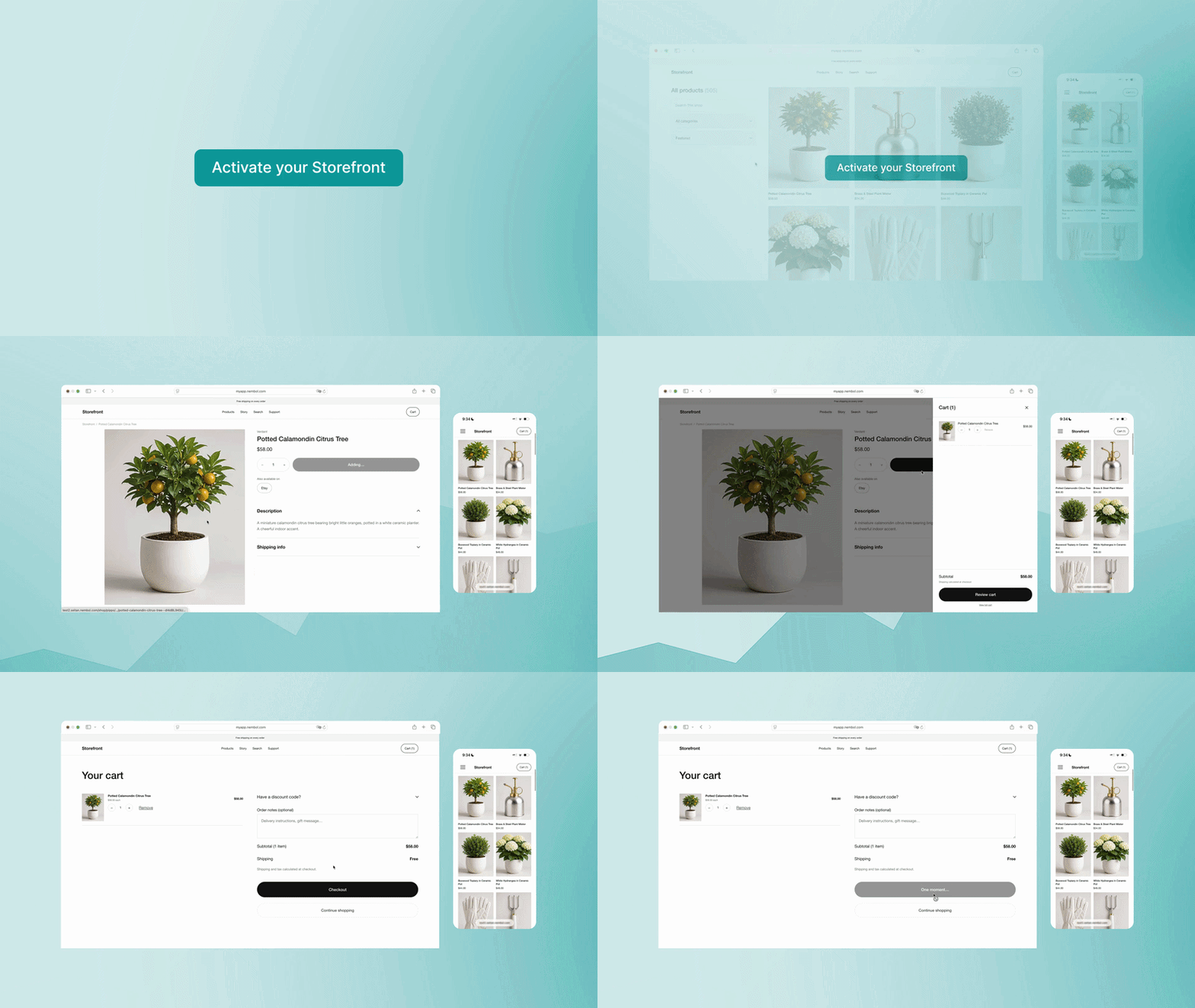
Nembol’s Storefront is already accessible to any AI agent, including Claude, ChatGPT, Perplexity, and others. It’s included in all plans and can be generated with one click from your existing catalog. Try it now!
How are sellers already exposed to agentic commerce?
You may already be in agentic commerce without having done anything. There are three routes in, and two of them are automatic.
* Whichever route you use, blocking OAI-SearchBot in your robots.txt makes your catalog invisible to ChatGPT shopping.
And one gate that catches people out regardless of which route they take: if you block OAI-SearchBot in your robots.txt, your catalog is invisible, no matter how good your feed is. Plenty of sites blocked AI crawlers in 2024 and 2025 on principle. If you sell things, that decision now has a direct commercial cost. Go and check.
The Etsy case deserves a moment, because it is the clearest example of how little agency an individual seller has here. US Etsy sellers were enrolled through the Offsite Ads programme, and whether you can leave it depends on a number. Under Etsy’s own rules, a shop that has taken $10,000 or more in any rolling 365-day period since 20 February 2019 is required to participate for the lifetime of the shop and pays a 12% fee on attributed orders. A shop that has never crossed that threshold is enrolled automatically but may opt out, and pays 15% if it stays in. So the sellers with the most to lose are the ones with no choice.
Whether you think that is good or bad, it is the shape of things. The platform you sell on decides your AI visibility far more than any choice you make yourself. Which is an argument for being on more than one.
More channels, more routes an assistant can find you through.
Nembol allows you to bulk publish your products on 20+ platforms, while keeping stock in sync.
It’s free to try, no credit card needed.
Discovery and checkout are different problems
This is the distinction that will save you from a lot of confused reading.
- Discovery is whether an AI assistant can find your product, understand it, and recommend it. It needs structured, accurate, machine-readable product data and a page it is allowed to crawl.
- Checkout is whether the buyer can pay without leaving the conversation. It needs ACP endpoints, a payment integration and partner approval. As of 2026 it is also, for practical purposes, not on offer: ChatGPT sends the buyer to your own checkout.
Almost everything written about agentic commerce collapses these into one thing. They are not one thing, they have different costs, and discovery is where the volume is. An assistant that recommends you and sends the buyer to your site has still done the hard part.
That uncertainty has now resolved, and it resolved in favour of discovery. OpenAI retired Instant Checkout in March 2026 and rebuilt around product discovery, with the purchase completed on the merchant’s own site. Shopify’s documentation now states the same thing from the other end: customers using ChatGPT are redirected to buy in your online store checkout, and there is no direct-checkout setting to toggle.
The reasons are instructive, because they are the reasons agentic checkout is hard for anyone. Merchant onboarding proved slow. Product data was often wrong. Multi-item carts and loyalty memberships did not work. And Walmart found conversion three times worse for items bought inside ChatGPT than for the same items when the shopper was sent to Walmart’s own site. The assistant was good at recommending and bad at transacting.
So the conclusion the early coverage reached by guessing is now the documented position, at least for ChatGPT: discovery is the whole game, and discovery runs on your catalog.
The other standard went the other way. Seven months after OpenAI withdrew, Google shipped Universal Cart, a cross-retailer cart with Google Pay checkout running on UCP, while still letting the shopper bounce into the retailer’s own cart instead. The merchant stays the seller of record either way. So the two biggest players have now run the same experiment and drawn opposite conclusions, and anyone who tells you the question is settled is reading one of them and not the other.
What does not change with either answer: every version of this future requires an assistant to be able to read your product data. None of them requires you, today, to build a checkout endpoint.
What does ACP mean if you sell on marketplaces?
If your business runs on Etsy, eBay, Amazon or TikTok Shop, the honest summary is this. Your AI visibility is currently the marketplace’s decision, not yours. Etsy has syndicated its sellers. Shopify has syndicated its merchants. Amazon has chosen a different path, advertising into ChatGPT rather than a commerce partnership, which gives it AI visibility without handing over the customer relationship. eBay, TikTok Shop and most others have not publicly committed either way.
That produces a strange and temporary situation: the same product, listed on four channels, may be visible to an AI assistant through one of them and invisible through the other three, entirely because of deals struck above your head.
One. Breadth is now a discovery strategy, not just a sales strategy. Listing on more channels used to be about reaching more buyers. It is now also about how many routes into AI shopping your catalog has.
Two. Your own site stops being optional. It is the only surface where you control the product data, the crawl permissions and the checkout. Every syndicated route is someone else’s decision to reverse.
Three. Catalog quality is now a ranking factor twice over. The same complete, accurate, well-photographed product record that wins marketplace search is what makes an assistant able to recommend you. There is no separate AI version of your product data to maintain.
What should sellers do about ACP now?
A short list, in order of effort.
- Check your robots.txt. If OAI-SearchBot is blocked, you are invisible to ChatGPT shopping. Two minutes, highest return on the list.
- Find out whether your marketplaces have already enrolled you. If you sell on Etsy in the US and have not opted out of Offsite Ads, you are already there. Shopify stores selling to US customers are in by default through Shopify Catalog, and opting out takes up to seven days to take effect.
- Audit your product data against the recommended fields, not just the required ones. The required fields get you listed; the recommended ones get you chosen.
- Make sure stock is accurate everywhere. Agentic checkout confirms availability against your system in real time. An oversell in front of an AI assistant is an oversell in front of the buyer, immediately.
- Get your own storefront live if you do not have one, so you have at least one surface whose AI visibility nobody else controls.
- Do not build ACP checkout endpoints. Not yet, and for most sellers not at all. OpenAI withdrew in-conversation checkout in March 2026 and now sends buyers to your site. The feed is the part that pays; the endpoints are the part that changed.
Where Nembol fits
Nembol helps merchants in two key ways:
1. Unlock multichannel publishing
Nembol allows you to share your existing catalog across multiple sales channels, all from one place. This helps you increase your visibility, reach more customers, and get discovered across more platforms.
2. Activate your own AI-ready storefront
If you don’t have a website, you can activate Nembol Storefront. It is generated directly from your existing catalog and structured for discovery by AI agents and search engines. You get your own domain and your own checkout powered by Stripe or PayPal.
It’s a discovery surface you own and control — not a marketplace where you are simply listed among others.
Frequently asked questions
What is the Agentic Commerce Protocol?
The Agentic Commerce Protocol, or ACP, is an open standard that defines how AI agents, buyers and merchants communicate during a purchase. It covers checkout, payments, fraud signals and fulfilment notifications, and is published openly so any assistant or merchant can build to it.
Who created the Agentic Commerce Protocol?
It was introduced by OpenAI with Stripe in September 2025 and published as an open specification. Building with it is open to anyone. It originally powered Instant Checkout, which let buyers pay inside ChatGPT; OpenAI retired that in March 2026 and now focuses on product discovery, sending buyers to the merchant’s own checkout.
Do I need to implement ACP to sell through ChatGPT?
Not necessarily. If you sell on Etsy or Shopify, your catalog may already be syndicated automatically. Implementing ACP endpoints yourself is only required if you want buyers to complete a purchase inside the assistant from your own store.
Are Etsy sellers already on ChatGPT?
Yes, in large numbers. US Etsy sellers enrolled in Offsite Ads are eligible to appear in ChatGPT shopping, and most were never asked individually because enrolment is automatic. Etsy requires shops that have taken $10,000 or more in any rolling 365-day period to stay in Offsite Ads permanently, at a 12% fee on attributed orders; smaller shops are enrolled by default at 15% and may opt out.
What product data does ChatGPT need to show my products?
A structured product feed in CSV, TSV, XML or JSON containing identifiers, titles, descriptions, price, availability, images, variants, shipping and returns. Feeds can refresh as often as every 15 minutes. Required fields control whether you appear; recommended fields such as rich media and reviews affect how well you rank.
Can blocking AI crawlers stop my products appearing?
Yes. If OAI-SearchBot is disallowed in your robots.txt, your catalog will not be indexed for ChatGPT shopping regardless of feed quality.
Does the AI assistant take my money or my customer?
No. Under ACP the merchant validates the order, calculates tax, assesses risk, charges through its own payment processor and accepts or declines. The assistant renders the interface; the merchant keeps the transaction, the funds and the responsibility.