Last update October 23, 2026
Overview
ChatGPT Ads for Shopify arrived as a free self-serve app. Amazon took a different route. Here is how the two compare, and which one you can actually use.
In September 2026, within a week of each other, both Shopify and Amazon opened routes into ChatGPT advertising. The coverage has largely treated these as the same announcement. They are not.
- Shopify shipped a free app that any merchant can install to sync their storefront and run ads themselves.
- Amazon opened a managed pilot for a limited set of US advertisers, with Amazon Ads representatives building the campaigns.
One is self-serve and open. The other is invitation-only and hands-on. Which you should use depends less on preference than on where your catalog already lives and how much you spend.
ChatGPT Ads for Shopify: how the app works
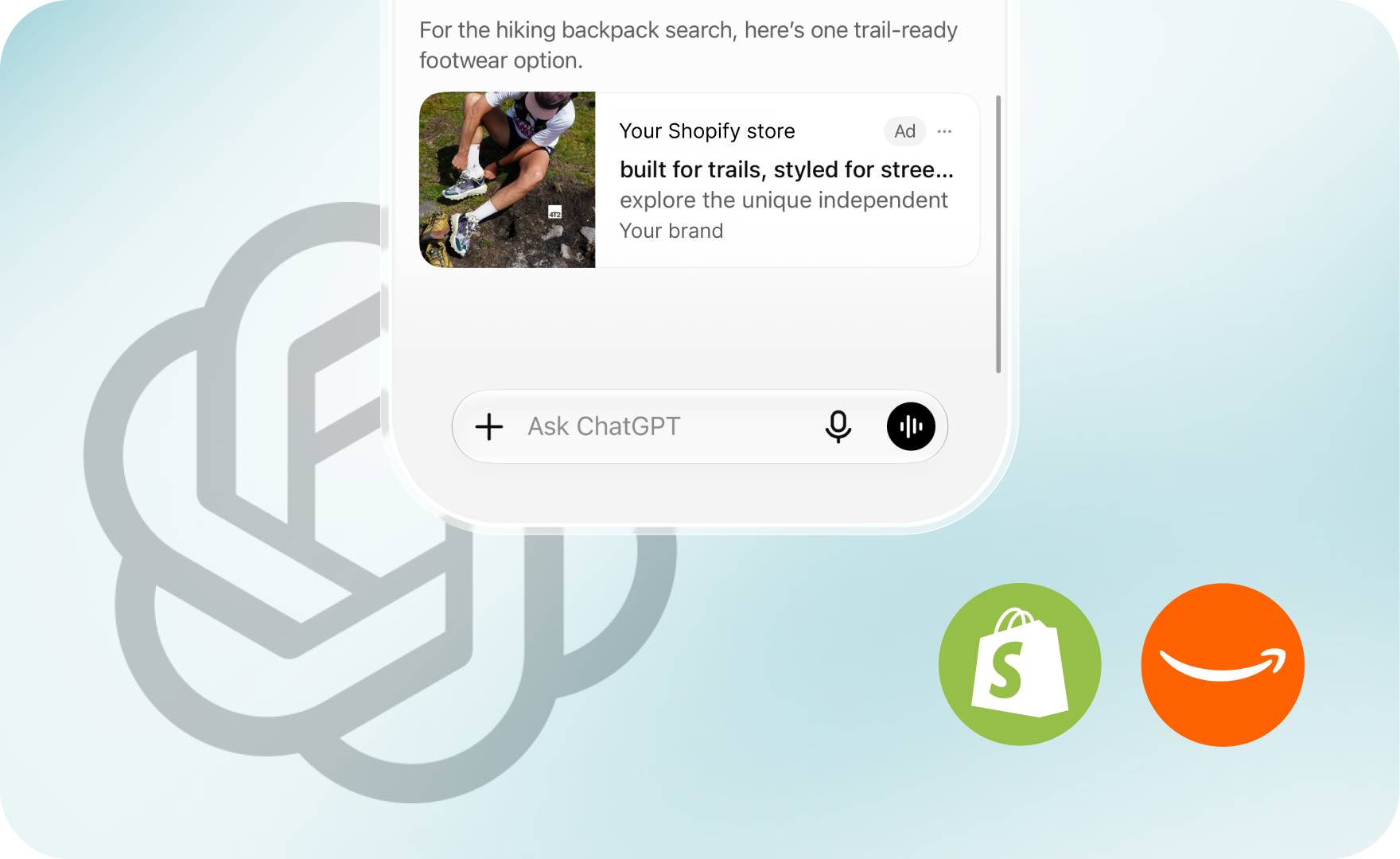
On 16 September 2026 Shopify became OpenAI’s first ecommerce partner for ChatGPT Ads, announced as part of OpenAI’s advertising launch. The integration is a free-to-install app in the Shopify App Store. Products flow through Shopify Catalog and the channel is managed from Agentic Storefronts in the Shopify admin, so most merchants are already connected and can set a campaign and a budget without any catalog work.
Alongside it, OpenAI began testing Sponsored Agents, an ad unit that opens a separate, clearly labelled conversation with a business-sponsored agent rather than simply placing a banner under an answer. HubSpot was named alongside Shopify.
Also shipped: prompt-driven campaign management inside ChatGPT itself, AI-suggested ad copy and imagery, and an opt-in setting that rewrites headlines to fit the conversation and translates them into the reader’s language.
Since then, two updates matter more to a feed-driven advertiser than any of that. On 30 September OpenAI added bulk creation of product feed campaigns from a spreadsheet and a per-product review status, so you can finally see which products were rejected and why. And on 5 October it introduced a visual ad format, tested first alongside image generation in ChatGPT and labelled as advertising, together with third-party measurement and attribution partners and brand suitability pilots run with DoubleVerify and Integral Ad Science. OpenAI also said ChatGPT now reaches 1.2 billion people a week, though ads appear only on the Free and Go tiers.
One more, and it has a deadline. From 29 October 2026 OpenAI switches creative enhancements on by default for new and existing self-serve campaigns, which covers the Shopify route. The system can rewrite headlines and descriptions, resize images, translate copy and redirect the click to another page on your site, and those versions “can run automatically without requiring you to review or approve each version.” If you want to keep your own wording, opt out in Ads Manager before that date.
Availability started with US Shopify merchants, extending from 23 September to other markets where ChatGPT Ads operate. ChatGPT Ads passed 60 countries at the end of September, and on 21 October OpenAI added 26 more to reach 89, saying over 100,000 advertisers have run a campaign since launch.
One thing Shopify’s own documentation is explicit about, and most coverage is not. Buying does not happen inside ChatGPT. Shopify states plainly that customers using ChatGPT are redirected to buy products in your online store checkout, and that there is therefore no direct-checkout setting to turn on or off. The ad and the recommendation happen in the assistant; the transaction happens on your site. That is the model across the whole channel now, for reasons covered further down.
Can Amazon sellers run ChatGPT Ads?
On 10 September 2026 Amazon Ads announced an integration letting advertisers extend existing Amazon Ads campaigns into a conversational ad experience on ChatGPT.
Read Amazon’s own wording carefully, because it is narrower than the headlines suggested: some advertisers in the United States are currently testing ChatGPT Ads as part of a pilot. Not all advertisers. Not all markets.
Ads appear as designated text or image units below ChatGPT responses. Amazon Ads representatives help build and manage the campaigns and provide context hints to match ads to the right topics and conversations.
The strategic logic is worth noticing. Amazon gets visibility inside AI shopping without entering a commerce partnership with OpenAI, so it keeps the customer relationship. OpenAI gets access to Amazon’s advertiser base and sales infrastructure rather than building its own.
It is worth adding that Amazon has not stayed out of the standards fight. In April 2026 it took a seat on the Universal Commerce Protocol technical committee, the Google and Shopify standard, alongside Meta, Microsoft, Salesforce and Stripe. So Amazon advertises into OpenAI’s assistant while helping govern a rival protocol. Read that as a company keeping both doors open rather than picking a side.

Both routes advertise whatever is in your catalog.
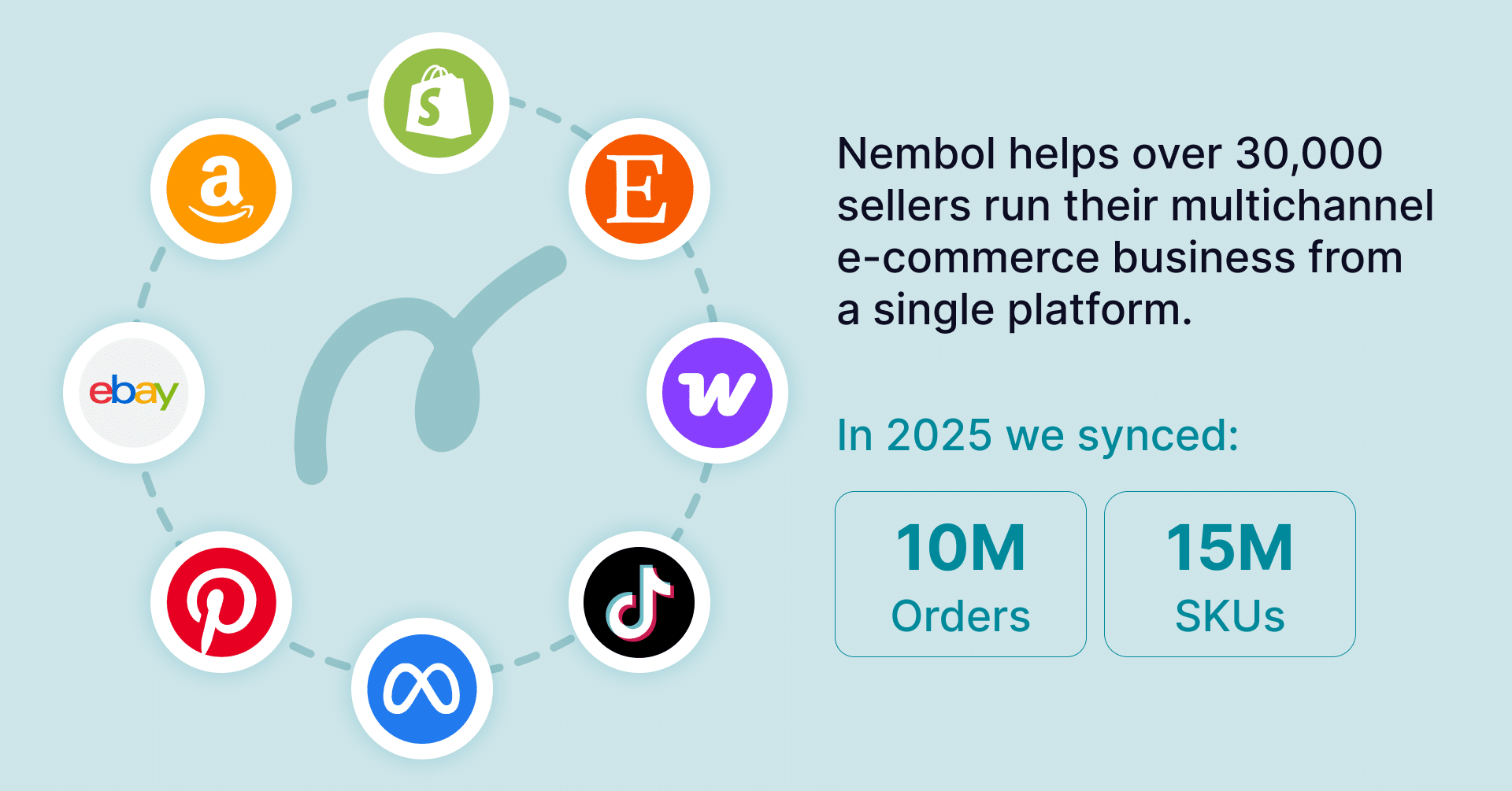
Nembol can publish your products to 20+ platforms, so there are more places for an ad, a listing or an assistant to find you.
Shopify vs Amazon ChatGPT Ads: how the two routes compare
* Based on Shopify, OpenAI and Amazon Ads announcements, September 2026. Amazon has published no performance or targeting detail beyond the pilot.
Which ChatGPT Ads route should you use?
If you sell on Shopify. ChatGPT Ads for Shopify is the lowest-friction entry point into AI advertising that currently exists. Install the app and run a small test. It is free to install, there is no minimum spend, and you control the budget. This is the lowest-friction entry point into AI advertising that currently exists.
If you sell on Amazon and already spend meaningfully on Amazon Ads. Ask your Amazon Ads contact whether you are eligible for the pilot. If you do not have a contact, you are almost certainly not in the pilot yet.
If you sell on both. Start with Shopify, because you can start today without permission. Add Amazon when the pilot widens.
If you sell on neither. This is the situation most marketplace sellers are in, and it is the least discussed. See below.
Can you advertise on ChatGPT if you sell on marketplaces?
If your business runs on eBay, Etsy, TikTok Shop or your own site, neither of these announcements applies to you directly. That does not mean you are absent from ChatGPT.
There are three routes into ChatGPT shopping, and advertising is only one of them. Products also arrive through marketplace syndication, which is how Etsy sellers ended up there without asking, and through a direct product feed submitted by the merchant.
So the practical question is not only “can I advertise” but “can the assistant see my products at all”. For most sellers the second question matters more and costs nothing to answer.
One thing worth checking today regardless of channel: if OAI-SearchBot is blocked in your robots.txt, your catalog is invisible to ChatGPT shopping, no matter what you spend on ads.
Keep reading: “Etsy Shop on ChatGPT: 6 Essential Checks for 2026”
Where Nembol fits
We do not manage ad campaigns. We make sure there is something accurate to advertise. Nembol can help sellers in three key ways:
1. Unlock multichannel publishing
Share your existing catalog across 20+ sales channels from one place, with stock synced across all of them. More places selling the same catalog, without more places to keep updated by hand.
2. Keep one catalog behind both ad routes
The Shopify route advertises your storefront; the Amazon route advertises your Amazon listings. If those two disagree with each other, and with your eBay and Etsy listings, you are paying to advertise inconsistent information about the same product. One record in Nembol ends that.
3. Different content per channel, not one compromise everywhere
One catalog does not mean one title. The same product can carry its own title and description on each channel — 140 characters of keywords on Etsy, 80 on eBay, 75 on Amazon — with AI content optimization tuning each version for the marketplace it is going to. Consistent stock and prices, content written for where it lands.
You decide where to spend. Nembol decides nothing about your campaigns and everything about what they are built from.

One catalog, every channel, content tuned to each.
One product record, synced stock, and a title written for the marketplace it lands on.
Free to try, no credit card.
Frequently asked questions
How do I run ChatGPT Ads on Shopify?
ChatGPT Ads for Shopify is a free app you install from the Shopify App Store. Once connected it syncs your storefront to ChatGPT, and you set campaigns and budgets from there. The integration launched for US merchants on 16 September 2026 and extended to other ChatGPT Ads markets from 23 September.
Can any Amazon seller run ChatGPT Ads?
No. Amazon’s integration is a pilot limited to select advertisers in the United States, with Amazon Ads representatives building the campaigns. It is not open self-serve like the Shopify route.
What are Sponsored Agents in ChatGPT?
Sponsored Agents are an ad unit OpenAI began testing on 16 September 2026. Rather than placing a unit below an answer, they open a separate, clearly labelled conversation with an agent sponsored by a business. Shopify and HubSpot were the first named partners.
Is the Shopify ChatGPT Ads app free?
The app itself is free to install. You pay for the advertising media, and there is no minimum spend, though a $25 minimum daily campaign budget applies to US-dollar accounts.
Which came first, the Amazon or Shopify ChatGPT deal?
Amazon announced first, on 10 September 2026, but as a limited pilot. Shopify followed on 16 September as OpenAI’s first ecommerce partner with an open, self-serve integration.
Can I advertise on ChatGPT if I only sell on eBay or Etsy?
Not through these two routes, which are specific to Shopify and Amazon Ads. You can apply to advertise directly through OpenAI’s Ads Manager, and your products may already appear in ChatGPT shopping through marketplace syndication, which is separate from advertising.
Does advertising on ChatGPT require a product feed?
For the strongest formats, yes. OpenAI added a Feeds section to Ads Manager in June 2026 that generates ads automatically from a connected product catalog. The Shopify route handles this for you by syncing your storefront.