Product
Channels
Resources
Last update October 22, 2026
Overview
Most TikTok Shop sales start in the feed, but a growing share starts in the search bar, where a shopper types what they want and TikTok decides which products to show. This guide explains how TikTok Shop search matches products to queries, and which parts of a listing you control: title, category, search terms, highlights and listing quality.
For sellers who already sell elsewhere, the challenge is doing this across an entire catalog without rewriting it by hand. Nembol publishes your products to TikTok Shop from the store or marketplace where your catalog already lives, lets you keep a dedicated title and description for TikTok Shop alongside the ones you use on other channels, and syncs stock in real time, so a product that climbs in search never sells units you no longer have.
Nembol brings those visitors to your listings: it publishes your Etsy catalog to Pinterest, Instagram and Facebook from one place, with direct links back to each product, and keeps stock in sync so no visit lands on an item that has already sold.
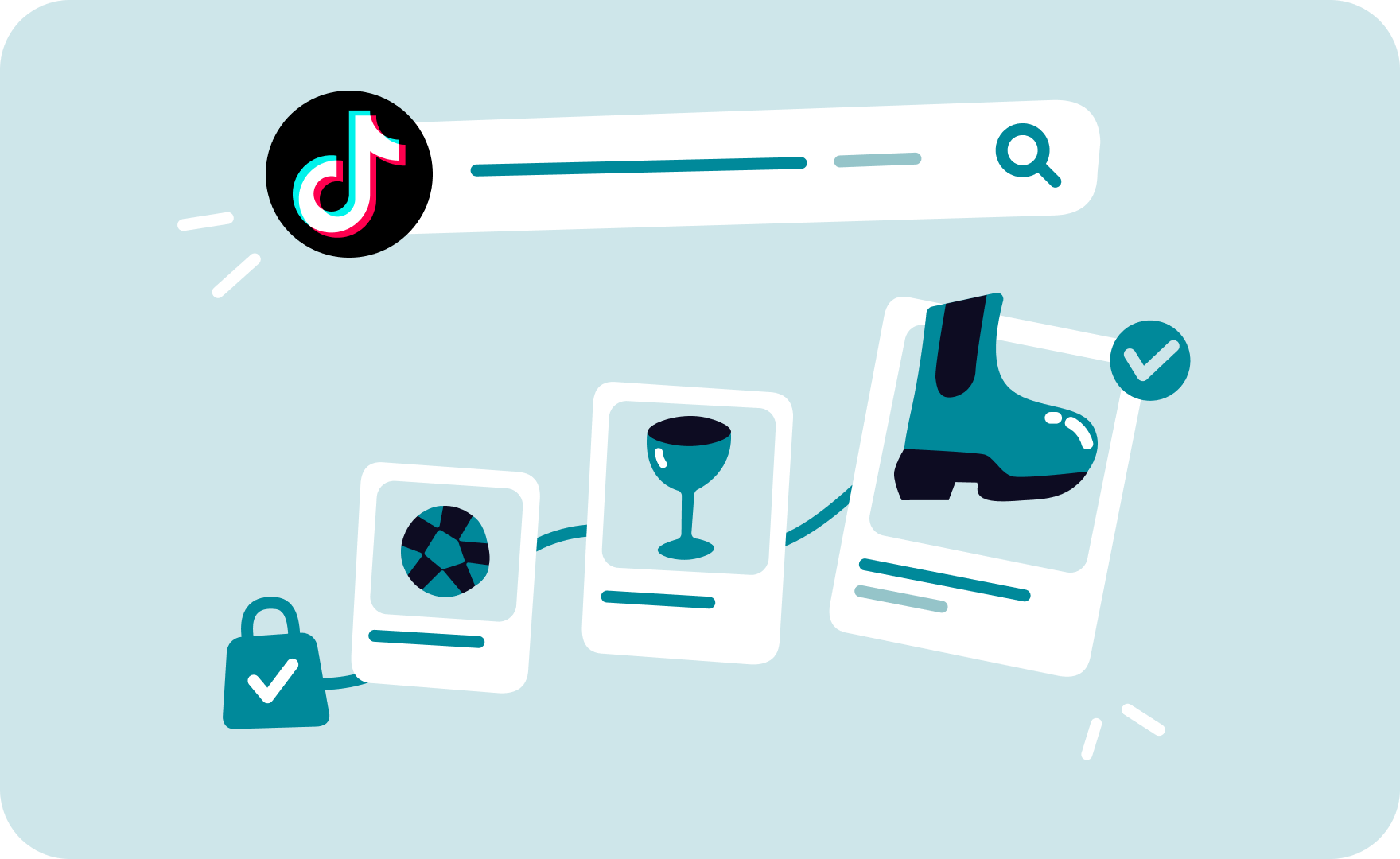

Bring your catalog to TikTok Shop, written for TikTok.
Publish in bulk from the channels you already use, with channel-specific titles and stock synced everywhere.
How does TikTok Shop search work?
TikTok Shop search starts from text. According to TikTok’s guide to product listings, “when customers search on TikTok Shop, they find products based on how well the search terms match the product title.” The same guide adds two more fields that influence search: the category, where a wrong choice “can mislead customers and negatively impact search results”, and the brand, which helps customers find your product and cannot be changed once approved.
This is the main difference from the For You feed. As TikTok explains in its description of how recommendations work, the feed is driven mostly by how people interact with content (likes, shares, follows, comments), with video information such as captions, sounds and hashtags as additional signals. In search, the shopper has already told TikTok what they want, so the words in your listing carry far more weight.
In practice, a product can be discovered through three routes: a creator’s video or LIVE, the product card in the Shop tab, and search results. Search is the only one where your listing text decides whether you appear at all.
What affects product ranking in TikTok Shop search?
TikTok does not publish a ranking formula or the weight of each signal. What its Seller University documentation does state is that relevance comes first, and that listing quality and completeness are measured. The factors you control fall into four groups:
* Based on TikTok Shop Seller University (Product Listing: What You Need to Know; Search keywords and Product highlights; Listing Quality Guidelines). TikTok does not publish the weight of each factor.
Beyond the listing, buyers see ratings, price and delivery information on every product card, and these shape whether they click and buy. TikTok also evaluates shops through the Shop Performance Score, which, among other things, determines access to the affiliate program. Cancellations and late shipments lower it, so operations and search visibility are connected: a product that ranks well but can’t be shipped on time works against you.
How to write a TikTok Shop product title
TikTok’s SEO and discovery course suggests a structure for product titles:
[Brand] + [Product] + [Application] + [Type] + [Main features/advantages]
For example: Northfield Stainless Steel Water Bottle for Gym and Travel, Insulated, Leak-Proof, 750 ml
The Product Detail Pages and Listing Quality Guidelines add the rules a title must follow to reach the Good tier:
- Length between 25 and 255 characters. Concise and accurate, “free of unnecessary content”.
- No word or phrase repeated four or more times. Keyword stuffing is the most common reason titles fall out of the Good tier.
- No variant or stock references, such as colors, sizes or “low stock”. Variant details belong in the variations and attributes.
- No promotional claims, such as “best seller”, discounts, sales or exclusivity.
- Standard letters and numbers, with Arabic numerals for quantities. Measurement abbreviations such as cm, oz or ml are allowed.
A useful test: read the title aloud. If it sounds like something a shopper would type or say, it is likely to match real queries. If it sounds like a list of keywords, TikTok’s own guidance suggests it will perform worse, not better.
What are search terms on TikTok Shop?
Search terms are backend keywords added to the listing, directly below the product title. They are not visible to customers, and their purpose, according to TikTok’s guide to search keywords and product highlights, is to help the search engine match your product to customer queries.
Use them for what the title can’t hold:
- Synonyms: “flask” and “tumbler” for a water bottle
- Alternative names and spellings: regional terms, common abbreviations
- Use cases and audiences: “hiking”, “school”, “office”
The field is optional, but TikTok recommends filling it in for search performance. Seller Center also suggests search terms based on your category and attributes, which you can accept or edit. Terms that are irrelevant to the product or break platform rules are deleted automatically, so the field rewards accuracy, not volume.
The same guide introduces product highlights: three to five short bullet points shown on the product page. They don’t replace the description, but they give shoppers who arrive from search a clear reason to buy, and conversion is what turns a search impression into a sale.
One rule connects the two programs: if the buyer’s last click before the purchase is an Offsite Ad, the order doesn’t qualify for Share & Save, and the Offsite Ads fee applies. The more of your external traffic you generate yourself, the lower the share of your sales that carries an advertising fee.
One catalog, a title for every channel.
Nembol keeps a dedicated TikTok Shop title and description for each product,
while your Shopify, Amazon or WooCommerce listings stay as they are.
Can you use your Amazon or Shopify titles on TikTok Shop?
You can, but they rarely work as they are. Titles written for other channels follow other rules and other shoppers:
- Marketplace titles are often long and dense with keywords and variant details. On TikTok Shop, repeated terms and references to colors or sizes keep a listing out of the Good tier.
- Store titles on Shopify or WooCommerce are often short and brand-led, written for visitors who already know the product. They may lack the product type and use case that a TikTok shopper types into search.
The product data behind the title, such as brand, material, size and features, is the same on every channel. What changes is how it is written. The efficient approach is one source catalog with a dedicated title and description for each channel, rather than separate catalogs to maintain.
How to find keywords for TikTok Shop
Start with TikTok’s own data rather than keyword tools built for Google or Amazon. Seller Center offers three sources, described in TikTok’s SEO and discovery course:
- Keyword Rankings (Analytics > Shop tab > Search): the most searched keywords in your category, plus rising and high-potential terms.
- Product Opportunities (Products): weekly trend insights, with popular, seasonal and hashtag keywords you can match to your catalog.
- Improve Listing Quality (Products > Manage Products > Optimize): recommendations to refine titles and descriptions for specific listings.
TikTok’s guidance is to treat these suggestions as a starting point and check them for accuracy, since the seller remains responsible for the published content. TikTok Shop’s Product Title Optimizer guide also recommends combining a generic term with a specific one, such as “shoes” and “white leather loafers”, starting from your best-selling products, and waiting three to seven days after an edit before judging the effect on views, clicks and ranking.
The words that work in search are also worth using in your videos. Captions and hashtags are part of the video information TikTok reads, so a creator video and a listing that use the same terms support each other.
Listing quality: the checklist for the Good tier
TikTok rates each listing as Poor, Fair or Good. The Listing Quality Guidelines set these requirements for the Good tier:
- Images: at least five images of the product, above 600×600 pixels. The main image shows the product clearly, on a high-quality background (white recommended), with no text, logos, watermarks, borders or promotional stickers.
- Description: relevant to the product, more than 80 characters long or with at least one image, with no broken links, clickbait or duplicate content.
- Attributes: all required attributes, and at least one key attribute.
- Category-specific information: such as material, specifications, size charts for fashion or how-to-use details, depending on the category. Without it, a listing can’t go beyond Fair.
These requirements apply to every product you publish. For a catalog of a few hundred items, missing attributes and weak images are often the real reason listings stay invisible.
How Nembol helps your TikTok Shop listings rank
Ranking in TikTok Shop search depends on listings that are relevant, complete and in stock. For merchants who already sell on other channels, Nembol handles the work that sits behind each of these.
- Your catalog on TikTok Shop, in bulk: import products from Shopify, Amazon, WooCommerce or one of the many other channels Nembol connects, or from a CSV file, and publish them to TikTok Shop without rebuilding each listing.
- A title and description for each channel: with product content management, each channel can have its own title and description while you keep one product and one stock figure. You also choose which content syncs where, including TikTok Shop category attributes.
- AI-written titles and descriptions: AI Content Optimization drafts channel-specific copy from your catalog data, with the tone, keywords and instructions you set. Available on Enterprise plans.
- Bulk edits by CSV: export your listings, update titles and search-relevant content in a spreadsheet, and upload them back.
- Stock that follows every sale: real-time inventory sync updates TikTok Shop and every other channel with each order, so a product that gains visibility doesn’t turn into cancellations and a lower Shop Performance Score.
- 0% commission, unlimited orders: more sales from search don’t raise your Nembol bill.
To connect TikTok Shop to the channel you already sell on, see the integrations with Shopify, Amazon and WooCommerce, or browse all Nembol integrations.
Frequently asked questions
Does TikTok Shop have SEO?
Yes. TikTok Shop has its own search engine, and products are matched to queries mainly through the title, the category and the backend search terms. TikTok doesn’t publish its ranking formula, but its seller documentation is explicit that title relevance and accurate categorization affect whether a product appears in search.
How long should a TikTok Shop product title be?
Between 25 and 255 characters, according to TikTok’s listing quality guidelines. Within that range, the guidance is to stay concise and accurate: brand, product, application, type and main features, without repeated keywords, variant details or promotional claims
Do hashtags help products rank in TikTok Shop search?
Hashtags and captions are part of the video information TikTok uses to understand content, so they help the videos that feature your product. Product listings themselves are matched through the title, category and search terms, which is where your main keywords belong.
How long does it take to see results after optimizing a listing?
TikTok Shop’s guidance on its Product Title Optimizer suggests waiting three to seven days after an edit, then checking views, clicks and search ranking for the product. Change one listing element at a time when you can, so the effect is clear.
Can I have different titles on TikTok Shop and Amazon for the same product?
Yes, with Nembol. Each marketplace has its own listing, so the title can differ, but with Nembol, the same product keeps one stock figure across channels, while TikTok Shop, Amazon and your other channels each have a dedicated title and description.