
Last update November 6, 2026
Overview
Pet supplies cover two different kinds of purchase. Food, treats, litter and grooming products run out and are bought again on a regular schedule. Collars, beds, toys and gifts are bought less often, and owners choose them on design, materials and fit, often after seeing them in a photo or a video.
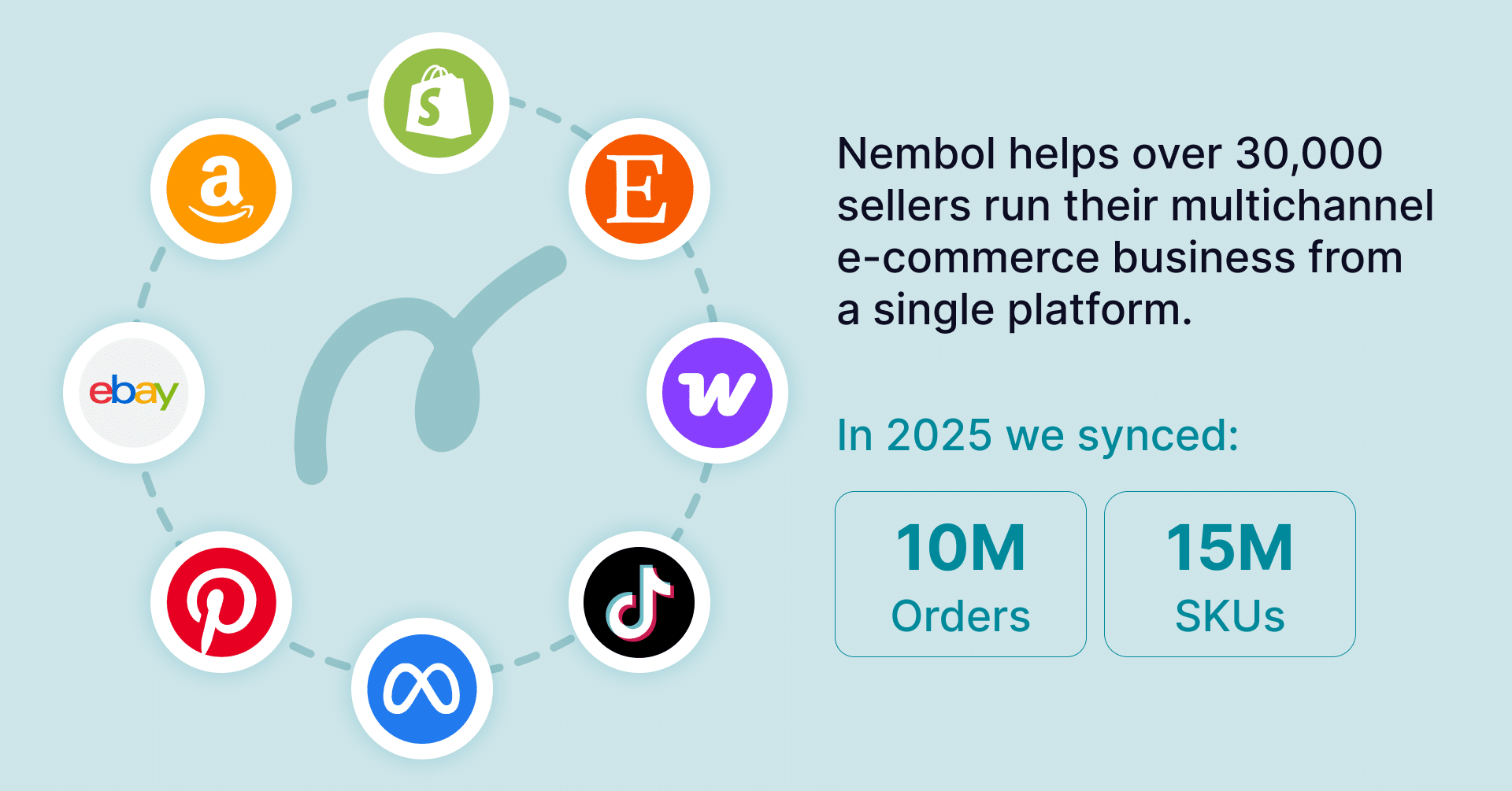
Selling pet supplies online means serving both: keeping consumables in stock wherever owners reorder them, and showing accessories on the channels where owners discover them. That idea runs through this 2026 guide, from the market figures to the channel data of the pet stores that use Nembol. With Nembol, your Shopify store, eBay, Etsy, Amazon and the rest of the supported channels run from one dashboard, and the stock you set once follows every order on every channel.
Every pet owner, one catalog. Sell on your own store, eBay, Etsy, Pinterest and more from a single dashboard, with stock always aligned and 0% commission on your sales.
What are the trends and outlook for the pet industry in 2026?
Steady growth, driven by repeat purchases. Three sources give a clear picture of the market pet sellers are working in:
- US spending keeps rising. Americans spent $158 billion on their pets in 2025, up 3.7% on the previous year, and the American Pet Products Association (APPA) projects $165 billion for 2026. 95 million US households own a pet, and dog ownership rose to 53% of households.
- Pet owners buy on repeat. At Chewy, the largest online pet retailer in the US, customers enrolled in Autoship generated $10.5 billion, or 83.3% of its $12.6 billion net sales in fiscal 2025 (Chewy fiscal 2025 results).
- Europe is just as large. European households keep 306 million pets, and 49% of households own at least one. The European pet food market alone was worth €29.4 billion in 2024, according to FEDIAF’s 2026 Facts & Figures, reported by Pet Worldwide.
Is selling pet supplies profitable?
Yes, when the product gives owners a reason to choose it and to come back for it. There is a nuance in the APPA data, though: 22% of owners spent less on their pets in 2025, and spending is moving toward essential care. For sellers, that points to products with a clear reason to buy them: a specific need, better durability or something a supermarket aisle doesn’t offer. Generic accessories compete with the big retailers on price.
What pet products sell the most?
Pet products split into two families: consumables that owners buy again and again, and accessories that they choose with care, often as a gift. This is how the main segments behave online:
* Segments drawn from marketplace bestseller rankings and pet industry reports, November 2026.
The two families need different strategies. Consumables win on availability: if your treats are out of stock on the day the bag runs empty, the owner buys someone else’s. Accessories win on photos, materials and story, which is why visual channels matter much more for them.
Which online channels work best for a pet business?
Pet Supplies is a specialist category on Nembol, gathering independent pet boutiques, makers of handmade collars and beds, natural treat brands, aquarium and reptile shops, and resellers of pet gear. Prices sit in the consumer range, with a typical product selling for a few tens of dollars, so profit comes from volume and from customers who come back.
Here is how their listings are spread across channels:
* Nembol internal data, November 2026. Other channels include WooCommerce, Amazon, TikTok Shop and Google Merchant Center. Percentages are rounded.
Fix what blocks your pet listings, then go further. Nembol points out missing data before a channel rejects a product, and publishes your Shopify, eBay or Etsy catalog on new channels in bulk.ive streams included.
What are the best websites to sell pet products?
The right mix depends on whether you sell consumables, accessories or specialist gear. These are the platforms that count for pet sellers in 2026.
Selling pet products on Shopify
Shopify is the first channel for pets on Nembol, with 30% of listings. An own store is where a pet brand builds the relationship that the category rewards: subscriptions to food and treats, a newsletter about new flavours or sizes, loyalty points for the owner who comes back every month. There is no referral fee on each order, which makes a real difference on products priced at a few tens of dollars. The store needs visitors from elsewhere, and pet sellers on Nembol usually bring them in from eBay, Etsy and Pinterest.
Selling pet supplies on eBay
eBay holds 25% of the category on Nembol. Its Pet Supplies section is organized by animal, from dogs and cats to fish, birds, reptiles and small animals, and its buyers often know exactly what they want: a filter model, a terrarium size, a replacement part for a cat fountain. Clear item specifics and real photos make those listings easy to find. eBay is also the main destination for used pet gear in good condition, such as crates, carriers and aquariums.
Selling handmade pet accessories on Etsy
Etsy, with 20% of pet listings on Nembol, has a Pet Supplies category of its own, and its rules suit makers: items must be handmade, vintage or craft supplies. Hand-sewn bandanas, leather collars, crocheted cat toys, engraved tags, custom portraits and memorial pieces are what Etsy shoppers come for, and personalization lets sellers charge more for each order.
Selling pet products on Pinterest and Facebook
Pinterest has 7% of pet listings on Nembol, and Facebook 5%. Pinterest catalogs turn product photos into shoppable pins that owners save while planning a new puppy’s corner or a cat-friendly living room. Facebook and Instagram put the same catalog in front of pet owners through shops and product tags in posts.
Selling pet supplies on Amazon and TikTok Shop
Amazon is the reference for food, treats, grooming products and everyday accessories bought again and again. It also applies strict rules to the category: products that kill or repel fleas and ticks are regulated as pesticides, so Amazon asks sellers to declare them and provide their EPA registration details, and medications and food have category-specific requirements. Review them in Seller Central before you list. Sellers who use FBA can also connect Amazon MCF and ship orders from other channels out of the same stock.
TikTok Shop fits pet toys, enrichment products, grooming tools and anything that looks good in a 15-second clip with a real dog or cat. In the US, Pet Supplies is one of the categories that require qualification documents before listing, according to TikTok Shop’s June 2026 policy reported by PPC Land, so prepare product documentation before you apply.
Other channels for pet brands
- WooCommerce: an alternative to Shopify for pet shops that already run a WordPress site.
- Google Merchant Center: shows branded food, treats and supplies in Google Shopping when owners search for an exact product.
- Faire: for pet brands that want to sell wholesale to independent pet boutiques and gift shops.
- Square: for sellers at dog shows, pet fairs and markets, or with a physical shop, so in-person sales draw from the same stock as online ones.
Your pet catalog, on the channels you’re missing. Import your products into Nembol once and send them to Amazon, TikTok Shop, Pinterest and more, with a title and description written for each audience
Can you sell pet food online?
Yes, but pet food is regulated like a food product, and the rules apply to treats too:
- United States: pet food is regulated by the FDA, which requires it to be safe, produced in sanitary conditions and labelled truthfully. Most states also require pet food products to be registered before they are sold there, so check the states you ship to.
- European Union: pet food falls under EU feed law. Producers must be registered as feed business operators, and labels must follow the EU feed marketing rules on ingredients, analytical constituents and feeding instructions.
- Marketplaces: Amazon, TikTok Shop and other channels can ask for documents on ingredients, safety or registration, and keep a listing offline until they receive them.
Shelf life adds another constraint: stock must be rotated, and expiry dates shown when a marketplace asks for them. Homemade treats sold online follow the same rules as industrial ones.
Do you need a license to sell flea and tick products?
You don’t need a personal license in most cases, but the product does need its own approval. In the US, flea and tick treatments are either pesticides registered with the EPA or animal drugs approved by the FDA. eBay requires the EPA registration number in the listing for topical and collar flea and tick remedies (eBay pesticides policy), and Amazon asks for the same details through its pesticide compliance process. In the EU, these products are authorised as veterinary medicines or biocidal products.
The same logic applies to claims. A shampoo, spray or bed described as killing fleas or bacteria can be treated as a pesticide even if it’s not sold as one. Keep descriptions accurate and leave out claims your product isn’t registered for.
How do I sell handmade pet products?
Start from what makes the product personal: a name engraved on a tag, a fabric chosen by the buyer, a portrait drawn from a photo. Etsy and your own store are the natural channels for these items, with Pinterest to bring in owners while they browse for ideas.
Three details keep handmade pet products selling and protect your reviews:
- Size guides for every animal: state neck and chest measurements, weight ranges and how to measure, so owners can order the right size of collar, harness or coat the first time.
- Safe materials: use non-toxic dyes and secure fastenings, avoid small parts on toys that can be swallowed, and say clearly when a product is decorative and not meant for chewing.
- Product safety rules: in the EU, the General Product Safety Regulation applies to handmade products sold to consumers online, including the need for a responsible person in the EU.
How do I run a pet store on Shopify, Etsy and eBay at the same time?
A pet seller’s week can look like this: four bags of treats leave from Shopify, a personalized collar sells on Etsy, a used aquarium pump finds a buyer on eBay, and a dog bed pinned months ago turns into an order. Keeping four channels aligned by hand is where stockouts and cancelled orders start. Nembol manages them from one place:
- Bring your products in from Shopify, Etsy, eBay, WooCommerce or a CSV file, and publish them on other channels in bulk with variants such as sizes, colours and flavours already set
- Write a title and description for each channel: brand and size first on eBay and Amazon, the maker’s process on Etsy, a short, visual line on Pinterest and TikTok Shop
- Let quantities update on every channel as each order comes in, so a sold-out flavour or a single used aquarium disappears everywhere at once
- Use the AI to improve titles and descriptions, and see missing attributes and incomplete variants flagged before a listing gets rejected
- Set a different price per channel with pricing rules, so marketplace fees don’t eat into the margin of low-ticket products
- Schedule promotions on every channel at once, from National Pet Day to Black Friday
- Ship through Amazon MCF, or import marketplace orders into Shopify, WooCommerce, Wix, Square or Squarespace and fulfill them with your usual tools
- Track orders and revenue for each channel in one dashboard
- Pay no commission on your sales, with unlimited orders on every plan
Can I open an online pet shop without a website?
Yes. If you sell only on Etsy or eBay today, Nembol Storefront creates your website from the products you already manage in Nembol.
- From catalog to shop: your listings, photos and variants become the website, with nothing to upload again
- Checkout without fees: owners pay by Stripe or PayPal, and direct orders carry no marketplace commission
- A pet shop with your identity: six themes, your domain, your delivery rules and bundles such as a bed with a matching blanket
- Visible to search engines and AI: mobile pages prepared for SEO and GEO
- Shared stock: an order on your website reduces the quantity on your marketplaces, and the other way around
- Part of your plan: no additional subscription for the website.
Frequently asked questions
When do pet products sell the most?
Q4 is the strongest period, with Black Friday and Christmas gifts for pets and their owners. Flea and tick products peak in spring, cooling mats and travel gear in summer, and Halloween costumes in October. New puppies and kittens bring a steady stream of first purchases all year. With Nembol, each seasonal promotion is scheduled once for every channel.
How do I price pet products online?
Start from the full cost of each product, including packaging and shipping, then add the fee of each channel: a $30 collar keeps a different margin on Etsy, eBay and your own store. Compare with sellers offering the same quality, not with mass-market brands. Nembol’s pricing rules set a separate price for each channel, so every sale keeps its margin.
Can I sell used pet supplies?
Yes, for durable gear such as crates, carriers, aquariums, terrariums, cat trees and bike trailers for dogs. Clean and disinfect each item, describe any wear and include the dimensions. eBay and Facebook are the main channels for second-hand pet gear. Opened food, medications and used toys are best left out.
How do I offer subscriptions for pet food and treats?
Subscriptions run on your own store, through the subscription apps available for Shopify and WooCommerce. Owners choose the frequency, and the order repeats on its own. Marketplaces then bring in first-time buyers, and your store turns the best of them into subscribers.
How do I avoid running out of stock across channels?
Consumables sell steadily on several channels at the same time, and a missed update means selling a bag of food you no longer have. Nembol updates the quantity on every channel as each order arrives, and the 14-day free trial lets you test it on your own catalog.
.