Last update October 23, 2026
Overview
ChatGPT Ads vs Google Ads is the budget question every ecommerce team is now asked. Here is what each costs, what each one measures, and which sellers should test which.
In 2026 there are two places people can be searching for products: Google, and an AI assistant. Google Ads is twenty-five years old, has a mature auction, deep conversion tracking and a queue of competitors bidding against you. ChatGPT Ads launched a self-serve manager in May 2026, removed its minimum spend, and reached a $1 billion annualised run rate in under 200 days. On 5 October 2026 OpenAI said ChatGPT now reaches 1.2 billion people a week, though ads run only on the Free and Go tiers, so that is the ceiling on the audience rather than the audience.
This comparison covers what each one costs, how the buyer intent differs, what you can actually measure, and which sellers should test which. It also flags the one thing most articles on this subject get wrong: the published conversion figures for ChatGPT Ads contradict each other, and nobody has resolved it.
The channel is also moving fast enough that anything written before October 2026 is already out of date on measurement, which used to be its weakest point.
Short version. Google Ads captures demand that already exists. ChatGPT Ads reaches people while they are still deciding what to want. Those are different jobs, and for most ecommerce businesses in 2026 the answer is Google first, fully optimised, then ChatGPT as a capped experiment.
What changed in ChatGPT Ads in October 2026?
Two announcements in the space of a week changed the comparison, and both of them narrow the gap with Google.
A visual ad format. On 5 October OpenAI introduced an image-based ad unit, tested first alongside image generation in ChatGPT. The ads are labelled and kept separate from the image being generated. Testing begins in the United States with an initial group of advertisers. OpenAI repeats in the same announcement that advertising does not influence the answers ChatGPT gives.
Real measurement. The same announcement added third-party measurement and attribution partners, including mobile attribution vendors and incrementality specialists, plus brand suitability evaluation pilots with DoubleVerify and Integral Ad Science that run without access to user conversations. DoubleVerify announced its own launch the same day, saying advertisers can now treat ChatGPT Ads as a touchpoint in the wider customer journey rather than a black box.
A week earlier, on 30 September, OpenAI shipped the unglamorous things that matter more if you sell products: bulk creation of product feed campaigns from a spreadsheet, a product review status view so you can see which products were rejected and why, and the ability to pull attributed conversion events beyond your campaign goal out of the public Insights API. ChatGPT Ads also expanded into Southeast Asia and Taiwan, taking availability past 60 countries. On 21 October it added 26 more, reaching 89, and said more than 100,000 advertisers have run a campaign since launch. Read that figure carefully: it is cumulative, counting everyone who has ever run one rather than who is spending now.
And one change you should act on before 29 October. OpenAI is turning creative enhancements on by default for new and existing self-serve campaigns. The system can write new headlines and descriptions, resize your images, translate your copy and send the click to a different page on your site, and OpenAI states plainly that these versions “can run automatically without requiring you to review or approve each version.” It is a setting in Ads Manager, campaign settings override the account default, and an opt-out you already made is kept. Advertiser emails said 30 October and the help page says 29 October, so treat the earlier date as the deadline.
Whether that is good or bad depends on how much you care about the exact words next to your brand. For a seller running feed-driven campaigns on a large catalogue it is probably a gain. For anyone with regulated claims, trademarked phrasing or a carefully chosen landing page, it is a reason to open Ads Manager this week.
Why all this matters for the comparison below: the strongest argument against testing ChatGPT Ads in mid-2026 was that you could not measure it properly. That argument is weaker now than it was three weeks ago. The newer question is how much of the creative you still control.
ChatGPT Ads vs Google Ads at a glance

* Cost and conversion figures are drawn from agency and industry reporting. OpenAI has not published official CPC or conversion benchmarks. Treat every number in this row as directional.
How much do ChatGPT Ads cost?
For ecommerce, reported cost per click sits around $3 to $5, with a default suggested bid in that range or a $60 CPM. Some reporting uses a different metric entirely, cost per engagement, and puts that at $0.40 to $1.20 for most categories. Those are not the same measurement and they are frequently compared as if they were.
There is no minimum spend. OpenAI removed it when the self-serve Ads Manager beta opened on 5 May 2026. There is a $25 minimum daily campaign budget for US-dollar accounts, which works out at roughly $750 a month if you run continuously.
Google Ads for comparison: most ecommerce categories land between $0.80 and $4.00 per click, with the cross-industry average nearer $5. Legal, insurance and finance run far higher, which is what drags that average up.
So on raw cost the two are broadly comparable for ecommerce, and ChatGPT is sometimes cheaper. The difference is not price. It is what you get for the click.
Both channels build the ad from your product feed.
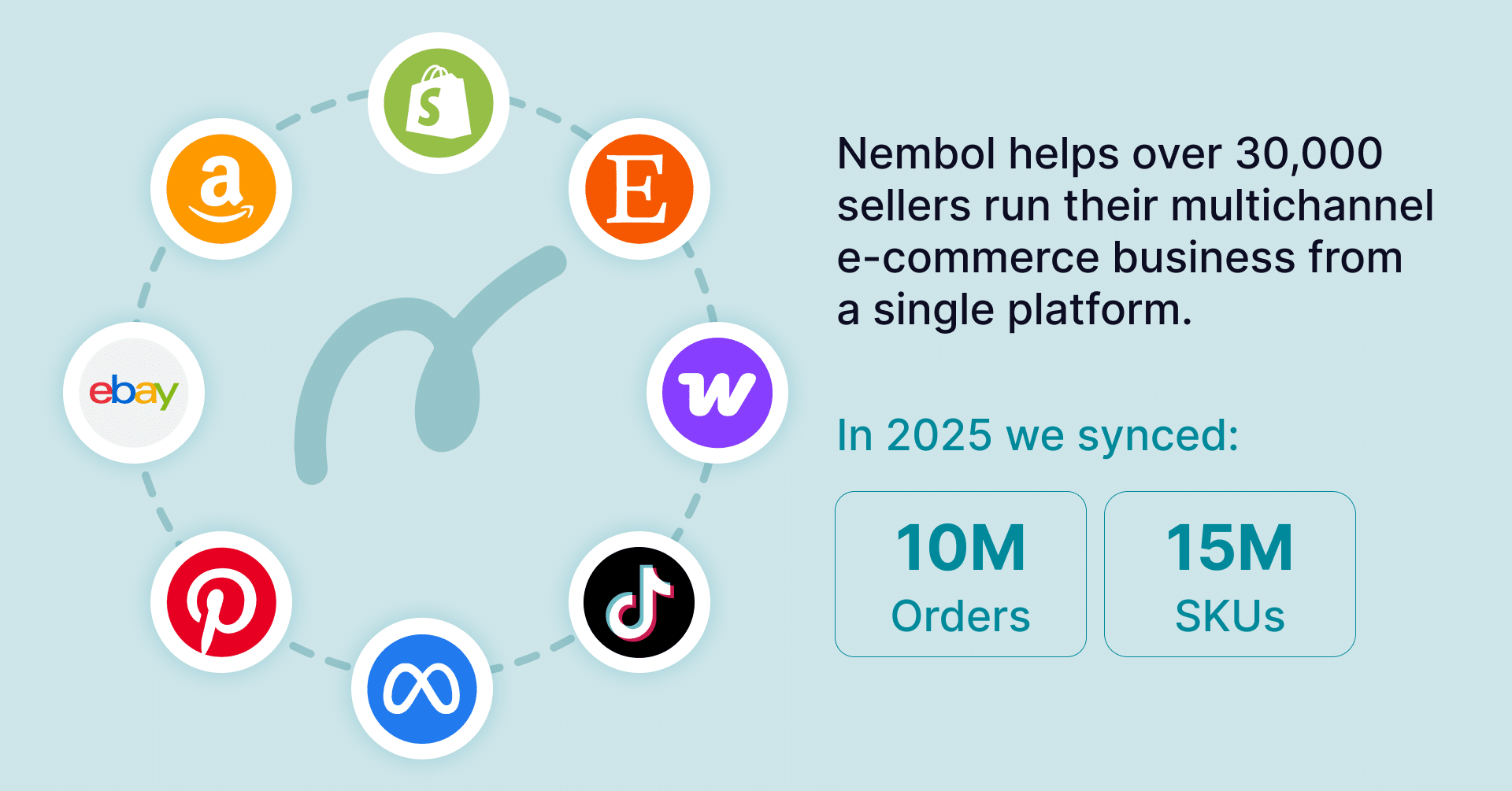
Nembol can publish your catalog on 20+ platforms, unlocking more discovery, promotion, and sales opportunities.
Do ChatGPT Ads convert better than Google Ads?
This is where the published numbers stop agreeing with each other, and it is worth being honest about rather than picking the flattering version.
The optimistic reading. Beta cohort data has been reported at 4 to 9 percent conversion, and by category at 3 to 11 percent, against Google Shopping benchmarks of 1.5 to 4 percent. That would be a two to three times lift.
The pessimistic reading. Other analysis says ecommerce sees lower conversion on ChatGPT than on Google Shopping or Meta, precisely because people asking an assistant about products are in research mode rather than purchase mode.
Both cannot be right, and there is a measurement reason they disagree. The optimistic figures measure engagement to purchase. Google Shopping benchmarks measure click to purchase. An engagement is a lower bar than a click, so the denominators are different and the comparison is not like for like.
What you can safely conclude: ChatGPT Ads are cheap enough and uncontested enough to be worth testing, and the industry still has no published benchmark set to tell you what good looks like. Anyone quoting you a precise expected ROAS for this channel is extrapolating from very little.
The first independently measured number arrived on 5 October 2026. In DoubleVerify’s announcement, Weight Watchers reported using DV Rockerbox to measure ChatGPT Ads as a member-acquisition source and found its attributed cost per acquisition 15.3% below its established benchmark over the measured period. One advertiser, one vertical, one window, measured by a vendor with an interest in the result. It is not a benchmark. It is, however, the first number on this channel that did not come from the platform selling the ads, and as of late October it is still the only one.
The real difference is buyer intent
Someone typing “waterproof jacket buy online” into Google has already decided what they want. The ad’s job is to be in front of them at that moment. This is demand capture, and Google is unmatched at it.
Someone asking an assistant “what should I wear hiking in Scotland in October?” has not decided anything yet. They will get a recommendation, ask three follow-up questions, and arrive at a shortlist. This is demand shaping, and it happens earlier and takes longer.
That has two practical consequences.
Attribution is harder, though less so than it was. A conversation that ends in a purchase two days later on a different device will not attribute cleanly to the ad that started it. Until October 2026 ChatGPT’s own reporting was the only view you had. With third-party attribution and incrementality partners now connected to the channel, you can at least measure it inside the stack you already use. Google still has a fifteen-year head start on modelled conversions, so expect to see less than the channel actually contributes.
Your product data does more of the work. In a conversation, the assistant is summarising and comparing products on the buyer’s behalf. It can only do that from structured information. A thin listing with one photo and a two-line description gives it nothing to recommend you on.
Which one should you use?
* Category exclusions and market availability current as of September 2026 and expanding.
The thing both channels have in common
Google Shopping runs on a product feed. ChatGPT Ads, since the Feeds section arrived in June 2026, runs on a product feed too. In both cases the platform generates the ad from your catalog rather than from copy you write per product. Since 30 September you can also build those campaigns in bulk from a spreadsheet and see a per-product review status, which is roughly where Google Merchant Center was a decade ago but is a long way from where ChatGPT Ads started.
Which means the same thing determines your performance on both: whether your product data is complete, accurate and consistent. Titles that describe the product rather than stuff keywords. Real attributes. More than one image. Stock levels that are true right now rather than true yesterday.
This is unglamorous and it is upstream of every bidding decision you will ever make. A brand with an excellent feed and a mediocre bid strategy will usually beat the reverse.
Where Nembol fits
Nembol can help your brand and advertisers in two key ways:
1. One accurate feed behind every ad
Google Shopping and ChatGPT Ads both read a product catalog. Nembol keeps one clean record and publishes it to 20+ sales channels and to Google Merchant Center, so the feed behind your ads is the same feed behind your listings, with stock synced across all of them.
2. A different title and description on every channel
Etsy gives you 140 characters and rewards a descriptive title. eBay caps you at 80. Amazon cut its limit to 75. One title cannot be right for all three, and a feed that compromises is a feed that underperforms everywhere. Nembol lets the same product carry its own title and description per channel, with AI content optimization tuning each version to the marketplace it is going to, and pricing rules adjusting the price per channel to cover each platform’s fees.
That matters more for ads than for organic listings. From 29 October ChatGPT rewrites your ad copy by default unless you opt out, and Google has been rewriting Shopping titles for years. The stronger your own per-channel content is, the less either platform has to invent.
The bidding stays yours. The data underneath it is where most campaigns are quietly won or lost.

Fix the feed before you raise the bid.
One product record, synced stock, consistent titles and images across every channel.
Free to try, no credit card.
Frequently asked questions
Are ChatGPT Ads worth it for ecommerce?
They are worth testing if you sell considered purchases and can afford a capped experiment. Costs are comparable to Google, competition is far lower, and there is no minimum spend. They are not yet a replacement for Google Shopping: reliable benchmarks still do not exist, and from 29 October 2026 OpenAI rewrites ad creative by default unless you opt out.
How much do ChatGPT Ads cost compared to Google Ads?
Reported ecommerce cost per click on ChatGPT is around $3 to $5, against $0.80 to $4.00 for most ecommerce categories on Google. There is no minimum spend on either, though ChatGPT requires a $25 minimum daily campaign budget in USD.
Do ChatGPT Ads convert better than Google Ads?
Published figures disagree. Some report 4 to 9 percent conversion against Google Shopping’s 1.5 to 4 percent, but those measure engagement to purchase rather than click to purchase, so the comparison is not like for like. Other analysis finds ecommerce converts worse on ChatGPT because users are researching rather than buying.
Can small businesses run ChatGPT Ads?
Yes. OpenAI removed the minimum spend in May 2026, so any approved advertiser can set whatever budget fits. A meaningful test still needs enough clicks to read, which in practice means a few thousand dollars over several weeks.
Which businesses cannot advertise on ChatGPT?
Dating, alcohol, tobacco, gambling, financial services, legal and health advertisers are excluded, and ads are kept away from health, mental health and political content.
Should I move budget from Google Ads to ChatGPT Ads?
Not yet, for most ecommerce businesses. Google still wins on purchase-ready intent, conversion tracking and predictability. Treat ChatGPT as incremental budget on top of a working Google account, not as a replacement for it.
Do ChatGPT Ads use a product feed?
Yes. OpenAI added a Feeds section to Ads Manager in June 2026. You connect a structured product catalog and ads are generated from product names, images and attributes rather than built one per SKU. Feed-based ads have been among the strongest performing formats in the beta.