

Last update October 5, 2026
Overview
Every parcel you ship between now and mid-January costs more than it did in September, and the increase is not one fee but four stacked on top of each other. USPS raised package prices on 4 October. UPS started on 27 September, FedEx on 28 September. The 8% fuel surcharge USPS introduced in April, the first of its kind in the agency’s history, is still running and does not expire until the same day the holiday rates come off. None of it is visible in your listing prices, which means it comes straight out of margin unless you do something about it.
Here is what each carrier is charging, when the increases land, what changed on TikTok Shop that can quietly cost you more than the postage itself, and the two pricing moves that let you recover the cost on the channels where it actually falls without rewriting your catalogue twice.
UPS and FedEx residential demand charges apply once the broader surcharge tiers kick in on 25 and 26 October respectively. Earlier dates cover oversize, additional-handling and international surge fees. Sources: USPS, Supply Chain Dive on UPS and on FedEx.
When do the 2026 holiday shipping surcharges start and end?
The season is already open. UPS went first on 27 September with fees on bulky, oversized and additional-handling parcels plus surge charges on some international lanes. FedEx followed on 28 September. USPS temporary rates took effect at 12:00 a.m. Central on 4 October.
The broad fees, the ones that hit an ordinary box with nothing unusual about it, arrive later: UPS applies its residential and high-volume demand charges from 25 October, FedEx from 26 October. Those are the charges that touch almost every order a marketplace seller ships.
Everything unwinds in the third week of January. UPS surcharges end on 16 January 2027. FedEx and USPS both end on 17 January 2027. That gives you a fifteen-week window with a known start and a known finish, which is exactly the shape a temporary pricing change should have.
How much is the USPS holiday price increase in 2026?
USPS filed notice with the Postal Regulatory Commission on 25 August and described the change as a temporary adjustment “to help cover extra handling costs to ensure a successful peak season.” Supply Chain Dive put the average at roughly 6%. It covers four product lines: Priority Mail Express, Priority Mail, USPS Ground Advantage and Parcel Select.
The averages are not the useful number, because the increase is not flat. It scales with weight and distance, so a small-parcel seller and a furniture seller are living in different realities this quarter.
Selected tiers from the USPS filing. The retail zones 1–4 column covers Priority Mail and USPS Ground Advantage; the other two columns shown are Priority Mail. Full tables for every product, weight band and zone are in the release. Rates were pending Postal Regulatory Commission review at the time of filing.
Read the far-zone column again. A 26-pound parcel crossing the country at retail rates costs $9.10 more than it did in September. On a $60 item that is fifteen points of margin gone, from one line on a label.
Two details make it worse than the table looks. First, these increases are a long way above last year’s. Set the 2026 filing against the 2025 one and the retail Priority Mail and Ground Advantage bands in zones 1 to 4 read like this: 0 to 3 pounds went from $0.40 to $0.50, 4 to 10 pounds from $0.60 to $0.80, 11 to 25 pounds from $0.95 to $1.25, and the heaviest band from $3.00 to $3.90. That is between a quarter and a third more, applied on top of a base that had already risen.
Second, the 8% fuel surcharge USPS introduced on 26 April, the first fuel-related surcharge in its history, covers the same four product lines and runs until 17 January 2027, the same day the holiday rates come off. The two are additive, and most sellers only notice the second one.
What are the UPS and FedEx 2026 peak season surcharges?
Both carriers kept the same structure as last year and raised the numbers. UPS charges \$0.50 on Ground Residential and Ground Saver through the opening and closing windows, and $0.75 between 22 November and 26 December. FedEx charges \$0.50 on Ground Residential and Home Delivery, rising to $0.80 between 23 November and 27 December.
Those sound like rounding errors until you look at the year-over-year move. Supply Chain Dive calculated that flat residential demand charges jumped between 22% and 32% across the three carriers: the fee on a perfectly ordinary box. Both UPS and FedEx also layer additional-handling, oversize and large-package fees on anything awkward, and UPS adds a separate charge for shippers whose volume spikes above their baseline, which is precisely what happens to a seller having a good Black Friday.
Shipping costs went up on every channel at once. Your prices do not have to.
Nembol pricing rules let you raise prices on one marketplace by a percentage or a fixed amount,
leave the others untouched, and switch it off in January.

Do Etsy and eBay sellers pay the USPS peak surcharge?
Not at the published rate, and this is where most of the confusion sits. Marketplaces negotiate their own USPS contracts, so the label you buy inside eBay or Etsy is not priced off the retail table above. Your increase will usually be smaller than the headline figure, and you will often find out what it is only when you buy a label.
That does not get you out of the problem. If you offer free shipping, every cent of the increase lands on you with no customer-facing line item at all. And on eBay there is a second-order effect worth knowing: eBay calculates final value fees on the total amount of the sale, which it defines as including the item price, any handling charges and any shipping costs collected from the buyer. Higher postage therefore raises your fee bill and inflates your reported gross merchandise volume even if you sell exactly the same number of items as last year. Your GMV chart will look like growth. Your bank account will disagree.
UK sellers are not insulated either. Royal Mail applies a peak surcharge of 12p per item on Royal Mail 24 and 48 Parcels and Tracked 24 and 48 Parcels from 2 November 2026 to 10 January 2027, and caps business collection capacity at three times normal usage through November and December. Anything you ship across the Atlantic also inherits the US surcharges at the receiving end.
Why TikTok Shop rejects USPS labels bought anywhere else
Since January 2026, every USPS label on a TikTok Shop order has to be bought and printed through TikTok Shipping. A label from ShipStation, from Shopify, from your 3PL’s postage account or from your own USPS account gets rejected as non-compliant. Supply Chain Dive reported the change ahead of the deadline and noted that TikTok did not give a reason for it. UPS, FedEx and other carriers are unaffected.
Nine months in, this is no longer news, but its consequences are still catching sellers out during peak, because a rejected label is not just an inconvenience. TikTok Shop asks sellers to keep their Late Dispatch Rate at or below 4% and their Valid Tracking Rate at or above 95%, and an order that is not updated to In Transit within two business days counts as a late dispatch. If your LDR goes above 10%, TikTok’s own policy says enforcement may follow: Account Health Rating deductions, reduced visibility, order volume limits, or losing Seller Shipping privileges altogether.
So the sequence that hurts is this. Volume triples in the last week of November. Someone on your team buys a USPS label the old way. It is rejected, the order sits, the dispatch clock runs out, and a metric you need for the rest of the quarter takes the hit, during the fortnight when visibility is worth the most. Note also that orders shipped through TikTok Shipping and Fulfilled by TikTok are exempt from the Valid Tracking Rate calculation altogether, which tells you exactly which way TikTok wants this to go.
If TikTok Shop is a channel you are scaling into for the season, the practical move is to keep its fulfilment entirely inside TikTok Shipping and keep your catalogue and stock levels in sync from outside. That is what the Nembol TikTok Shop integration is for.
Amazon and USPS just moved the delivery-speed goalposts
One more thing changed in the last fortnight, and it is not a fee. On 24 September, USPS and Amazon started a pilot that lets Amazon hand over packages between noon and 1 p.m. local time for USPS carriers to deliver the same day, between 2 and 8 p.m. It is tiny for now: two ZIP codes, in Morgantown, West Virginia and Lake Havasu City, Arizona, capped at 200 packages each. A third site in Columbia, South Carolina opens on 20 October with a 500-package cap.
The volumes do not matter. The signal does. Amazon is using the postal network to push its same-day cutoff later into the afternoon, and every extension of that cutoff raises what shoppers treat as normal. You are not going to beat it on speed. What you can do is be present on more channels than Amazon competes with you on, and price for the service you actually provide rather than apologising for not being Prime.
The 2026 USPS holiday deadlines, for what it is worth, are 16 December for Ground Advantage, 17 December for First-Class Mail, 18 December for Priority Mail and 19 December for Priority Mail Express, for the contiguous United States.
Why it matters: the margin math on a $35 order
Take a 4-pound item selling at $35 with free shipping, going two zones out on commercial Ground Advantage. The postage goes up $0.65 from the temporary rates. The 8% fuel surcharge is still on top. Add a residential demand charge if you are on UPS or FedEx instead, and in the peak fortnight that is another $0.75 to $0.80.
Call it $1.50 a parcel, conservatively. On $35 that is 4.3 points of gross margin. Ship 400 parcels in December and you have given away $600. Nobody notices $1.50. Everybody notices the January profit and loss.
The reflex is to absorb it, because changing prices during the season feels like the wrong moment. That reflex is backwards. Peak season is the only time of year when demand is inelastic enough that a 4% price move is genuinely invisible to buyers, and when the reason for it is in the news they are already reading.
Fifteen weeks of higher postage, one switch.
Set a seasonal increase per channel, keep .99 rounding, and turn it off on 18 January.
Nembol is free to try with no credit card.
Raise prices, or raise your free shipping threshold?
Both work, and they solve different problems.
Raising the free shipping threshold protects margin on small orders, which is where a per-parcel surcharge does its real damage. A $0.75 residential demand charge is a rounding error on a $90 basket and a visible wound on a $14 one. Push the qualifying order value up and you either stop eating postage on the orders that cannot carry it, or you nudge the basket over the line. Either outcome beats shipping a $14 order for free in December.
The catch is that on most marketplaces you do not control the threshold. Etsy, eBay and TikTok Shop set their own shipping mechanics, and some of them reward free shipping with placement, so opting out costs you visibility at the worst possible moment. On those channels the only variable you hold is the price of the item.
Which leads to the move that works everywhere: raise the item price on the channels where postage actually got more expensive, by an amount that covers it, and leave the rest alone.
How to raise prices on one channel without touching the others
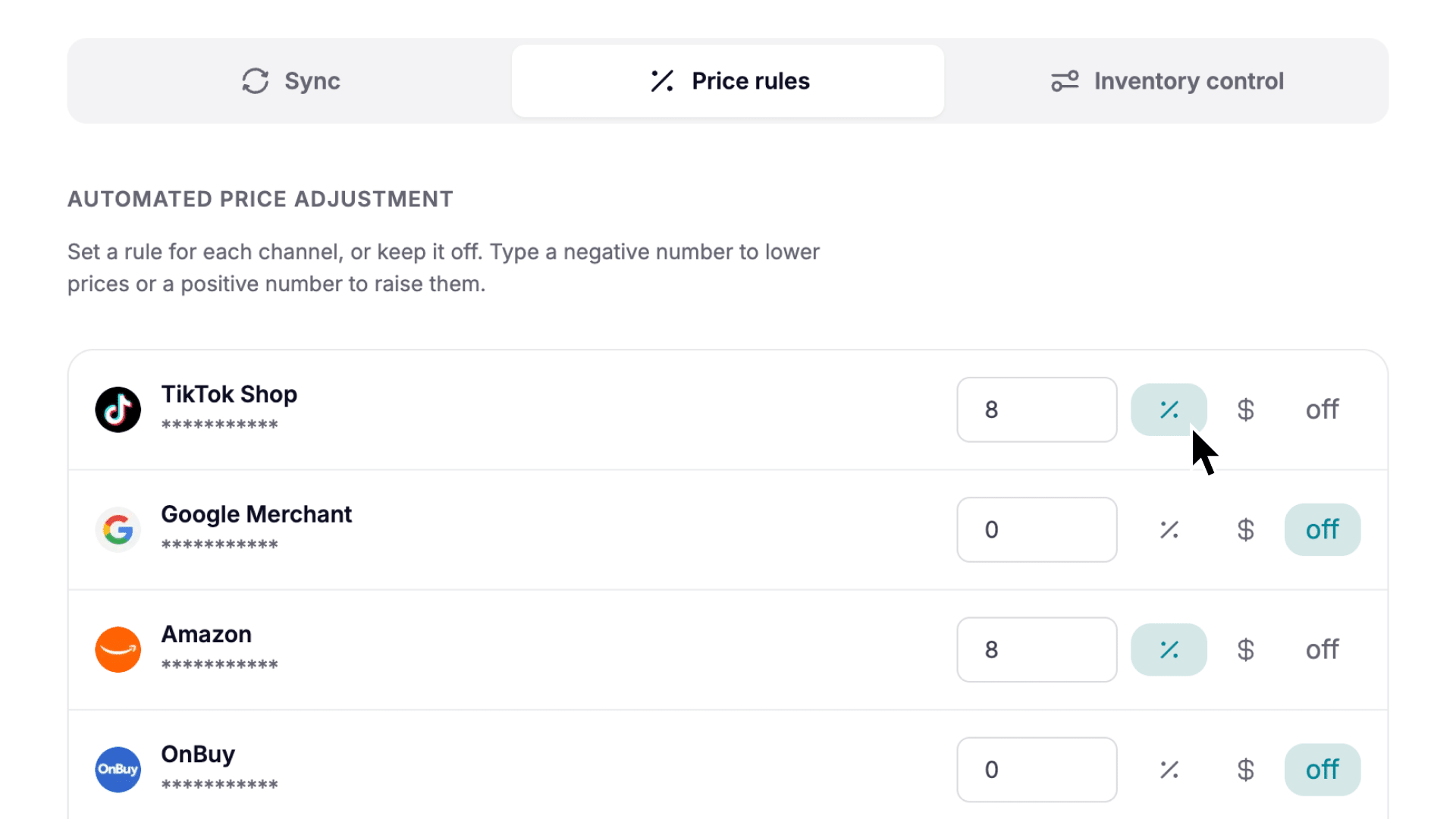
This is what Nembol pricing rules do. You set a rule per sales channel, choose whether it is a percentage or a fixed amount, and choose whether it raises or lowers the price. Each channel keeps its own rule, so Etsy can carry +6% while your own store stays flat and eBay carries a flat +$1.50 to cover the final value fee on the postage.
Three things make this the right instrument for a surcharge window rather than a permanent repricing exercise:
It is reversible in one action. The rule is a setting, not an edit. You switch it on in October and switch it off when the surcharges expire in January, and your underlying catalogue prices never changed. Nothing to restore, nothing to remember.
It is per channel, which is where the cost difference actually lives. A Kaufland order and a TikTok Shop order do not cost the same to fulfil, and a single flat markup across everything either leaves money on the table or prices you out of your cheapest lane.
It keeps your prices looking deliberate. Activate the automatic .99 price rounding, and a +6% rule turns $34.00 into $35.99, not $36.04. Buyers read $35.99 as a price someone chose. Psychologically, it is way more appearing then $36.04.
If you would rather make one sweeping move than a rule per channel, Nembol also offers a feature called bulk price editing: select hundreds or thousands of products, apply a percentage, and every connected channel updates at once. Rules are better for the seasonal case precisely because they come back off.
Then schedule the discount instead of rewriting the price
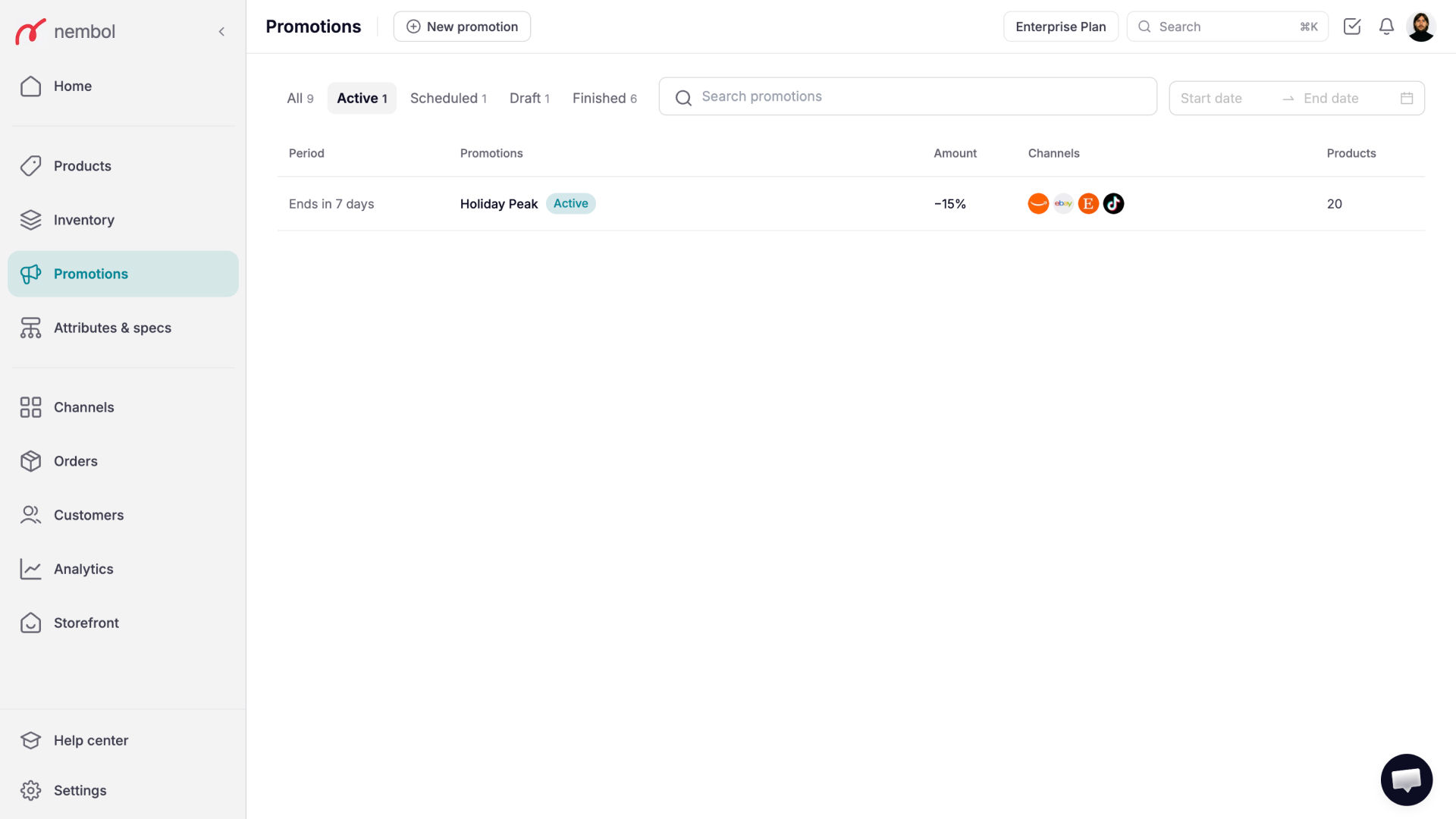
Higher list prices and holiday promotions are not in conflict, as long as the promotion is a separate layer. Nembol promotions run limited-time discounts across your channels without modifying your original pricing. You define the discount type as a percentage or a fixed amount, set a start and end date, choose which channels it applies to and which products are included, and it reverts by itself.
Together the two features give you the shape most sellers actually want for Q4: a baseline lifted to absorb the surcharge, and short promotional windows cut into it for Black Friday, Cyber Monday and the last-posting-date panic in mid-December. When January arrives, the promotion has already expired and the pricing rule gets switched off, and you are back where you started without having touched a single product record.
The alternative, which is what most people do, is to edit prices up in October, edit them down for Black Friday, edit them up again on 2 December, and then try to reconstruct the original numbers in February. That is where the stale-price errors come from.
Sell more, not just dearer: cross-list before the peak
Pricing defends the margin you have. It does not add revenue. The cheapest incremental revenue in Q4 comes from putting inventory you already own in front of audiences you are not currently reaching, because the cost of a second listing is zero and the holiday demand peak does not arrive at the same time on every platform.
Cross-listing with Nembol pushes one product record out to all your connected channels, and multichannel inventory sync keeps the stock count aligned so you are not overselling the one piece you had left on the day it matters most. That second part is what makes seasonal expansion safe rather than terrifying: oversells during peak do not just cost you the order, they cost you the metrics that determine next year’s visibility.
The practical order of operations is: cross-list in October while you still have time to fix category and attribute problems, set the pricing rule per channel before the residential demand charges land on 25 October, then schedule promotions for the dates you want to be loud. By late November you should be executing, not configuring.

More channels, one catalog, synced stock.
List once, publish everywhere, and let Nembol keep inventory aligned through the busiest weeks of the year.

What to do this week
Four things, in order, none of which takes a day.
Work out your real number. Pull your last month of labels, find your most common weight and zone, and look up what it now costs. One number per channel is enough. You cannot price for a cost you have not measured, and the published averages are not your cost.
Set a pricing rule per channel, not one for everything. Cover the increase plus the fee drag on the channels that charge fees on postage. Turn on .99 rounding. Diary the date you will switch it off: 18 January 2027, the day after the last surcharge expires.
Fix TikTok Shop fulfilment before volume arrives. If anyone on your team can still buy a USPS label outside TikTok Shipping, close that door now. A rejected label in the first week of December is expensive in a way the postage is not.
Cross-list the inventory you are sitting on. The channels you are not on yet are the only place in your Q4 plan where the upside is not capped by what you already sell.
The surcharges are temporary and they have a published end date. Your prices should have one too.
Frequently asked questions
When do the 2026 holiday shipping surcharges start and end?
UPS surcharges began on 27 September 2026 and run to 16 January 2027. FedEx began on 28 September 2026 and runs to 17 January 2027. USPS temporary rates took effect at 12:00 a.m. Central on 4 October 2026 and end at 12:00 a.m. Central on 17 January 2027. The broad residential demand charges on UPS and FedEx start later, on 25 and 26 October, and peak between 22 November and 27 December depending on the carrier.
How much are USPS prices going up for the 2026 holidays?
USPS filed the change on 25 August 2026; Supply Chain Dive put the average at about 6%. It is not flat. On retail Priority Mail and Ground Advantage in zones 1 to 4, a 0-to-3-pound parcel rises $0.50 and a 26-to-70-pound parcel rises $3.90. In zones 5 to 9 the same weight bands rise $1.00 and $9.10. Commercial rates rise less. A separate 8% fuel surcharge introduced on 26 April is still in effect and expires the same day.
Do Etsy and eBay sellers pay the USPS peak surcharge?
Not at retail rates. Marketplaces negotiate their own USPS contracts, so labels bought inside eBay or Etsy are priced off those agreements and the increase is usually smaller than the published figures. If you offer free shipping, however, the whole increase falls on you. On eBay there is an added effect: final value fees are charged on the total amount of the sale, which eBay defines as including shipping costs collected from the buyer, so higher postage raises your fee bill and inflates reported GMV without any extra sales.
Can I still use my own USPS account for TikTok Shop orders?
No. Since January 2026, USPS labels for TikTok Shop orders must be bought through TikTok Shipping. Labels from ShipStation, Shopify, a 3PL postage account or a direct USPS account are rejected as non-compliant. UPS, FedEx and other carriers are not affected. A rejected label delays dispatch, which feeds your Late Dispatch Rate; TikTok asks sellers to keep LDR at or below 4% and Valid Tracking Rate at or above 95%, with enforcement possible above 10% LDR.
What are the USPS holiday shipping deadlines for 2026?
For the contiguous United States, USPS recommends 16 December for USPS Ground Advantage, 17 December for First-Class Mail, 18 December for Priority Mail and 19 December for Priority Mail Express. Alaska, Hawaii and international destinations have earlier dates. These are recommendations, not guarantees, and the peak surcharge window runs well past them.
Is it better to raise prices or raise my free shipping threshold?
On your own store, raising the threshold is often the cheaper lever, because a per-parcel surcharge hurts small orders most and a higher qualifying value either recovers the postage or grows the basket. On marketplaces you generally cannot set a threshold, because the platform controls shipping mechanics and some of them reward free shipping with placement. There, the item price is the only lever you hold, which is why a per-channel pricing rule is the more portable answer.
How do I raise prices on one marketplace but not another?
With a per-channel pricing rule. In Nembol you open a channel’s settings, activate pricing rules, and choose a percentage or fixed-amount increase or decrease that applies only to that channel, with optional .99 rounding. Your underlying catalogue prices do not change, so when the surcharges expire in January you switch the rule off and every listing returns to its original price without any editing.