

Overview
Squarespace has become one of the reference platforms for entrepreneurs, creatives, and small businesses that want to combine a polished website with a functioning online store.
For sellers, though, a Squarespace store rarely stays the only place products are listed for long: marketplaces, social channels, and comparison shopping engines all add reach that a single storefront cannot provide on its own. Managing that expansion by hand, however, means re-entering titles, descriptions, prices, and stock levels on every additional channel, and keeping all of them aligned as products change.
Nembol addresses this by connecting directly to a Squarespace store and centralizing catalog management across every channel a business sells on, so that product data, pricing, and inventory stay consistent without duplicated manual work.
What exactly does Squarespace do
Squarespace is a hosted, all-in-one website builder. Founded in 2003, it lets users design and publish a website through a browser-based, drag-and-drop editor, without installing or maintaining any software. Every plan includes managed cloud hosting, SSL security, a content management system, and a library of designer templates that can be adapted through style controls or custom code.
Beyond the website itself, Squarespace bundles a set of business tools under one subscription:
- Domain registration
- Professional email through Google Workspace
- SEO and analytics tools
- Email marketing (Email Campaigns)
- Booking (through Acuity Scheduling)
- Built-in e-commerce engine
That e-commerce engine allows merchants to sell physical products, digital content, services, and subscriptions directly from their site, accept payments through Squarespace’s native Squarespace Payments (alongside PayPal, or through Stripe as an alternative processor), and manage orders, shipping, and basic inventory from the same dashboard used to edit the website.
Is Squarespace free to use
Squarespace does not offer a permanent free plan. Every new site starts with a 14-day free trial that does not require a credit card, after which a paid subscription is needed to publish the site and keep it live.
Pricing is organized into four tiers — Basic ($12/month), Core ($18/month), Plus ($32/month), and Advanced ($69/month), all billed annually (monthly billing costs more). All paid plans include hosting, a free custom domain for the first year, and the ability to sell products or services, but the ecommerce terms differ meaningfully between them:
- Basic applies a 2% transaction fee on online store sales and a 7% fee on digital content and memberships.
- Core removes the online store transaction fee and reduces the digital content fee to 5%, while adding custom code access and business integrations.
- Plus lowers the digital content fee further to 1% and adds features such as abandoned cart recovery and subscription selling.
- Advanced removes commerce and digital product fees entirely and adds the lowest payment processing rates, along with the most complete analytics and marketing tools.
Beyond the subscription itself, sellers should budget for payment processing fees (charged regardless of plan), domain renewal after the first year, and any third-party extensions used to extend functionality.
Is it worth it to sell on Squarespace
For many small and medium-sized businesses, yes.
Squarespace combines website management, ecommerce, content publishing, and marketing tools within a single platform, making it particularly suitable for brands that value design and want to control their own storefront.
The platform supports unlimited products on eligible ecommerce plans, product variants, inventory management, secure checkout, shipping configuration, tax settings, and integrations with payment providers.
However, businesses that also sell on marketplaces such as Amazon, eBay, Etsy, or other ecommerce platforms often discover that managing multiple catalogs independently requires additional work.
Using a multichannel solution such as Nembol allows merchants to keep Squarespace as their primary store while distributing the same catalog across multiple sales channels and maintaining synchronized inventory.
Downsides of Squarespace
Although Squarespace provides a strong all-in-one solution for many businesses, there are a few areas where merchants may eventually need additional tools as their operations grow:
- Squarespace prioritizes ease of use and a streamlined experience. As a result, businesses with highly customized ecommerce workflows may find fewer advanced configuration options than on more specialized ecommerce platforms.
- The built-in product management tools work well for many stores, but merchants with larger or frequently changing catalogs may benefit from additional solutions to simplify ongoing catalog maintenance.
- Squarespace focuses primarily on your own online store. Businesses looking to sell across marketplaces and additional ecommerce platforms typically must rely on external integrations to manage products and inventory efficiently.
- Squarespace includes a solid set of built-in features, but as business needs evolve—whether for advanced automation, fulfillment, or multichannel selling—additional integrations must be used to extend the platform’s capabilities.

Publish Squarespace products on multiple channels with Nembol
Growing beyond a single online store usually means managing products, inventory, orders, and performance across several independent platforms. As the number of sales channels increases, keeping all of that information aligned becomes progressively more complex.
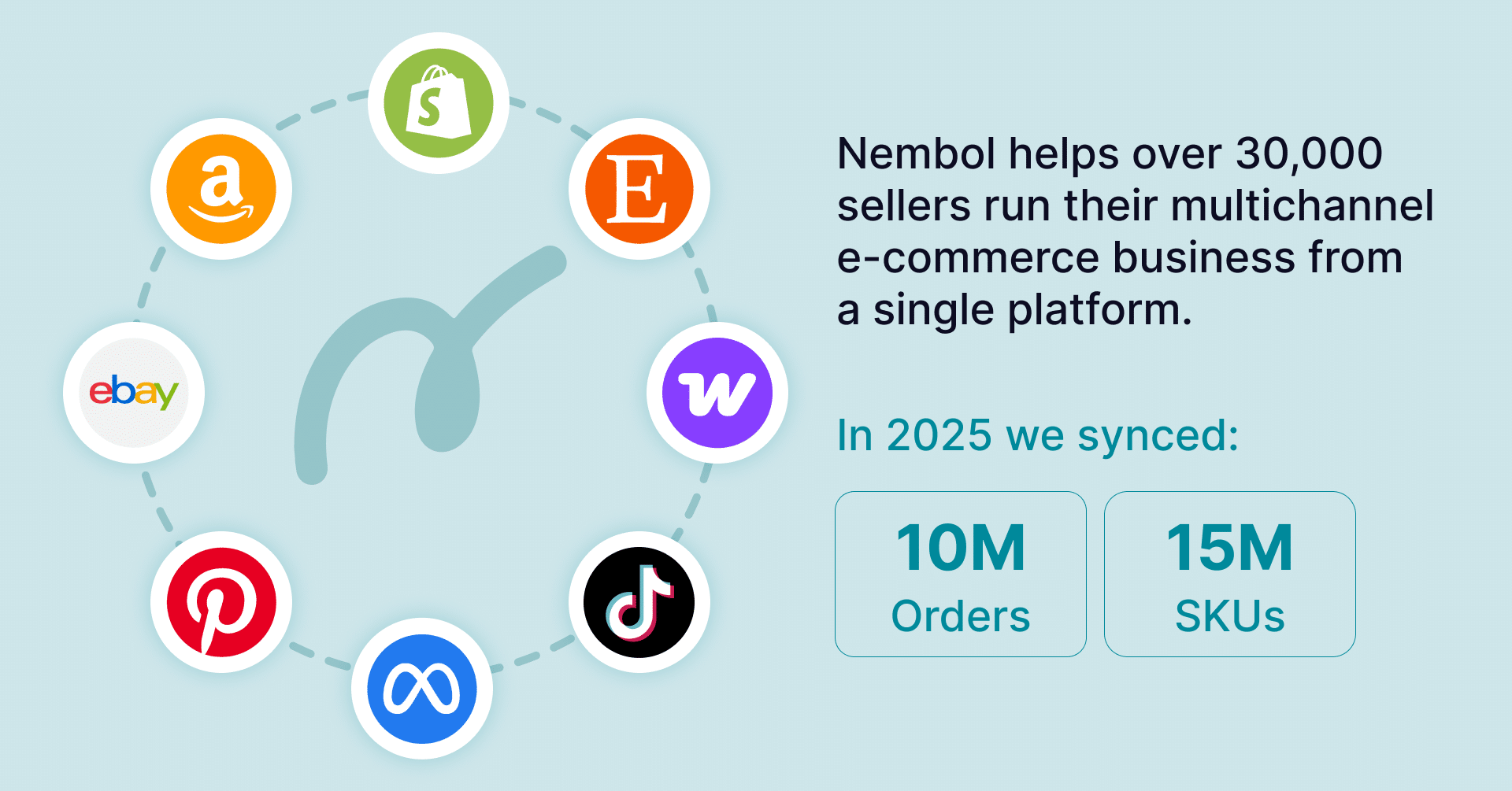
Nembol turns Squarespace into the starting point of a broader commerce ecosystem. Instead of managing each marketplace or storefront separately, merchants can work from a centralized environment that connects Squarespace with multiple types of sales channels, including leading marketplaces such as Amazon, eBay, and Etsy, Google’s shopping surfaces through Google Merchant Center, additional ecommerce platforms like Shopify and WooCommerce, and point-of-sale solutions such as Square.
This allows businesses to expand their reach without maintaining separate product catalogs for every destination. Product information can remain consistent across channels while reducing repetitive catalog management as new sales opportunities are added.
Beyond multichannel publishing, Nembol also centralizes many of the day-to-day operations involved in running an ecommerce business. Product information—including titles, descriptions, prices, images, and variant images—can be managed from a single interface, making it possible to keep catalogs consistent across every connected channel without repeating the same edits multiple times.
As operations grow, having a unified workspace becomes increasingly valuable. Rather than switching between different marketplace dashboards, merchants can manage products, monitor activity, and coordinate their sales channels from one platform.
Sync inventory between Squarespace and other channels
Inventory synchronization is only one part of maintaining a healthy multichannel business, but it is one of the most critical. When products are available across multiple stores and marketplaces, stock discrepancies can quickly lead to overselling, canceled orders, or inaccurate availability.
Nembol keeps inventory aligned across connected channels by maintaining a shared view of stock levels. Whether a sale occurs on Squarespace, a marketplace, another ecommerce platform, or a connected point-of-sale system, inventory updates can be propagated across the entire sales network so that product availability remains consistent.
Beyond inventory synchronization, Nembol also provides:
- Centralized Order Management – Orders from connected sales channels are gathered in a single dashboard, giving merchants one place to monitor and manage fulfillment activities.
- Amazon Multi-Channel Fulfillment (MCF) – Eligible orders can be routed directly to Amazon’s fulfillment network, allowing Amazon to handle picking, packing, and shipping even for orders placed outside Amazon.
- Automated Pricing Rules – Apply channel-specific pricing strategies by increasing or decreasing prices by a percentage or fixed amount.
- Multichannel Analytics – Monitor key business metrics across all connected sales channels from a single view, without comparing reports from multiple platforms.
- Nembol Checkup – Identify inconsistent or incomplete product data before listings are published, helping improve catalog quality, synchronization, and marketplace performance.
Taken together, these capabilities make Nembol more than a multichannel listing tool. It provides a centralized environment for managing products, inventory, orders, catalog quality, and business performance across an expanding ecommerce operation.