

Nembol vs Crosslist: Multichannel Listing Software Compared (2026)
Nembol and Crosslist both publish one listing to many places, but they are built around two different kinds of inventory. Crosslist is a crosslisting tool for resellers — Poshmark, Vinted, Depop, Mercari, Grailed, eBay — priced by how many new listings you add each month. Nembol is multichannel software for stocked catalogs — Amazon, eBay, Etsy, TikTok Shop, Shopify, WooCommerce — priced by how many products you hold. That difference decides the comparison before any feature does.
12 min read • Last update September 11, 2026
The quick verdict
Choose Nembol if you hold stock and restock it, and you want that stock to stay accurate across marketplaces such as Amazon, TikTok Shop, eBay, Etsy and your own website. Beyond marketplace selling, Nembol includes Storefront — a customisable branded online store on every plan — plus scheduled social posting, per-channel pricing rules, order transfer for fulfillment, and up to ten accounts on the same channel. Nembol supports a wide range of sales channels and is available worldwide, in 150+ countries.
Choose Crosslist if you sell secondhand or one-of-a-kind items on the resale marketplaces. Poshmark, Vinted, Depop, Mercari, Grailed and Whatnot are the whole point of the product, and Nembol connects to none of them. Crosslist’s one-universal-form workflow, listing templates, bulk delist and relist, and iOS and Android apps are built around the way resellers actually work. Note that it is available only to sellers in the United States, United Kingdom, Canada and Australia.
What Is Nembol?
Nembol is a multichannel listing and inventory platform founded in 2014 in San Francisco, used by more than 40,000 sellers in over 150 countries. It is built for stocked catalogs of roughly 200 to 15,000 products.
It connects 15+ channels: Amazon, eBay, Etsy, TikTok Shop, Kaufland, OnBuy and Subito.it; Shopify, WooCommerce, PrestaShop, Squarespace, Square and Wix; and Google Merchant Center, Facebook Page and Shop, Instagram, Pinterest and Tumblr. Temu and Faire are coming soon.
You import a catalog once, publish it in bulk, and from then on stock, prices and content stay in sync both ways in real time, server-side, with nothing running on your computer. Around that sit per-channel pricing rules, timed promotions, analytics, scheduled social posting, a built-in storefront, order transfer for fulfillment including Amazon MCF, and up to ten accounts on the same channel.
Pricing runs $39 to $129 a month by product count, with unlimited listings, unlimited orders, every channel and 0% commission on all plans. The trial is 14 days, full access, no credit card. Nembol is web only; there is no mobile app.
What Is Crosslist?
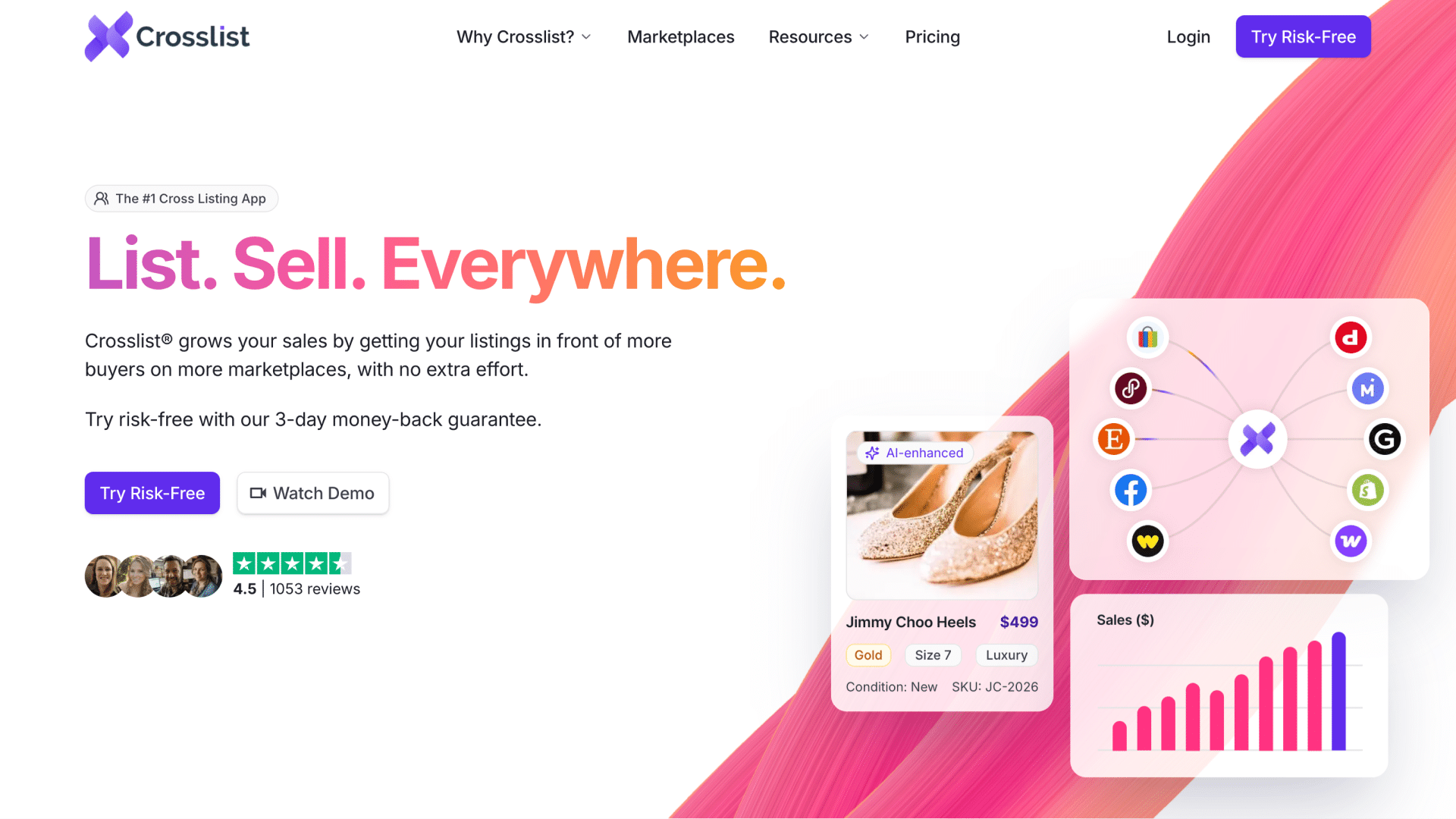
Crosslist is a crosslisting app for resellers, moving one listing across “11+ marketplaces” — and the marketplaces it means are the resale ones: eBay, Poshmark, Vinted, Mercari, Depop, Etsy, Facebook Marketplace, Grailed, Whatnot, Shopify and WooCommerce.
The workflow is one universal form. You fill it in once, Crosslist maps categories and attributes per destination, and posts in the background. It imports existing listings, saves templates and shipping profiles, clones and drafts them, converts sizes, and delists or relists in bulk. Photo editing and background removal are included on every plan; a $4.99 AI add-on adds listing and photo generation and price suggestions, metered in credits. There are iOS and Android apps.
Connections are “API-first whenever a marketplace supports it”, falling back to “a secure browser extension that runs inside your own browser” where no API exists — which is most of the resale marketplaces.
Pricing is metered by new listings added per month: $29.99 for 200, $34.99 for 500, $39.99 for 1,000 and $44.99 for unlimited. There is no free trial, only a three-day money-back guarantee. Crosslist is available only in the United States, United Kingdom, Canada and Australia, and states it does not support users residing in the European Union.
Supported sales channels
Channel coverage is where these two tools diverge most sharply: they share exactly four destinations — eBay, Etsy, Shopify and WooCommerce — and everything either side of that belongs to one of them alone. Nembol spreads across marketplaces, ecommerce platforms and social commerce; Crosslist concentrates entirely on the resale marketplaces.
Nembol Supported Channels
Nembol is built for sellers who want one stocked catalog to reach marketplaces, their own website and social commerce at the same time. It supports:
- Amazon
- eBay
- Etsy
- TikTok Shop
- Kaufland
- OnBuy
- Subito.it
- Shopify
- WooCommerce
- PrestaShop
- Squarespace
- Square
- Wix
- Google Merchant Center
- Facebook Page / Facebook Shop
- Tumblr
- Nembol Storefront (its own branded store, included on every plan)
Nembol’s coverage makes it particularly suitable for sellers combining marketplaces, an ecommerce store and social selling, and for European sellers in particular — Kaufland, OnBuy and Subito.it serve Germany, the UK and Italy.
Crosslist Supported Channels
Crosslist focuses on the marketplaces where secondhand and one-of-a-kind items sell. Its supported channels are:
- eBay
- Poshmark
- Vinted
- Mercari
- Depop
- Grailed
- Whatnot
- Facebook Marketplace
- Etsy
- Shopify
- WooCommerce
That is eleven channels against Nembol’s fifteen-plus, and the gaps are structural rather than incidental. Crosslist has no Amazon and no TikTok Shop, the two largest destinations for sellers holding stock in quantity.
Inventory sync
This is the difference that costs money if you get it wrong, and it is not visible from a feature list.
Nembol syncs continuously. Quantities move in both directions across every connected channel in real time, on Nembol’s servers. If a product sells on eBay, stock drops on Amazon, Shopify and everywhere else within moments, whether or not your computer is switched on. If you receive a delivery and update stock in Shopify, the same happens outward. Sync is included on every plan, starting at $39.
Crosslist reacts to a sale. Its autodelist feature, in Crosslist’s own words, means that “when an item sells, autodelist automatically updates your other connected listings, either delisting them or lowering the quantity.” That is the correct behavior for one-of-a-kind stock and it does handle multi-quantity items where the marketplace tracks quantity.
Two caveats are worth knowing before you buy. First, autodelisting is only on the Gold and Diamond plans — $39.99 and $44.99. On Bronze at $29.99 and Silver at $34.99 you get crosslisting with no automatic oversell protection at all, which is a surprising place to draw the line. Second, sale detection is automatic through Crosslist’s servers only for eBay, Etsy, Shopify and WooCommerce. For Poshmark and the other extension-based marketplaces, the Chrome extension detects the sale while your browser is running. Close the laptop for a weekend and the delisting waits.
For a reseller with unique items that is usually an acceptable trade, and Crosslist is transparent about it. For a business holding stock across Amazon and Shopify, continuous server-side sync is not a nice-to-have.
Onboarding, User Interface & Overall Experience
Onboarding
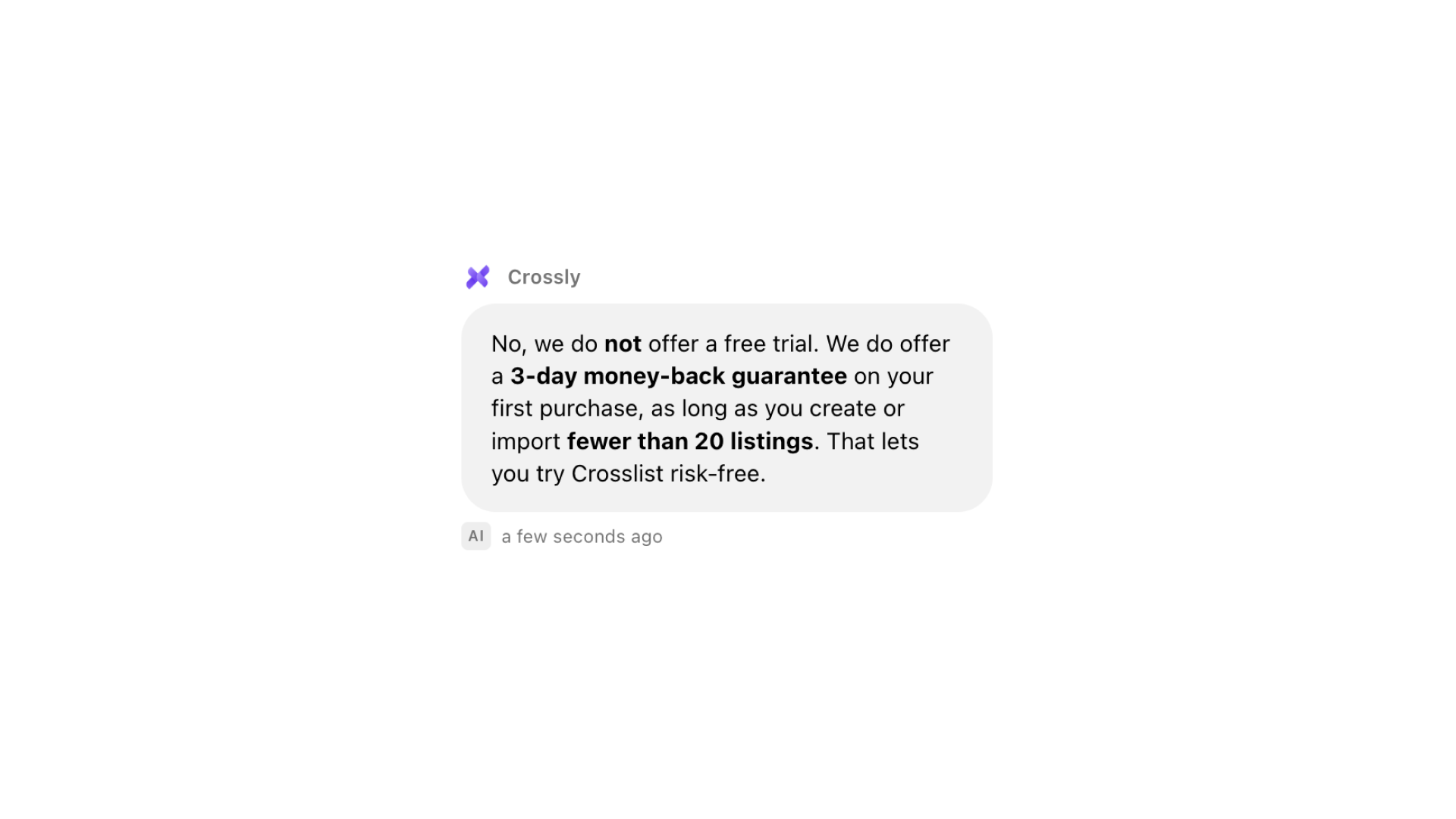
Crosslist asks for your card before you list anything. There is no free trial. The “Try Risk-Free” button leads to a purchase: you pick a plan, enter payment details and are charged. What you get instead of a trial is a three-day money-back guarantee, and it carries two conditions — you must have created fewer than 20 listings, and you must contact support through the chat widget inside the application within 72 hours of purchase. Miss either and the money stays spent. In practice you are buying the tool and then deciding, on a 72-hour clock, whether to ask for it back.
Connections are API-first where a marketplace offers an API, and fall back to “a secure browser extension that runs inside your own browser” where none exists — which covers most resale marketplaces. Setup therefore means installing the extension and signing in to each marketplace through it. Importing is done one marketplace at a time: the Import screen asks you to select the marketplace to import from, and offers a grid of the eleven it supports.
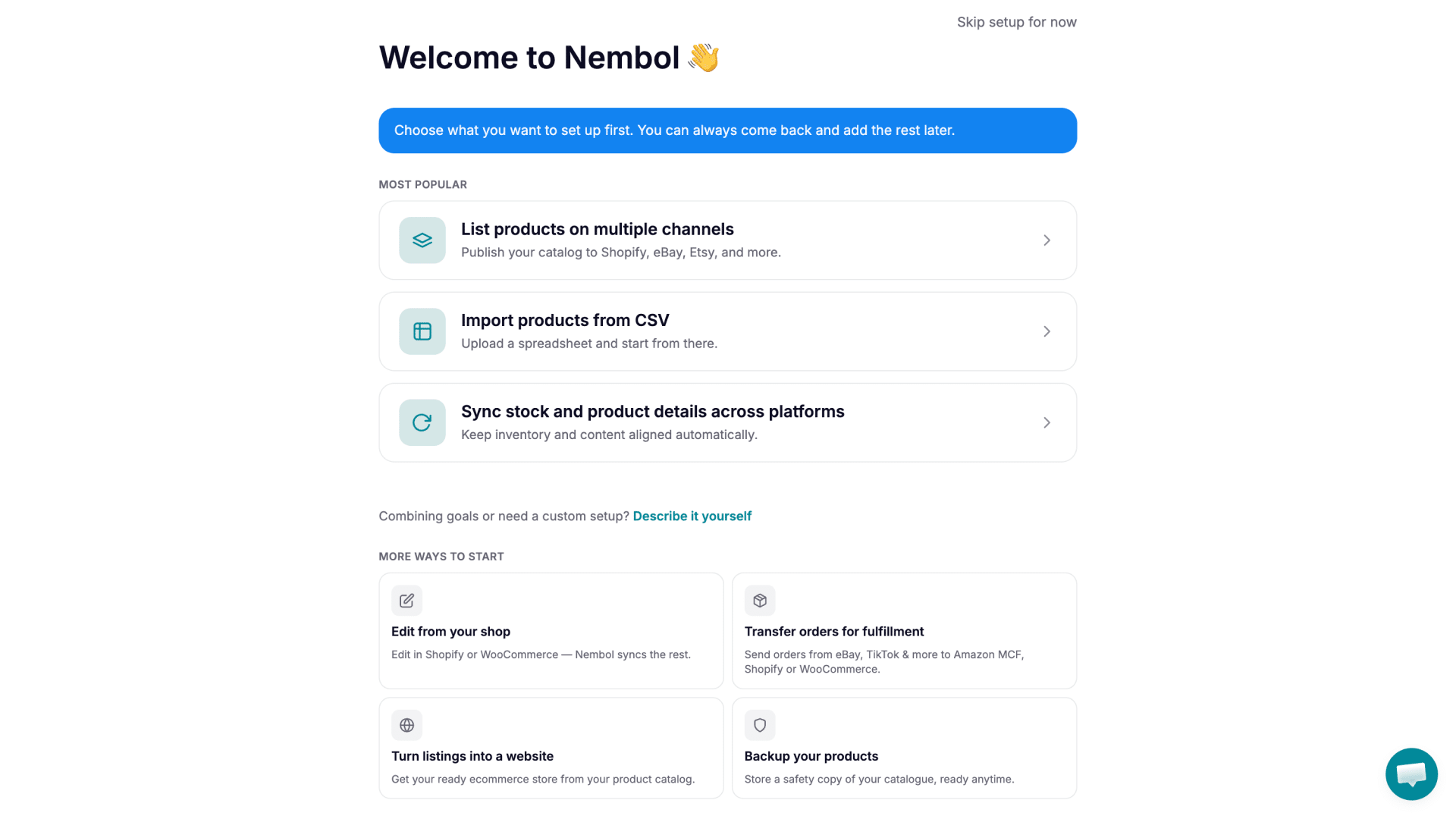
Nembol gives 14 days with every feature and no credit card. Channels connect through their official APIs, and the catalog can be built from any direction — imported from a marketplace, from a shop, or from a CSV — rather than from one nominated source. Free onboarding calls are included on every plan, not reserved for the expensive tiers.
User Interface (UI) & User Experience (UX)
Crosslist is well designed and pleasant to use.
The important difference is structural, not cosmetic. In Crosslist the unit of work is the listing. You select channels per item, and you post, relist or delist it. There is no quantity in that flow, because a resale item is a single object that exists until it sells. In Nembol the unit is the product, and it carries a quantity. Channels are connected once, publishing is a property of the product, and stock and price are edited straight in the list with the pending change visible before you save.
Neither is better in the abstract. If your inventory is one-of-a-kind, Crosslist’s model fits it exactly and Nembol’s quantities are overhead. If you hold the same product in tens or hundreds, Crosslist’s model has nowhere to put that number.
Import Feedback & Error Handling
Crosslist handles this well. Posting opens a progress dialog with one row per marketplace, a green tick and “Successfully posted” as each completes, and a Show listing button that opens the live listing so you can check it yourself. Bulk posting shows a counter, the channel icons for each listing, and a Retry all failed button, so a partial failure is visible and recoverable rather than silent.
Nembol takes a step earlier: Checkup inspects the catalog and flags missing or malformed data before you publish, so the errors surface while you can still fix them in bulk rather than after a channel has rejected them.
Customer Support
Crosslist runs an in-app chat widget, visible on every screen, and maintains a documentation site. That widget is also the only route to the money-back guarantee, which makes it load-bearing rather than optional. Nembol includes free onboarding calls on every plan, and support is not tiered by what you pay.
Bottomline
Crosslist is the more focused product, and for a reseller moving unique items across Poshmark, Vinted, Depop, Grailed and Whatnot it is easier to learn and faster to work in than a general multichannel tool. Nembol asks more of you at the start and gives you a catalog, quantities, continuous sync, per-channel pricing and a storefront of your own in return. The deciding question is not which interface you prefer — it is whether the thing you sell has a quantity.
Feature-by-Feature Comparison
Verified against each vendor’s public website and documentation in September 2026.
| Feature | Nembol | Crosslist |
|---|---|---|
| Listing & Catalog | ||
| Link existing listings across channels | ✓ | ✓ |
| CSV import / export | ✓ all plans | ✓ Gold and above |
| Reusable saved listing templates | ✕ | ✓ all plans |
| Clone listings and save drafts | ✕ | ✓ all plans |
| Catalog checkup (missing / inconsistent data) | ✓ Enterprise and above | ✕ |
| AI title and description generation | ✓ Enterprise+ only | ✓ paid add-on, +$4.99/mo |
| AI photo generation and editing | ✕ | ✓ paid add-on |
| Images per listing | No published limit | 9 / 9 / 15 / 24 by plan |
| Images per variant | ✓ | ✕ |
| Inventory & Sync | ||
| Continuous two-way stock sync | ✓ all plans | ✕ |
| Delist or reduce quantity when an item sells | ✓ | ✓ Gold and above |
| Sale detection without the browser open | ✓ | Only on eBay, Etsy, Shopify, WooCommerce |
| Price and content edits pushed back to channels | ✓ | ✓ |
| Multiple accounts per channel | ✓ 1 / 2 / 4 / 10 by plan | Not published |
| Channels | ||
| Resale marketplaces (Poshmark, Vinted, Depop, Mercari, Grailed, Whatnot) | ✕ | ✓ |
| Facebook Marketplace | ✕ | ✓ |
| Amazon | ✓ | ✕ |
| TikTok Shop | ✓ | ✕ |
| eBay, Etsy, Shopify, WooCommerce | ✓ | ✓ |
| Squarespace, Square, Wix, PrestaShop | ✓ | ✕ |
| Kaufland, OnBuy, Subito.it | ✓ | ✕ |
| Google Merchant, Meta, Pinterest, Tumblr | ✓ | ✕ |
| Beyond Listing | ||
| Built-in storefront / website | ✓ all plans | ✕ |
| Social auto-posting | ✓ | ✕ |
| Per-channel pricing rules | ✓ % or fixed, with .99 rounding | ✓ price adjustments |
| AI-powered price suggestions | ✕ | ✓ paid add-on |
| Timed promotions | ✓ | ✕ |
| Order transfer for fulfillment | ✓ Pro and above, incl. Amazon MCF | ✕ |
| Customer list across channels | ✓ | ✕ |
| Multichannel sales analytics | ✓ all plans — revenue, orders, top products, sales by country | ✓ Gold and above — adds fees and estimated profit |
| API access | ✓ Enterprise+ only | Not published |
| Mobile app | ✕ | ✓ iOS and Android |
Pricing comparison
The two platforms use different pricing approaches. Nembol pricing is based on the number of products in your catalog, while Crosslist pricing depends on how many new listings you add each month. Neither charges commission, but they scale differently: Nembol for predictable growth by catalog size, with every channel and unlimited listings and orders on all plans; Crosslist by the volume of new items you process, with oversell protection and analytics on its top tiers only.
Nembol pricing
| Plan | Products | Seats | Accounts / Channel | Key Features Included | Price / Month |
|---|---|---|---|---|---|
| Basic | 200 | 1 | 1 | Inventory sync, Easy Website, Social Posting | $39 |
| Pro | 2,000 | 1 | 2 | Nembol Link + Transfer Orders | $49 |
| Enterprise | 5,000 | 2 | 4 | Attributes Manager | $79 |
| Enterprise+ | 15,000 | 5 | 10 | Nembol Checkup + AI Title & Description + API access | $129 |
Annual billing saves 25%. Every plan includes unlimited orders, every channel and 0% commission. The trial runs 14 days with full features and no credit card.
Crosslist pricing
| Plan | New Listings / Month | Images per Listing | Key Features Included | Price / Month |
|---|---|---|---|---|
| Bronze | 200 | 9 | Crosslisting, one universal form, import, delist and relist | $29.99 |
| Silver | 500 | 9 | Everything in Bronze | $34.99 |
| Gold | 1,000 | 15 | Everything in Silver, plus autodelisting, CSV import and export, sales analytics | $39.99 |
| Diamond | Unlimited | 24 | Everything in Gold | $44.99 |
What the plans actually meter
Crosslist counts new listings created this month. Nembol counts products held. The two can point in opposite directions for the same seller.
A reseller who sources and lists 800 new items a month but never holds more than 300 at once needs Crosslist’s Gold plan at $39.99 and would fit Nembol’s $39 Basic tier on catalog size — if Nembol connected to their channels, which it does not. A shop with 4,000 stocked products that adds 50 new ones a month sits on Nembol’s $79 Enterprise plan and would technically fit Crosslist’s cheapest tier, while getting no Amazon, no continuous sync and no oversell protection below Gold.
The other thing worth pricing in is the AI add-on. Crosslist’s AI listing generation, photo editing and price suggestions cost an extra $4.99 a month and are metered in credits — 200 to 2,000 depending on plan. Nembol includes AI title generation from the $79 tier and AI descriptions from $129, uncapped. Below those tiers Nembol has no AI at all, so for a seller who wants AI cheaply, Crosslist at $34.98 all-in is the lower number.
Strengths and Weaknesses
Nembol: strengths
- Continuous two-way stock sync on every plan, running server-side with nothing to keep open.
- Amazon and TikTok Shop, the two largest destinations for sellers holding stock, neither of which Crosslist reaches.
- 15+ channels spanning marketplaces, ecommerce platforms (Squarespace, Square, Wix, PrestaShop) and a full advertising and social layer with scheduled posting — Google Merchant, Meta, Pinterest, Tumblr.
- A branded Storefront included on every plan, with no separate ecommerce subscription to run.
- Analytics on every plan — revenue, orders, best sellers, sales by country — rather than a paid upgrade.
- Order transfer for fulfillment from the Pro plan, including Amazon MCF for orders taken on other channels.
- Catalog Checkup flags missing or inconsistent SKUs, GTINs, titles, prices and images before a channel rejects them.
- Unlimited listings, orders and variants, every channel and 0% commission on all plans, with up to ten accounts per channel.
- A real 14-day trial with full features and no credit card, available in 150+ countries.
Nembol: weaknesses
- No resale marketplaces at all — no Poshmark, Vinted, Depop, Mercari, Grailed, Whatnot or Facebook Marketplace — which rules it out for most of Crosslist’s customers.
- No mobile app; the product is web only.
- No reusable listing templates, listing cloning or drafts, which resellers lean on heavily.
- No photo editing, background removal or AI price suggestions.
- AI title and description generation and API access only on the $129 Enterprise+ plan.
- Analytics cover revenue and units but not marketplace fees or estimated margin per order.
- The largest published plan covers 15,000 products, and the catalog extends beyond that with 5,000 product slots at $40, and discounted slots on a growth plan at scale.
- The $39 entry plan costs more than Crosslist’s most expensive tier.
Crosslist: strengths
- The resale marketplace coverage is the point, and it is good: Poshmark, Vinted, Depop, Mercari, Grailed, Whatnot and Facebook Marketplace alongside eBay, Etsy, Shopify and WooCommerce.
- The one-universal-form workflow, with automatic category and attribute mapping per destination, removes genuine drudgery.
- Templates, cloning, drafts, auto-linking, size conversion, bulk actions and one-click delist-and-relist are built for the way resellers actually work.
- iOS and Android apps carrying nearly the full feature set, which matters when you list as you source.
- Photo editor and background remover on every plan, with generative AI and price suggestions as a $4.99 add-on.
- Sales analytics on Gold and above break out marketplace fees and estimated profit per order.
- Unlimited new listings for $44.99, and every plan priced below Nembol’s entry tier.
Crosslist: weaknesses
- No Amazon and no TikTok Shop.
- No continuous stock sync: quantities are reconciled after a sale rather than held level across channels.
- Autodelisting — the feature that stops you overselling — is withheld from the two cheapest plans.
- Sale detection on the resale marketplaces depends on your desktop browser being open; close the laptop and the delisting waits.
- Nine images per listing on the two cheapest plans, tight for clothing, and no per-variant images.
- CSV import and export only from the Gold plan.
- No storefront, no advertising or social channels, no order and fulfillment handling, no customer list.
- No free trial, only a three-day or twenty-listing money-back window on your first purchase.
- Available to sellers in the US, UK, Canada and Australia only; residents of the European Union are not supported.
Who Should Use Nembol vs Crosslist?
Crosslist makes sense in one clearly defined situation. If your inventory is genuinely one-of-a-kind and your buyers are on the resale marketplaces, Nembol reaches none of those channels and the decision is made for you — provided you sell from the United States, the United Kingdom, Canada or Australia.
Almost everything else points to Nembol, and not only on inventory. It reaches the channels a stocked business actually earns on — Amazon and TikTok Shop before anything else — along with the ecommerce platforms and the advertising and social layer Crosslist has no equivalent of. It gives you a sales channel of your own, with a branded storefront included rather than bolted on as a second subscription, and it keeps every buyer who comes through those channels in one customer list. It handles what happens after the sale, transferring orders for fulfillment where Crosslist stops at the listing. It keeps the catalog itself honest, flagging missing or inconsistent product data before a marketplace rejects it. And underneath all of that, stock stays level everywhere continuously, without your computer being involved, where Crosslist reacts only after a sale and only on its upper tiers.
There is very little middle ground, and what traffic exists between the two runs mostly one way. A seller who starts with unique finds and ends up buying the same item in quantity has stopped describing a crosslisting problem. They have grown into a catalog, and a catalog needs software built to keep it in sync.
Frequently Asked Questions
What channels does Nembol support that Crosslist does not?
Amazon, TikTok Shop, Kaufland, OnBuy and Subito.it on the marketplace side; Squarespace, Square, Wix and PrestaShop on the ecommerce side; and Google Merchant Center, Facebook Page and Shop, Instagram, Pinterest and Tumblr for advertising and social. Nembol also includes its own storefront. Temu and Faire are published as coming soon.
What channels does Crosslist support that Nembol does not?
The resale layer: Poshmark, Vinted, Depop, Mercari, Grailed, Whatnot and Facebook Marketplace. Nembol connects to none of these and has published no plans to.
Can I use Crosslist if I live in the EU?
No. Crosslist states it is available in the United States, the United Kingdom, Canada and Australia, and that it does not support users residing in the European Union. Nembol is used in more than 150 countries and its interface runs in five languages.
Does either platform charge per order or take a commission?
Neither does. Nembol charges a flat monthly fee with unlimited orders and 0% commission. Crosslist charges a flat monthly fee metered by new listings added, with no transaction fee.
Does Crosslist need a browser extension?
For some marketplaces, yes. Crosslist says it is “API-first whenever a marketplace supports it” and falls back to “a secure browser extension that runs inside your own browser” where no API exists — which covers most resale marketplaces, Poshmark included. In practice that means listing and sale detection on those channels happen while your browser is running. Nembol uses official APIs for every channel and runs entirely on its own servers, with nothing installed.
Is there a free trial for Crosslist?
No. Crosslist offers a three-day money-back guarantee on your first purchase, valid only if you have created fewer than 20 listings, and annual plans carry a $9.99 processing fee on refund. So you pay first and evaluate against the clock. Nembol gives 14 days of full access with no credit card required, which is a materially easier way to test a tool.
How much does Crosslist cost?
Bronze is $29.99 a month for 200 new listings, Silver $34.99 for 500, Gold $39.99 for 1,000 and Diamond $44.99 for unlimited. Images per listing run 9, 9, 15 and 24 across those tiers, and autodelisting, CSV import and export and sales analytics start at Gold. AI listing generation and photo editing are a separate $4.99 a month, metered in credits. Quarterly billing saves 10%; annual gives two months free.
Does Crosslist protect me from overselling on every plan?
No. Autodelisting requires the Gold ($39.99) or Diamond ($44.99) subscription. Bronze and Silver include sales detection but not the automatic delist or quantity reduction. Nembol includes two-way inventory sync on every plan, starting at $39.
Can Nembol replace my ecommerce website?
It can be one. Nembol Storefront is included on every plan — one theme on Basic, three on Pro, all themes on Enterprise and above — with control over design, payments, shipping and promotions. Crosslist has no storefront equivalent; it connects to Shopify and WooCommerce stores you already run.
Can I use Nembol and Crosslist together?
You can, and a seller doing both new and secondhand stock might: Nembol for the stocked catalog on Amazon, eBay, Etsy and Shopify, Crosslist for one-off items on Poshmark and Vinted. There is no integration between them, so keep the two catalogs separate rather than letting both manage the same SKU — two tools writing stock to the same eBay listing will fight. In practice most sellers are clearly one or the other.
Is there a mobile app for Nembol or Crosslist?
Crosslist has one, Nembol does not. Crosslist offers iOS and Android apps for creating and managing listings on the go, which is a genuine advantage for resellers who photograph and list items as they source them. Nembol is web-based only.
Try Nembol free for 14 days
No credit card required.