

Nembol vs LitCommerce: Multichannel Listing Software Compared (2026)
Both Nembol and LitCommerce are multichannel e-commerce platforms that help sellers manage listings, synchronize inventory, and expand across multiple sales channels. While they share the same core purpose, they differ in features, workflows, and pricing models — which we will compare throughout this article.
10 min read • Last update September 4, 2026

The quick verdict
Choose Nembol if you want to grow your business across multiple sales channels while maintaining control over your catalog, brand, and customer experience. Beyond marketplace selling, Nembol includes Storefront — a customizable branded online store that allows sellers to create their own sales channel with control over design, payments, shipping, promotions, and more. Its multichannel approach, catalog management tools, social commerce features, and AI-ready foundations make it a strong choice for businesses looking to expand long term.
Choose LitCommerce if your priority is connecting an existing ecommerce store to a broad selection of marketplaces, particularly Walmart, Faire, Reverb, or Shopee. Its marketplace-focused tools, listing templates, and shipping integrations make it a practical option for sellers with specific marketplace expansion needs.
What Is Nembol?
Nembol is a multichannel commerce platform that helps businesses manage products, inventory, listings, orders, and sales channels from a centralized dashboard.
Rather than focusing exclusively on marketplaces, Nembol combines marketplaces, ecommerce platforms, social commerce, and a proprietary Storefront. Supported channels include Amazon, eBay, Etsy, Shopify, WooCommerce, Wix, TikTok Shop, Google Merchant Center, Meta Commerce, Pinterest, Square, Squarespace, OnBuy, PrestaShop, Tumblr and Subito.it.
Nembol Storefront gives merchants an additional sales channel they control themselves. Products already managed in Nembol can be sold through a customizable branded online store, with control over design, payments, shipping, promotions, and branding.
The platform also includes bidirectional synchronization on supported channels, Nembol Link for connecting existing listings, Nembol Checkup for identifying catalog data issues, automated pricing rules, promotions and customer management, social media auto-posting, and multi-account support.
What Is LitCommerce?
LitCommerce is a multichannel listing and inventory management platform designed to help merchants sell across multiple online marketplaces and e-commerce platforms from a single interface.
Focused primarily on marketplace connectivity, it allows sellers to publish listings, synchronize inventory, prices, and orders, and manage products across channels including Amazon, eBay, Etsy, Walmart, TikTok Shop, Temu, Faire, Reverb, Shopee, Shopify, WooCommerce, Wix, BigCommerce, Squarespace, Square, and Google Merchant Center.
LitCommerce also provides marketplace-specific tools for eBay and Etsy sellers, including listing templates, bulk editing, and AI-assisted listing optimization. For shipping and fulfillment, it integrates with ShipStation, while Shippo is currently listed as coming soon.
Overall, LitCommerce is particularly suited to businesses focused on expanding across a broad range of marketplaces, with specialized listing tools and integrations that support marketplace management, shipping, and fulfillment workflows.
Supported sales channels
The supported sales channels highlight the different positioning of the two platforms. Nembol combines marketplaces, ecommerce platforms, social commerce, and its own branded Storefront, while LitCommerce focuses primarily on marketplace expansion and broad channel coverage.
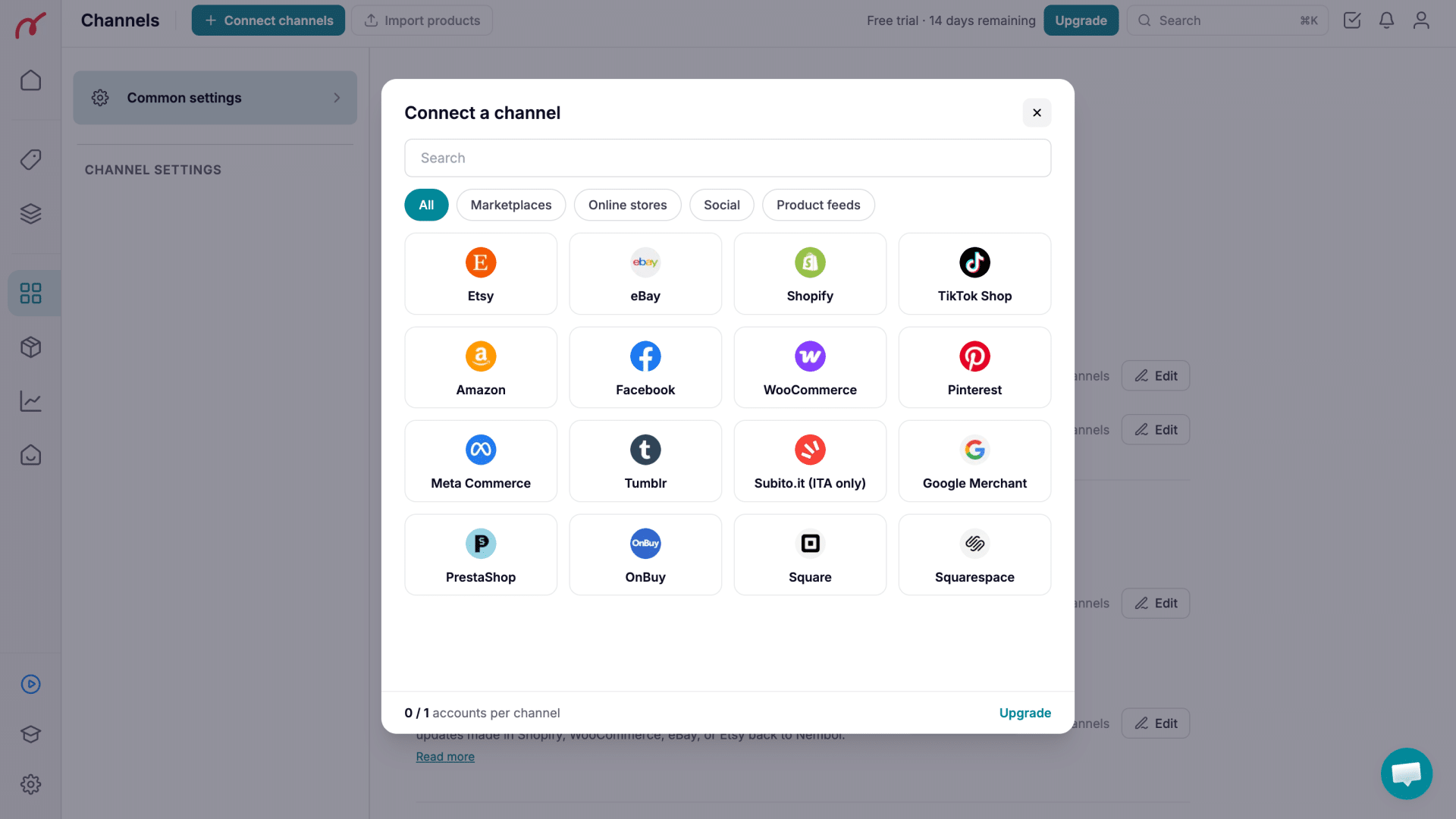
Nembol Supported Channels
Nembol is built for sellers who want to expand beyond traditional marketplaces into social selling and a broader mix of ecommerce channels. Current integrations include:
Marketplaces
- Amazon
- eBay
- Etsy
- TikTok Shop
- OnBuy UK
- Subito.it
Ecommerce websites
- Shopify
- WooCommerce
- Wix
- Squarespace
- Square
- PrestaShop
Social & advertising
- Google Merchant Center
- Meta Commerce
- Facebook Page
- Tumblr
Beyond third-party channels, Nembol Storefront gives merchants a branded ecommerce sales channel connected to their centralized catalog, providing control over their website, payments, shipping, promotions, and customer experience — a capability not currently offered by LitCommerce.
LitCommerce Supported Channels
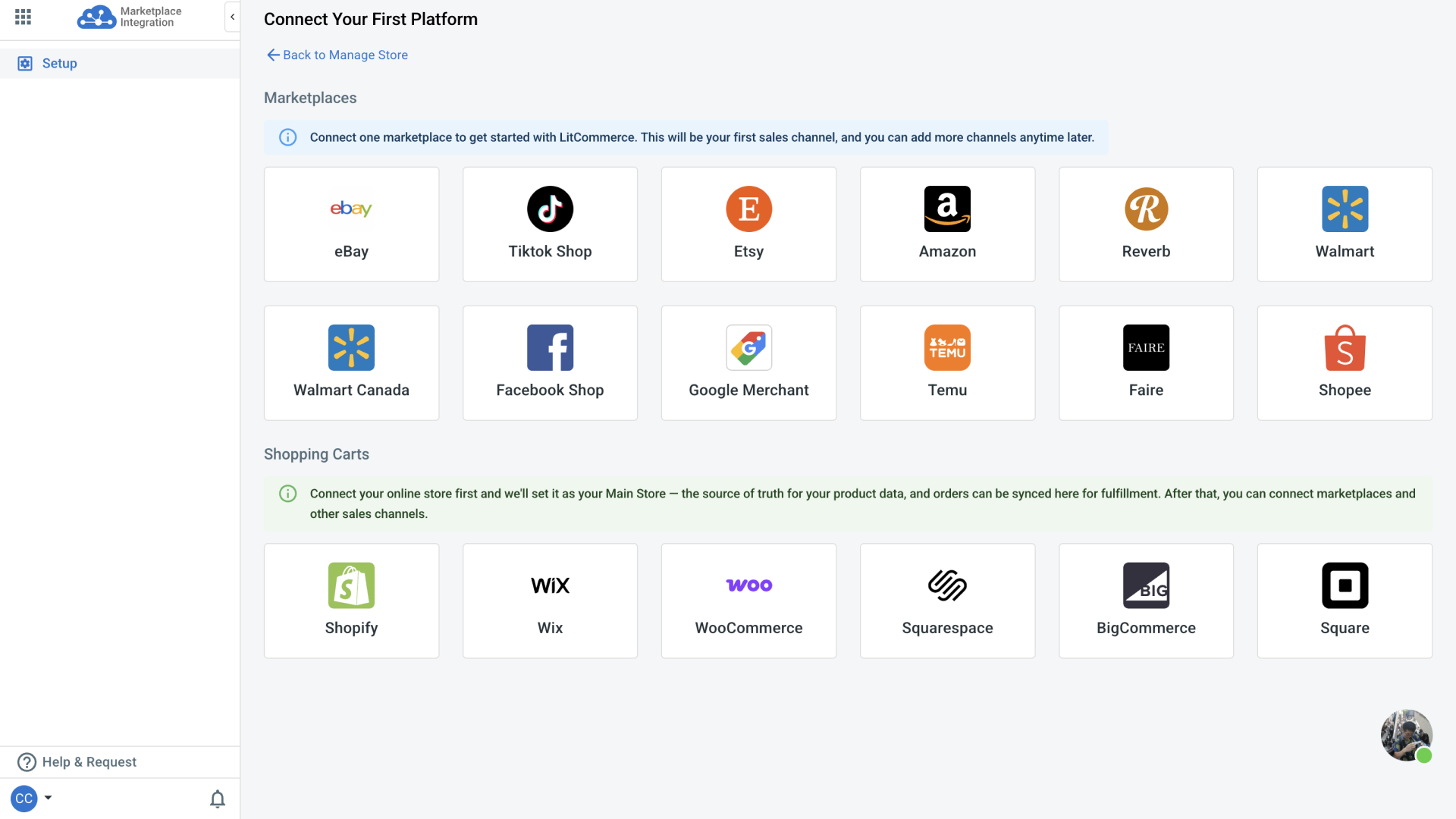
LitCommerce supports a broad selection of marketplaces and ecommerce platforms, with its strongest differentiation coming from marketplace coverage. Current integrations include:
Marketplaces
- Amazon
- eBay
- Etsy
- Walmart
- TikTok Shop
- Temu
- Faire
- Reverb
- Shopee
- Google Merchant Center
- Facebook Shops
Ecommerce platforms
- Shopify
- WooCommerce
- Wix
- BigCommerce
- Squarespace
- Square
Onboarding, User Interface & Overall Experience
Both platforms can be set up without assistance, and both maintain a Help Center and video tutorials. The difference shows up in what each one asks you to decide before you can start, how much of the product you have to configure yourself, and how quickly a first import turns into live listings.
Onboarding
The main difference is what the first screen asks of you.
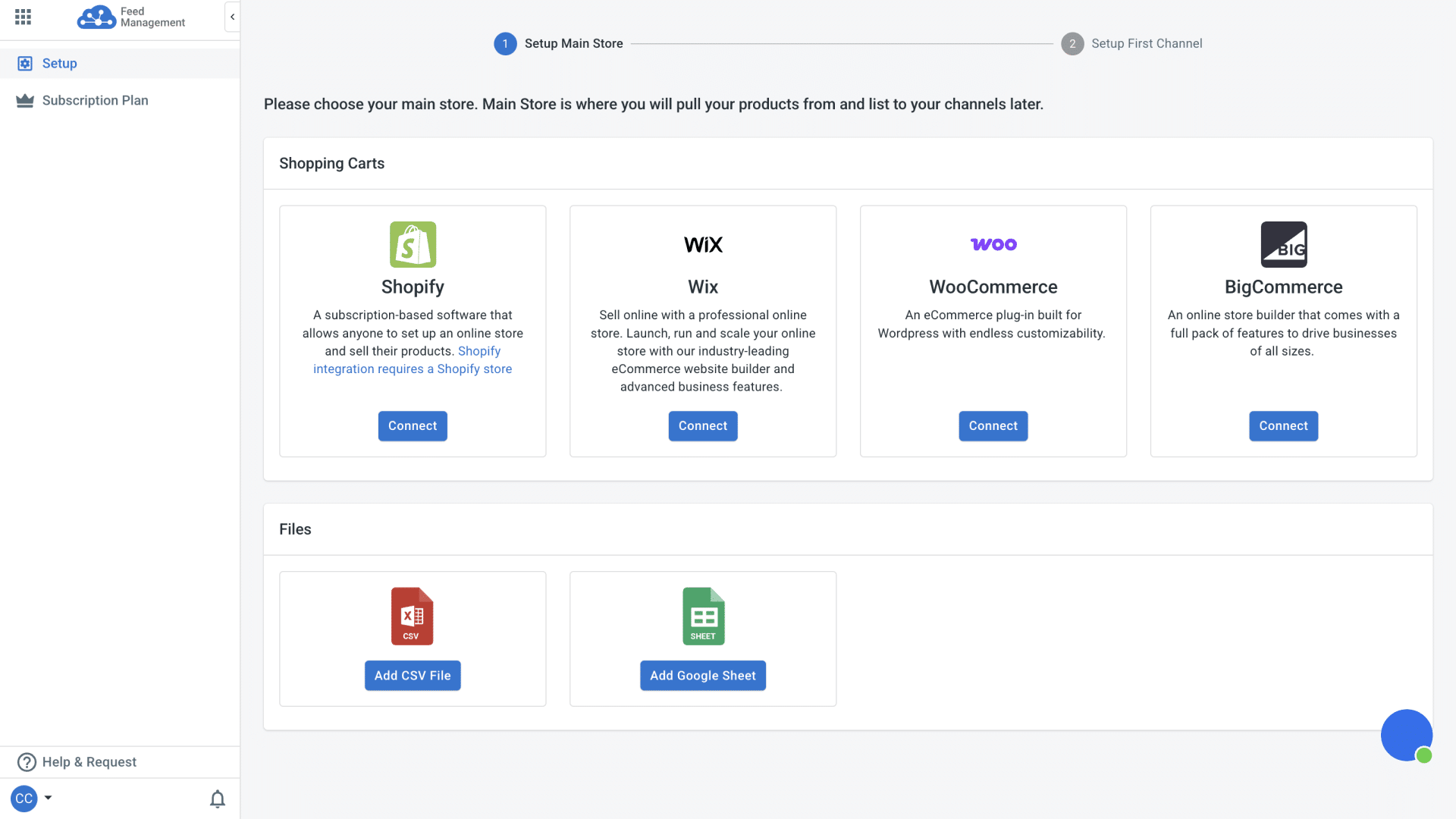
LitCommerce runs a two-step wizard: set up a Main Store, then connect your first channel. Step one requires you to nominate that Main Store from Shopify, Wix, WooCommerce or BigCommerce, or to upload a CSV file or Google Sheet. The app describes it as the place you will pull your products from and list to your channels later, and the source of truth for your product data. Sellers who already run one of those stores will find this natural. Sellers whose catalog lives on marketplaces such as eBay, Etsy or Amazon have to either nominate a store they do not use as their main one or begin from a spreadsheet.
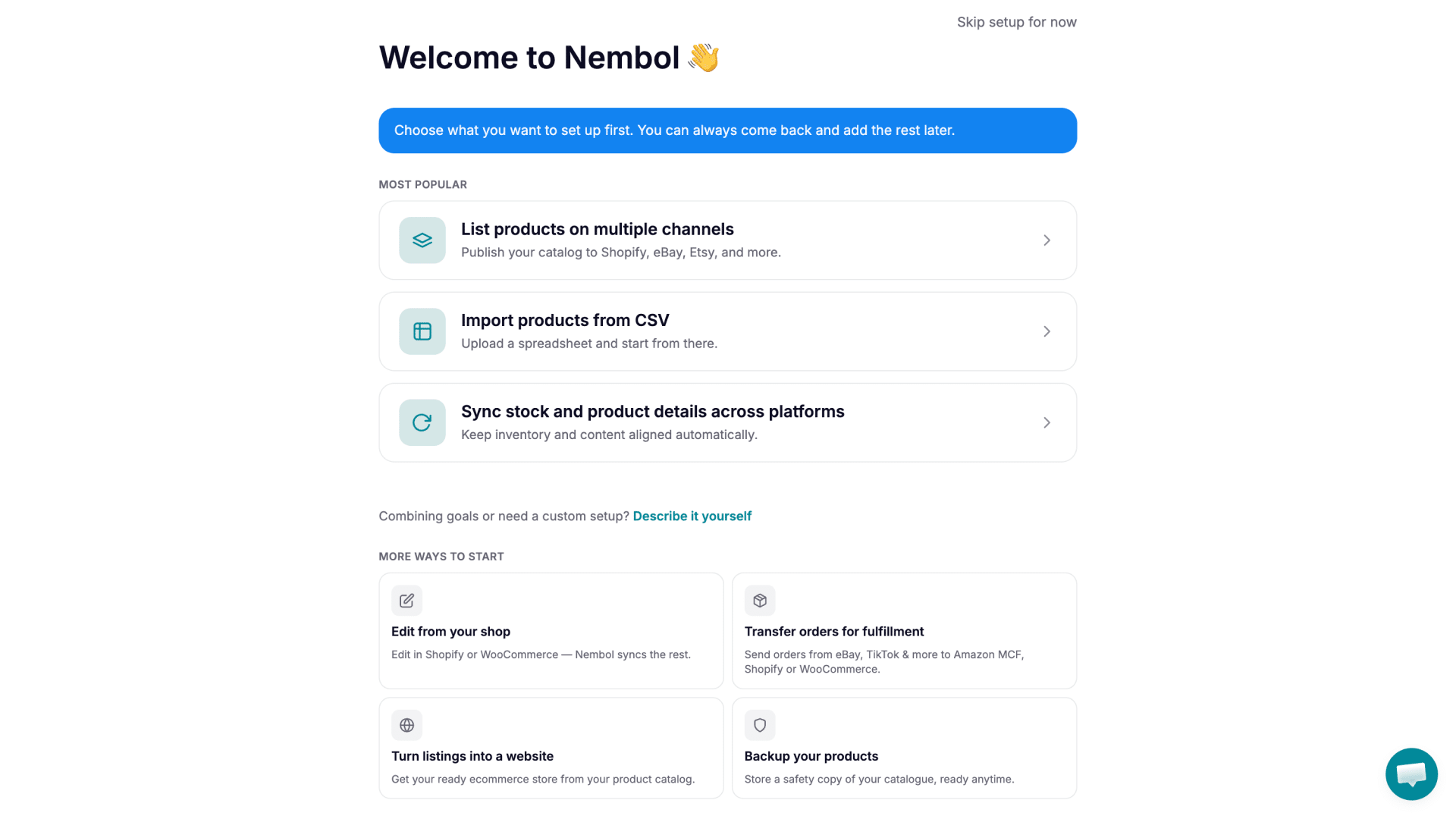
Nembol opens on a dedicated setup page and asks what you want to accomplish first, offering several preconfigured paths: listing products on multiple channels, importing a catalog from CSV, syncing stock and product details across platforms, editing from an existing shop, routing orders for fulfillment, turning listings into a website, or backing up a catalog. If none of them matches, you can describe your goal in your own words and Nembol builds a setup path around it. No channel has to be designated as the master: products can be imported from any connected channel or from CSV, and marketplace-only sellers are not asked to introduce an ecommerce platform they do not use.
Once a path is selected, Nembol guides you through it one step at a time, showing the current step, the number of steps remaining, a completion percentage, and an estimated time for each stage. Steps can be skipped and resumed later, the goal can be changed at any point, and the relevant video tutorial is linked inside the step it applies to. LitCommerce’s two-step bar indicates neither completion percentage nor expected duration.
User Interface (UI) & User Experience (UX)
LitCommerce is not one application but two, one for marketplaces and one for product feeds, switched between from a menu and each with its own navigation and its own subscription. That split is the first thing to understand about living with it: a seller who needs both is learning two products and paying for two.
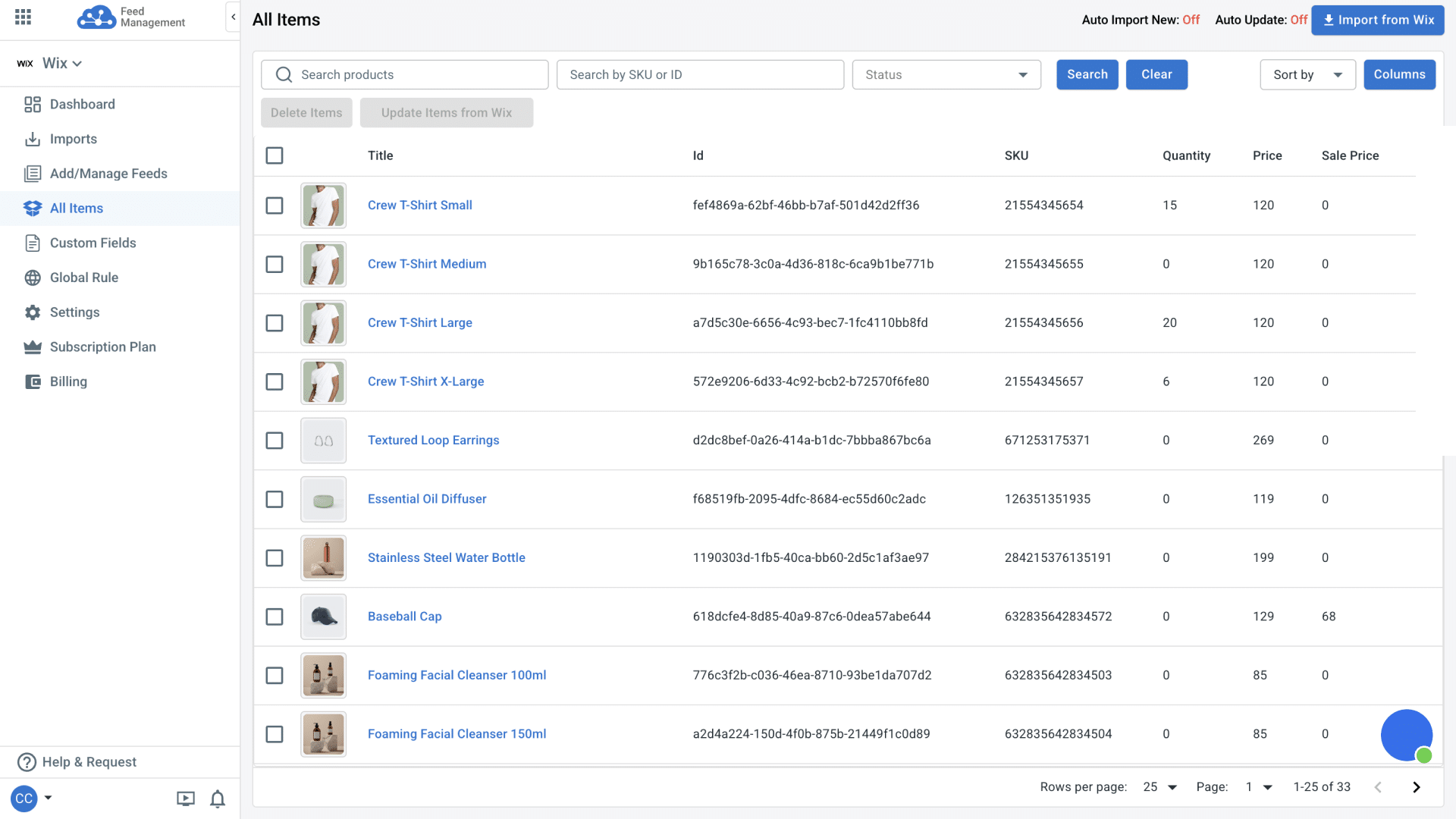
Inside either one, the screens are built for operators rather than newcomers. Tables carry a dozen columns and scroll sideways, product lists show internal system identifiers alongside the SKU, and menu names describe how the software is organized rather than what you are trying to get done. Everything you might need is on screen at once, which is efficient once you know the platform and heavy going before you do.
A good deal of it also arrives switched off. Price, inventory and order syncing each start disabled on every channel, and automatic imports and updates start disabled too, so nothing moves on its own until you have found each switch and enabled it, channel by channel, in both applications.
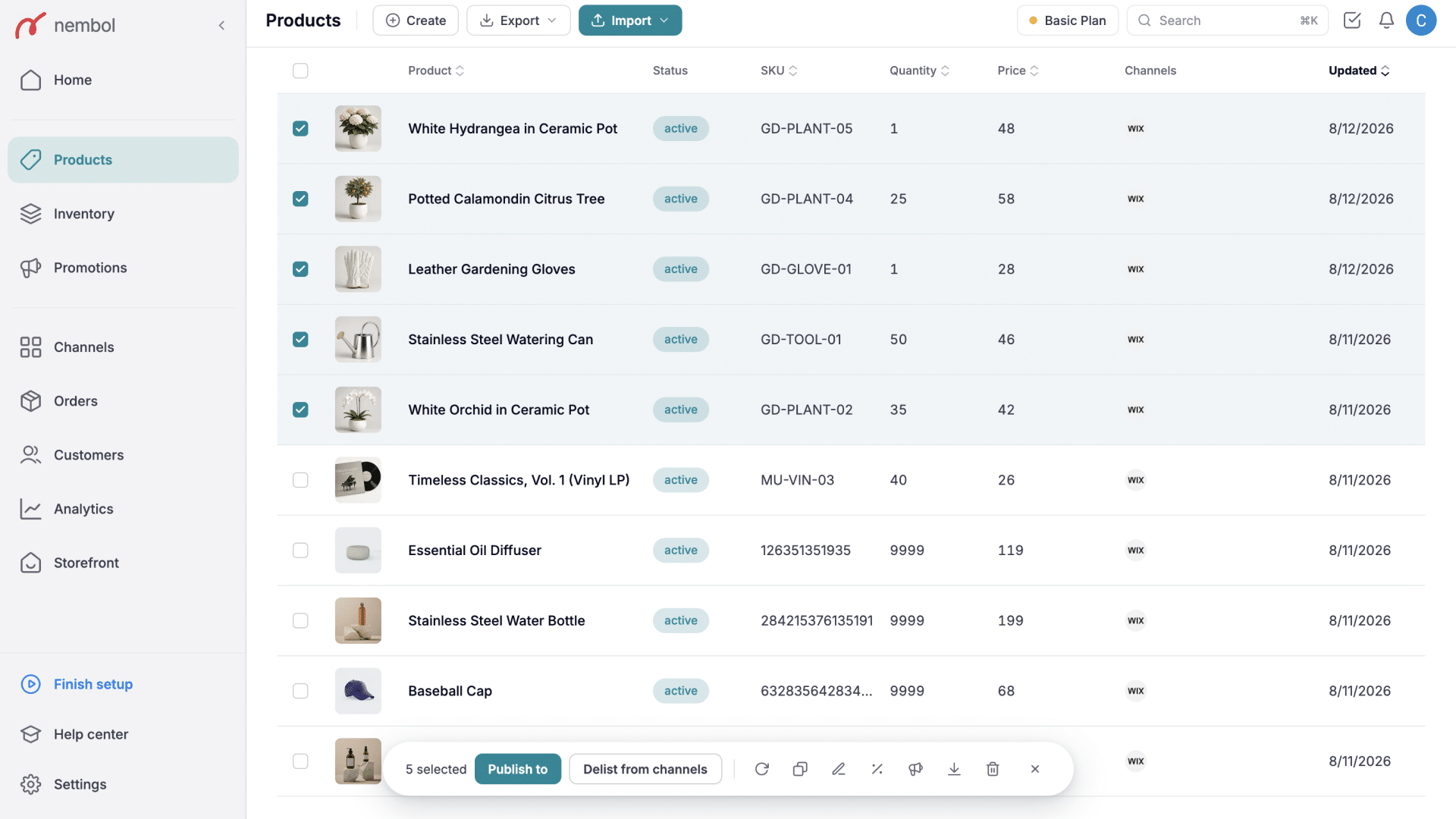
Nembol is a single application with one sidebar of plainly named sections, covering products, inventory, orders, customers, channels, promotions, analytics and its built-in Storefront, with nothing nested underneath them. Synchronisation is set once, on one screen that says in words which direction each rule runs, instead of being configured again for every channel. The effect is a platform that shows you less at any one moment and asks you to decide less before you start.
Daily work feels the same. Stock and prices are edited straight in the list, with the pending change visible before you save it, and selecting products raises a single bar to publish or delist them. The design is modern and uncluttered, built for coming back to every day rather than for showing everything it can do on the first screen.
Import Feedback & Error Handling
Most sellers begin by importing an existing catalog, so what each platform tells you about that import shapes the first hours of use.
LitCommerce places imported listings into a Drafts tab and flags the incomplete ones with a Missing Info badge, with a banner explaining that these listings are not yet published and that required fields must be completed first. The feedback is precise, and it is per listing: the work of finding what is missing happens one product at a time.
Nembol reports import results per channel and in real time, showing how many products were imported, how many were linked to existing items, and how many failed for each connected source. Failed rows can be downloaded as a file, corrected in bulk, and re-imported without leaving the setup flow.
Customer Support
Nembol provides assistance inside the app. An AI assistant trained on Nembol’s own product documentation answers questions at any hour, including outside business hours and at weekends, and the Nembol team takes over the same conversation during CET business hours, with no separate ticket to open. These are complemented by a full Help Center and a library of video tutorials, with the relevant video linked inside the setup step it applies to.
LitCommerce provides an in-app chat widget and a Help & Request center reachable from every screen in both of its applications.
Bottomline
LitCommerce is built around a main store as the source of truth, split across two applications, with synchronization controlled channel by channel. For a seller who already runs a Shopify, Wix, WooCommerce or BigCommerce store and wants granular control over what syncs where, that structure is an advantage.
Nembol is built around reaching a working setup quickly, in one application, without requiring any channel to be the master. It adapts onboarding to your goal rather than applying one sequence to everyone, tells you how far along you are and how much is left, configures sync once with the direction stated plainly, makes import errors fixable in bulk, and keeps help available in the app at the moment you need it. For sellers whose catalog spans marketplaces and social channels, and who want to be listing within their first session, Nembol is the more practical choice.
Feature-by-Feature Comparison
Data gathered from each product’s public website and documentation as of August 2026.
| Feature | Nembol | LitCommerce |
|---|---|---|
| Listing & Catalog | ||
| Bulk product listing | ||
| Variation / multi-SKU support | ||
| Variant images | ||
| Connect existing listings | ||
| Listing templates | ||
| Product catalog management | ||
| AI title optimization | ||
| AI description optimization | ||
| Inventory & Sync | ||
| Real-time inventory sync | 15 min | |
| Bidirectional synchronization | Supported channels | |
| Inventory rules | ||
| Promotions | ||
| Orders & Fulfillment | ||
| Centralized order management | ||
| Order transfer to fulfillment | Supported channels | |
| Tracking number management | ||
| Shipping systems integration | ShipStation; Shippo coming soon | |
| Channel Coverage | ||
| Amazon | ✓ | ✓ |
| eBay | ✓ | ✓ |
| Etsy | ✓ | ✓ |
| TikTok Shop | ✓ | ✓ |
| Google Merchant Center | ✓ | ✓ |
| Meta Commerce | ✓ | ✓ |
| Wix | ✓ | ✓ |
| WooCommerce | ✓ | ✓ |
| Shopify | ✓ | ✓ |
| Squarespace | ✓ | ✓ |
| Square | ✓ | ✓ |
| PrestaShop | ✓ | ✕ |
| ✓ | ✕ | |
| Tumblr | ✓ | ✕ |
| OnBuy | ✓ | ✕ |
| Subito.it | ✓ | ✕ |
| Temu | Coming soon | ✓ |
| Walmart | ✕ | ✓ |
| Reverb | ✕ | ✓ |
| Shopee | ✕ | ✓ |
| Faire | ✕ | ✓ |
| BigCommerce | ✕ | ✓ |
| Additional Features | ||
| Nembol Storefront | ||
| Social media auto-posting | ||
| Multi-account per channel | ||
| Free trial | 14 days | 7 days |
| Customer support | ||
| API access | After approval | |
Pricing comparison
The two platforms use different pricing approaches. Nembol pricing is based on the number of products in your catalog, while LitCommerce pricing depends on listings, connected channels, and plan limits. Both platforms include unlimited orders, but they scale differently: Nembol is designed for predictable growth based on catalog size, while LitCommerce is built around expanding into more marketplaces.
Nembol pricing (by product count, unlimited orders)
| Plan | Products | Seats | Accounts / Channel | Key Features Included | Price / Month |
|---|---|---|---|---|---|
| Basic | 200 | 1 | 1 | Inventory sync, Easy Website, Social Posting | $39 |
| Pro | 2,000 | 1 | 2 | Nembol Link + Transfer Orders | $49 |
| Enterprise | 5,000 | 2 | 4 | Attributes Manager | $79 |
| Enterprise+ | 15,000 | 5 | 10 | Nembol Checkup + AI Title & Description + API access | $129 |
All plans include unlimited listings, orders, and variants. Annual billing saves 25%. The Idle Plan (catalog backup only, no active sync) is available at $9.99/mo.
LitCommerce pricing (by product listings and connected channels)
LitCommerce follows a flexible “Pay As You Go” pricing model starting at $29/month for its multichannel listing solution. Pricing scales based on the number of product listings and connected channels, ranging from entry-level plans with around 1,000 listings and 3 integrated channels up to higher-tier plans reaching $489/month for larger catalogs and broader channel coverage.
All multichannel listing plans include unlimited orders, inventory and price synchronization, and no commission fees. Sync frequency runs on a 15-minute cycle, with access to features such as bulk editing, listing templates, automated publishing, and marketplace management tools.
In addition to its multichannel listing plans, LitCommerce offers a separate Product Feed Management solution for distributing product data to advertising channels such as Google Shopping. This package ranges from a free plan up to $139/month depending on feed requirements and scale.
LitCommerce also provides a 7-day free trial with access to the platform’s features. Unlike Nembol’s trial, a credit card is required to start the trial.
Which pricing model works better for you?
The right pricing model depends on what you need from your multichannel platform. Nembol’s product-based pricing is designed around catalog size, making costs more predictable as order volumes increase. This can be particularly valuable for established sellers that process a high number of orders or are scaling their business across multiple channels.
LitCommerce’s pricing model is more closely tied to the number of listings and connected channels. This can work well for sellers who need access to a wide selection of marketplaces and want to scale their channel coverage as their business expands. However, businesses managing larger catalogs across multiple channels may need to move to higher plans as their listing and integration requirements grow.
For businesses looking beyond marketplace listing alone, Nembol also provides additional value through its broader commerce ecosystem. Storefront, bidirectional synchronization on supported channels, catalog management, social commerce, promotions, and customer management allow sellers to manage more of their sales operation from one platform rather than relying on separate tools.
As a result, Nembol can be particularly attractive for businesses that want predictable costs and a platform capable of supporting both marketplace expansion and direct-to-consumer growth.
Strengths and Weaknesses
Nembol: Strengths
- Unlimited orders and no commission fees on every plan, with pricing based on catalog size rather than sales volume
- Bidirectional synchronization that allows sellers to keep product data aligned across connected channels
- Advanced catalog management tools designed for businesses managing products across multiple marketplaces and stores
- Nembol Checkup for identifying product data quality issues and improving catalog accuracy
- Nembol Link for connecting existing marketplace listings and keeping them synchronized
- Built-in Storefront that allows merchants to create a branded online store using products already managed in their central catalog, with control over design, payments, shipping, promotions, and branding
- Amazon Multi-Channel Fulfillment (MCF) integration, allowing orders from supported sales channels to be transferred to Amazon for fulfillment
- Social commerce support across Facebook, Instagram, Pinterest, and Tumblr
- Automated pricing rules for managing channel-specific price adjustments
- Catalog backup through the Idle Plan ($9.99/mo), helping protect product data
- Multi-account support for businesses managing multiple marketplace accounts
- Support for European marketplaces and channels such as PrestaShop, OnBuy, and Subito.it
- Customer support available across all plans
Nembol: Weaknesses
- No native shipping label platform such as ShipStation
- No multi-warehouse inventory management
- No Walmart, Faire, Temu, Reverb, or Shopee integrations.
LitCommerce: Strengths
- Broad marketplace coverage, including Walmart, Faire, Temu, Reverb, Shopee, and other channels not currently supported by Nembol
- Marketplace-focused workflows designed for sellers expanding across multiple sales channels
- Dedicated tools for eBay and Etsy sellers, including listing templates, bulk editing, and AI-assisted listing optimization
- ShipStation integration for shipping and fulfillment workflows
- Product Feed Management solution for distributing product data to advertising channels such as Google Shopping
- Supported BigCommerce, and additional marketplace integrations.
LitCommerce: Weaknesses
- No built-in branded Storefront for creating an independent sales channel from the central catalog
- No Amazon MCF integration for transferring orders from connected sales channels to Amazon for fulfillment
- No bidirectional synchronization for pulling all marketplace edits back into the central catalog
- Limited social commerce capabilities compared with Nembol, with Facebook as the main supported social channel
- No catalog backup or product data quality monitoring tools
- Advanced marketplace coverage can make the platform more complex for sellers who mainly need a centralized catalog management solution
- Only a 7-day free trial is available.
Nembol vs LitCommerce: which platform is right for your business?
The right platform ultimately depends on how you plan to grow your multichannel business. LitCommerce is a strong option for sellers whose main priority is expanding across a wide range of marketplaces, particularly if channels such as Walmart, Faire, Reverb or Shopee are essential to their strategy.
Nembol is better suited to businesses looking for a broader and more centralized approach to multichannel commerce. Beyond connecting marketplaces, Nembol brings ecommerce platforms, social commerce, promotions, fulfillment through Amazon MCF, catalog management, and a branded Storefront into one ecosystem. This gives merchants greater control over their products, sales channels, and customer experience as their business grows.
For sellers who want more than simply listing products on additional marketplaces — and are looking to build a scalable multichannel operation with greater control over their catalog and direct sales — Nembol provides a more complete foundation for long-term growth.
Frequently Asked Questions
Is Nembol better than LitCommerce for multichannel selling?
Nembol is a strong choice for businesses seeking broader multichannel management, with centralized catalog control, bidirectional sync on supported channels, promotions, social commerce, Amazon MCF, and a branded Storefront.
What is the best LitCommerce alternative for managing inventory across multiple channels?
Nembol is a strong LitCommerce alternative for centralized inventory management. It synchronizes inventory across supported marketplaces, ecommerce platforms, and social channels while keeping products and orders managed from one dashboard.
What is the difference between Nembol and LitCommerce?
Nembol focuses on broader multichannel commerce, combining marketplaces, ecommerce, social selling, fulfillment, and Storefront. LitCommerce is more marketplace-focused, with wider coverage of channels such as Walmart, Faire, Reverb and Shopee.
Do I need a Shopify or WooCommerce store to use LitCommerce?
Effectively yes, or a spreadsheet. LitCommerce’s setup begins by asking you to nominate a Main Store, chosen from Shopify, Wix, WooCommerce or BigCommerce, or uploaded as a CSV file or Google Sheet, and the app treats that store as the source of truth for your product data. Sellers whose catalog lives on marketplaces such as eBay, Etsy or Amazon therefore have to designate a store they may not otherwise use, or begin from a file. Nembol does not require a main store: products can be imported from any connected channel or from CSV, and no channel has to be designated as the master.
Does inventory sync automatically in LitCommerce?
Not until you switch it on, channel by channel. Each connected channel in LitCommerce opens with Price Sync, Inventory Sync and Order Sync set to Off, and each has to be enabled individually for that channel. That gives precise control over what syncs where, and it also means nothing moves until every channel has been configured. Nembol configures synchronization once, under Channels in a Common settings screen that states the direction of each rule: stock flows from channels into Nembol when an order is received or stock is edited, and content updates flow from Nembol out to channels.
Which marketplaces does LitCommerce support that Nembol does not?
LitCommerce supports several marketplaces Nembol does not currently integrate with, including Walmart, Faire, Temu, Reverb and Shopee. If your expansion plan depends on any of those specific marketplaces, LitCommerce covers them today and Nembol does not. Nembol’s coverage leans instead toward social commerce and European channels, including Meta Commerce, Pinterest, Tumblr, PrestaShop, OnBuy and Subito.it.
Can I build an online store with Nembol or LitCommerce?
Nembol includes one. Nembol Storefront is a branded online store built from the catalog you already manage in Nembol, with control over design, payments, shipping, promotions and branding, so sellers can run a direct sales channel alongside their marketplace listings. LitCommerce has no built-in branded storefront: it connects to existing ecommerce platforms such as Shopify, Wix, WooCommerce and BigCommerce rather than providing a store of its own.
What is the difference between LitCommerce Marketplace Integration and Feed Management?
They are two separate applications inside LitCommerce, chosen from a Switch App menu, each with its own setup flow and its own navigation. Marketplace Integration handles listing and syncing products to marketplaces and ecommerce platforms. Feed Management handles distributing product data to advertising channels such as Google Shopping. Nembol keeps both in a single application: product feeds appear alongside marketplaces, online stores and social channels on the same Connect a channel screen.
Does Nembol integrate with ShipStation?
No. Nembol has no native shipping label platform such as ShipStation and no multi-warehouse inventory management. It transfers orders to Amazon Multi-Channel Fulfillment and to ecommerce platforms including Shopify, WooCommerce, Square, Squarespace and Wix, from which shipping and fulfillment apps in those platforms’ own marketplaces can pick them up and ship them. LitCommerce integrates with ShipStation directly, which is the shorter path if you already run it.
Start your free trial with Nembol
Connect both platforms with Nembol and keep your products, inventory, and sales in sync.
14-day free trial | No credit card required