

Nembol vs Veeqo: Listing Software vs Shipping Software (2026)
Nembol and Veeqo are often shortlisted together, but today they do opposite halves of the same job. Nembol creates listings and publishes them to your channels. Veeqo, which Amazon bought in 2021, pulls in the listings you already have and handles the orders, stock and shipping labels that follow. One puts products on channels; the other takes orders off them. Veeqo recently announced a listing tool of its own for 2026, which narrows the gap on four channels and leaves it untouched everywhere else.
12 min read • Last update September 9, 2026
The quick verdict
Choose Nembol if the job is getting products onto channels and keeping them consistent there. Nembol publishes a catalog to 15+ marketplaces, ecommerce platforms and social channels, syncs stock in both directions on every plan, and includes a branded Storefront, scheduled social posting and multichannel analytics without an upgrade. It works in 150+ countries and charges no commission on anything.
Choose Veeqo if your listings already exist and the pain is downstream: orders, warehouse and shipping. Veeqo’s shipping tier is free, with pre-negotiated carrier rates, bulk label buying and up to 5% back in credits, and its inventory tier adds picking, scanners, forecasting and purchase orders. It is a US and UK product, and it is owned by Amazon.
What Is Nembol?
Nembol is a multichannel listing and inventory platform founded in 2014 in San Francisco, now used by more than 40,000 sellers across 150+ countries. Its purpose is narrow and deep: get a catalog onto more channels, and keep it honest once it is there.
It reaches 15+ channels — Amazon, eBay, Etsy, TikTok Shop, Kaufland, OnBuy and Subito.it on marketplaces; Shopify, WooCommerce, PrestaShop, Squarespace, Square and Wix on ecommerce; Google Merchant Center, Facebook Page and Shop, Instagram, Pinterest and Tumblr on advertising and social. Temu and Faire are coming soon.
The working pattern is import once, publish outward in bulk, then let stock, prices and content move in both directions in real time on Nembol’s servers, with bidirectional sync available on supported channels. Around that sit per-channel pricing rules, timed promotions, multichannel analytics, variant images support, scheduled social posting, a branded Storefront that turns the catalog into a shop of your own, a unified customer list, order transfer for fulfillment including Amazon MCF, and up to ten accounts on a single channel. AI title and description generation and API access sit on the top plan.
Plans run $39, $49, $79 and $129 a month by product count, each with unlimited listings, orders and variants, access to every channel, and no commission of any kind. Fourteen days free, no card.
What Is Veeqo?
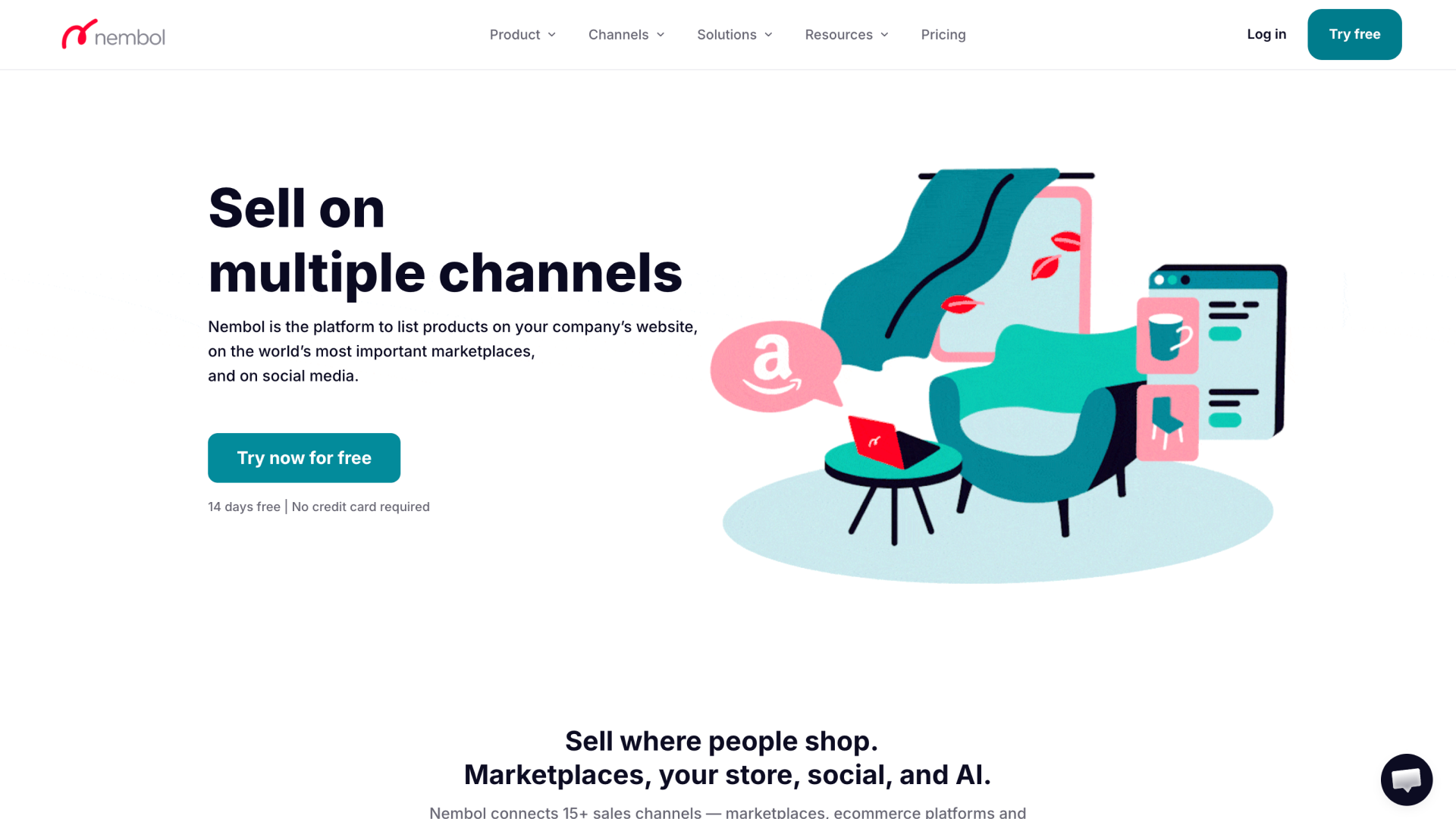
Veeqo is Amazon’s free shipping software — founded in the UK by an ecommerce seller in 2013, bought by Amazon in 2021, and entirely candid about both facts.
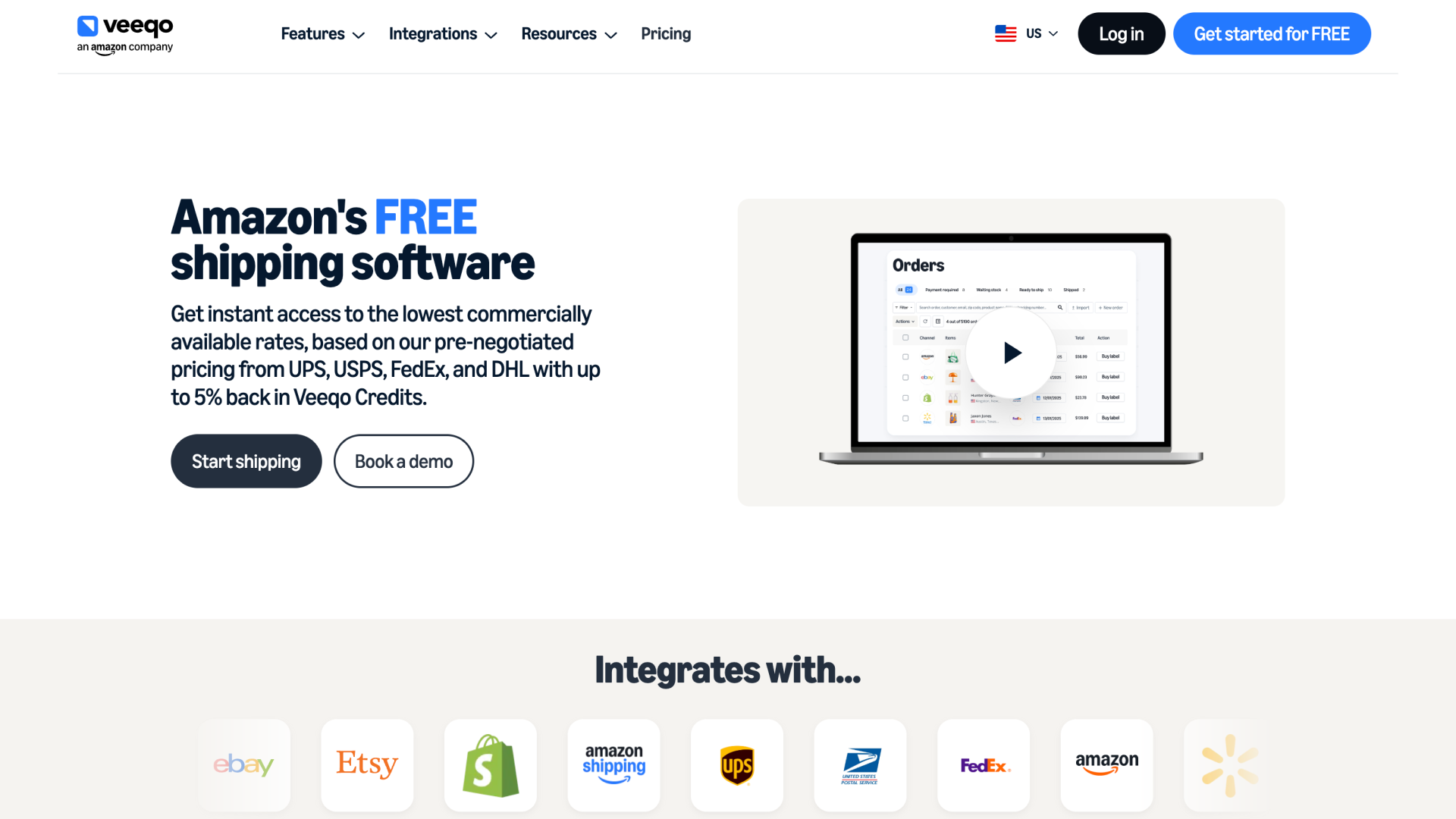
They are focused on shipping. Orders arrive from Amazon, eBay, Etsy, Shopify, Walmart, WooCommerce, TikTok Shop, Wix, Magento, BigCommerce and more; Veeqo shops live rates at what it calls “the lowest commercially available rates”, and you can buy a hundred labels in one click.
Surrounding that: digital picking with optimized paths, a barcode scanner, real-time stock sync, reorder points, demand forecasting, purchase orders and supplier management, multi-warehouse stock, a Profit Analyzer and sales reporting. Users, products and warehouse locations are unlimited on every plan, free tier included.
The economics are the genuinely interesting part. Shipping is free in the plain sense — no card, no order cap — because, as Veeqo says, “Carriers pay us a small commission on each label you buy.” Inventory management starts at $19 a month and a High Volume tier with ERP integrations at $350, both metered by monthly order volume, with FBA and MCF orders excluded from the count. US sellers earn up to 5% back in Veeqo Credits.
Two boundaries define it. It does not create listings yet. And it is a US and UK product — Veeqo’s about page says so directly — which means a seller anywhere else gets the thin half of it.
Supported sales channels
Both tools connect to channels, but they are shopping for different things. Veeqo wants channels that send orders. Nembol wants channels that accept listings. That explains why the lists overlap on the household names and part company immediately after.
Nembol’s channels
– Amazon
– eBay
– Etsy
– TikTok Shop
– Kaufland
– OnBuy
– Subito.it
– Shopify
– WooCommerce
– PrestaShop
– Squarespace
– Square
– Wix
– Google Merchant Center
– Facebook Page / Facebook Shop
– Instagram
– Pinterest
– Tumblr
– Nembol Storefront (its own branded shop, on every plan)
Temu and Faire are published as coming soon. Carriers: none, but they do offer transfer orders for fulfillment feature. Which is a solid alternative.
Veeqo’s channels
– Amazon
– eBay
– Etsy
– Walmart
– TikTok Shop
– Shein
– Temu
– AliExpress
– Shopify / Shopify Plus
– WooCommerce
– Magento
– BigCommerce
– Wix
Wayfair, Squarespace, Faire, Alibaba, Mirakl, Best Buy and Newegg are listed as coming soon; Netsuite, Sellercloud and Rithum cover ERP and OMS. On carriers — Veeqo connects UPS, USPS, FedEx, DHL Express, Amazon Shipping and OnTrac in the US, and Royal Mail, DPD, Evri, DHL, UPS, FedEx and Amazon Shipping in the UK, plus Amazon MCF.
Onboarding & Overall Experience
Onboarding
Veeqo’s setup is a reconciliation exercise, not a publishing one. You connect your stores, Veeqo pulls in the listings you already have, and then the real work starts: every listing has to be linked to a Veeqo product before anything syncs. Veeqo is explicit about this in its own documentation — listings must be linked to a product so it can “pull in your orders and maintain accurate stock levels”. An unlinked listing is inert.
The matching is partly automated. Where Veeqo finds the same SKU on both sides it proposes a link and you approve it with a green tick or dismiss it with a red cross, and a Link Matched button bulk-approves the SKU matches in one go. Everything else is manual: each unmatched row carries a “Search Veeqo for matching product” box, and you find the right product yourself. If your SKUs are clean this is quick. If they are not — and the sellers most likely to need a tool like this are the ones whose SKUs are not — this is the afternoon.
After that come warehouses and carriers. Carriers are worth reading carefully: Veeqo ships with pre-negotiated rates from UPS, USPS, FedEx, DHL and Amazon Shipping, and those rates are the main reason to use it. If you connect your own carrier accounts instead, Veeqo warns that you “no longer see Veeqo rates for your orders”. Carrier accounts also two-way sync with Amazon Seller Central, so removing one in Veeqo removes it from Seller Central as well.
Nembol’s setup runs the other way. You connect channels through their official APIs, import a catalog from a marketplace, a shop or a CSV, and publish outward to channels you are not on yet. Matching by SKU exists here too, for linking listings you already have, but it is a step on the way rather than the whole job — because the point of the tool is to create listings, not to account for them. Fourteen days, every feature, no credit card, and free onboarding calls on every plan.
Customer Support
Veeqo runs a detailed public help center, organized by task and by channel, and it is genuinely good — most of what is described above is documented there openly, including the caveats about carrier rates. Support is available on the free tier as well as the paid plans. Nembol includes free onboarding calls on every plan, which is a different kind of help: a person walking through your catalog rather than an article about a screen.
Bottomline
Veeqo asks more of you at the start than its free price suggests, because the linking has to be done before any of it works. What you get for that effort is accurate stock across channels and the best shipping rates on this comparison. Nembol asks you to connect channels and publish, and gives you listings where you had none. Neither interface will be the reason you choose: the reason is whether your problem is that your listings are not reconciled, or that they do not exist yet.
Feature-by-Feature Comparison
Verified against each vendor’s public website and help documentation in September 2026. Where a vendor does not publish an answer, the table says so rather than guessing.
| Feature | Nembol | Veeqo |
|---|---|---|
| Creating and publishing listings | ||
| Create a listing and publish it | ✓ 15+ channels | ✕ announced for 2026, 4 channels |
| Bulk publishing across channels | ✓ | ✕ |
| Edits pushed back out to channels | ✓ | ✕ |
| Link and map existing listings | ✓ | ✓ |
| AI title and description generation | ✓ Enterprise+ | ✕ |
| Catalog checkup for missing or inconsistent data | ✓ Enterprise and above | ✕ |
| Images per variant | ✓ | ✓ |
| CSV import / export | ✓ | ✓ |
| Product bundles and kits | ✕ | ✓ |
| Inventory and stock accuracy | ||
| Two-way stock sync | ✓ every plan | ✓ Inventory tier and above |
| Multi-warehouse, location-aware stock | ✕ | ✓ |
| Reorder points and stock automation | ✕ | ✓ |
| Demand forecasting | ✕ | ✓ |
| Multiple accounts per channel | ✓ 1 / 2 / 4 / 10 by plan | Not published |
| Order fulfillment and shipping | ||
| Buy and print carrier labels | ✕ | ✓ |
| Compare live carrier rates | ✕ | ✓ |
| Bulk label buying | ✕ | ✓ 100 at once |
| Digital picking and pick lists | ✕ | ✓ |
| Barcode scanner | ✕ | ✓ |
| Purchase orders and supplier management | ✕ | ✓ |
| Order transfer for fulfillment | ✓ Pro and above, incl. Amazon MCF | ✓ 3PL and Amazon MCF |
| Selling and merchandising | ||
| Built-in storefront | ✓ every plan | ✕ |
| Advertising and social channels | ✓ | ✕ |
| Scheduled social posting | ✓ | ✕ |
| Per-channel pricing rules | ✓ | ✕ |
| Timed promotions | ✓ | ✕ |
| Customer list across channels | ✓ | ✕ |
| Multichannel analytics | ✓ every plan | ✓ incl. Profit Analyzer, free tier |
| Commercial terms | ||
| Commission or transaction fees | None | Carriers pay Veeqo per label |
| Availability | 150+ countries | US and UK |
| API access | ✓ Enterprise+ | ✓ rate shopping free; full API on High Volume |
Pricing comparison
Both companies publish their prices, which makes this unusually easy to compare — as long as you read what each price actually buys.
Nembol plans
| Plan | Products | Seats | Accounts / Channel | Key Features Included | Price / Month |
|---|---|---|---|---|---|
| Basic | 200 | 1 | 1 | Inventory sync, Storefront (1 theme), CSV import and export, customers list | $39 |
| Pro | 2,000 | 1 | 2 | Everything in Basic, plus Nembol Link, order transfer for fulfillment, 3 storefront themes, unlimited timed promotions | $49 |
| Enterprise | 5,000 | 2 | 4 | Everything in Pro, plus attributes and product specs, AI title generator, catalog checkup, CSV light edit, all storefront themes | $79 |
| Enterprise+ | 15,000 | 5 | 10 | Everything in Enterprise, plus AI description generator and API access; extra 5,000-product slots at $40 each | $129 |
Annual billing saves 25%. Every plan includes unlimited orders, every channel and 0% commission. The trial runs 14 days with full features and no credit card.
Veeqo plans
| Plan | What it covers | Price / Month |
|---|---|---|
| Shipping | Order management, live carrier rate comparison, bulk label buying, unlimited orders per month | Free |
| Inventory | Everything in Shipping, plus inventory management and digital picking. Priced by monthly order volume | From $19 |
| High Volume | Everything above, plus ERP integrations and priority support, API consulting. Priced by monthly order volume | From $350 |
What “free” actually means
Veeqo’s free tier is real, not a trap. There is no card at sign-up and no order cap on the shipping plan. But it is worth understanding where the money comes from: carriers pay Veeqo a commission on every label bought through it. The software is free because the shipping is not, and the tool has a structural interest in you buying labels through it rather than elsewhere. For most sellers that is a fair trade, particularly with negotiated rates and up to 5% back in credits. It is simply not the same thing as a product with no revenue attached.
The comparison that matters is not $0 against $39. It is that Veeqo’s free tier does not do the job Nembol does at any price, and Nembol does not do Veeqo’s job at any price. A seller who needs listings published pays $39 a month for Nembol whether or not Veeqo is free. A seller who needs labels bought uses Veeqo whether or not they pay Nembol.
Where the two genuinely overlap is inventory sync, and there Veeqo’s $19 tier undercuts Nembol’s $39. If stock sync across Amazon, eBay, Shopify and Walmart is the entire requirement, and you are in the US or UK, and every listing already exists, Veeqo is cheaper. But if you need listing creation, social channels, a storefront, or a country outside those two markets — Veeqo stops being an option at all.
Strengths and Weaknesses
Nembol: Strengths
– Storefront on every plan — a full branded shop built from your catalog, with six themes, your own domain, Stripe or PayPal checkout and no Nembol transaction fee. It supplies the product pages Google Merchant Center requires and the structured data AI shopping assistants read, opening Google Shopping to sellers with no website of their own.
– Creates and publishes listings, in bulk, across 15+ channels.
– Pushes content edits back out to every connected channel.
– Advertising and social channels — Google Merchant Center, Meta, Instagram, Pinterest, Tumblr — with scheduled posting.
– Per-channel pricing rules and timed promotions.
– A unified customer list across every channel.
– Catalog Checkup, flagging missing or inconsistent product data before a marketplace rejects it.
– AI title and description generation.
– API access and webhooks, to drive the catalog, stock and orders from your own ERP, WMS or custom software.
– Kaufland, OnBuy, Subito.it, Square and PrestaShop alongside the major marketplaces.
– Two-way stock sync included from the entry plan, running server-side.
– Up to ten accounts on the same channel.
– Available in 150+ countries, with 0% commission and a 14-day trial with no card.
Nembol: Weaknesses
– No shipping: no carrier rates, labels, pick lists or scanners.
– No multi-warehouse stock, reorder points, purchase orders or demand forecasting.
– No inventory kits that draw down component stock.
– No Walmart, Shein, Temu, AliExpress, Magento or BigCommerce.
– AI generation and API access only on the $129 plan.
– Published plans run to 15,000 products, extended beyond that with 5,000 product slots at $40, and discounted slots on a growth plan at scale.
– No free tier; entry is $39 a month.
Veeqo: Strengths
– A genuinely strong free shipping desk: pre-negotiated rates, hundred-label batches, up to 5% back in credits.
– Deep warehouse stack — picking paths, scanner, multi-warehouse stock, reorder points, forecasting, purchase orders.
– Unlimited users, SKUs and warehouse locations on every plan, free tier included.
– Wide order-side channel list including Walmart, plus Netsuite, Sellercloud and Rithum for ERP.
– FBA and MCF orders excluded from billing; states it does not share your data with other Amazon units.
– Profit Analyzer and multichannel reporting from the free tier.
Veeqo: Weaknesses
– Cannot create a listing today; the announced tool reaches four channels.
– US and UK only, which excludes most of the world before any feature is considered.
– No storefront or website, so a seller without a site is left where they started.
– No advertising or social channels, no per-channel pricing rules, no promotions, no customer list.
– No Square, PrestaShop, OnBuy, Subito.it or Kaufland; Squarespace only announced.
– Stock sync sits behind the paid Inventory tier, where Nembol includes it at entry.
– The economics depend on your postage going through it.
– Your order and inventory data sits with a company that also runs your largest marketplace.
So which one solves your problem?
Veeqo is the better product at the thing it does, and that thing begins after a customer has already found you, chosen an item and paid for it. For a US or UK seller drowning in packing, that is worth more than any listing tool. But it is downstream work: it assumes your products are already on the right channels, correctly priced, described, in stock and findable. Nembol handles that upstream work across 150+ countries, through a subscription rather than shipping volume.
Storefront makes the difference even clearer. Nembol turns your existing catalog into a complete branded shop, with product pages, cart, checkout, your own domain, Stripe or PayPal, shipping rules, discounts, bundles and analytics, with no transaction fees. It is included from the $39 plan. Instead of renting an audience from a marketplace, you own the storefront, customer list and checkout.
It also gives marketplace-first sellers a path to Google. Nembol can connect the Storefront to Google Merchant Center, providing the landing pages and product data needed for Google Shopping, while making the catalog ready for SEO and AI-driven discovery. Veeqo has nothing comparable in this direction.
That is the honest summary of the comparison:
Veeqo helps you ship the orders you already have.
Nembol helps you get more of them.
Running both: how it actually works
For a US or UK seller who lists actively and ships in volume, this is the sensible configuration, and it is cheap: $39 for Nembol plus whatever Veeqo’s inventory tier costs at your order count, with the free shipping tier if stock sync stays in Nembol.
The division of labour is clean because the products barely overlap. Nembol creates products, publishes them across every channel, and holds prices, content and promotions in line. Orders land on those channels. Veeqo pulls the orders in, picks and packs them, shops the rates and buys the labels.
The two connect through your store backend, and that is the part worth understanding. Nembol transfers orders from Amazon, eBay, Etsy and TikTok Shop into Shopify, WooCommerce, Wix, Squarespace, Square or Amazon MCF. Veeqo already reads Shopify, WooCommerce and Wix, and connects to Amazon MCF as well. So a marketplace order can be created by Nembol, dropped into your store, picked up by Veeqo and shipped on a negotiated rate. Your multichannel order routing survives the move without any direct Nembol-to-Veeqo integration existing, because the store is the meeting point.
What that leaves is one decision that matters more than the rest: which system holds authoritative stock. Run it in Nembol if listing and publishing drive your business and Veeqo is there to ship; run it in Veeqo if you have multiple warehouses, reorder points and purchase orders to respect. Do not let both write quantities to the same channels expecting them to agree.
Outside the US and UK, this pairing is not available — the shipping half simply is not offered there, while the listing half works in 150+ countries. That asymmetry is worth noting before building a workflow around a tool you cannot buy in your market.
That is the honest summary of the comparison: Veeqo helps you ship the orders you already have. Nembol helps you get more of them.
Frequently Asked Questions
Can Veeqo create and publish new listings?
Not today — it imports existing listings and lets you link, map, activate and archive them. Veeqo Listings is announced for 2026, publishing to Shopify, eBay and Walmart from an imported Amazon catalog, with ten free listings a month on Shipping and unlimited on Inventory.
Can Nembol buy shipping labels?
No. Nembol has no carrier integrations. It can hand orders to a fulfillment partner — Amazon MCF, Shopify, WooCommerce — but it does not compare rates or print labels.
Is Veeqo really free?
Yes, genuinely. The shipping plan costs nothing, has no monthly order cap, and needs no card to sign up. Veeqo explains the model openly: “Carriers pay us a small commission on each label you buy.” So the software is funded by your shipping spend rather than a subscription. Inventory management is a paid add-on from $19 a month, and a High Volume tier with ERP integrations starts at $350, both priced by monthly order volume with FBA and MCF orders excluded from the count.
Is Veeqo available outside the US and UK?
Veeqo’s shipping is built on US and UK carrier networks — UPS, USPS, FedEx and DHL in the US, and UPS, DPD Local and Evri in the UK — and the site offers US and UK selection only. Veeqo Credits are for US-based users. A seller in Germany, Australia or Canada can connect channels but gets little of what makes Veeqo worth using. Nembol works in more than 80 countries because it never touches a carrier.
Does Nembol print shipping labels?
No. Nembol has no carrier integrations, no rate comparison and no label printing, and it does not do warehouse picking, barcode scanning or bin locations. What it does have is order transfer for fulfillment: orders can be routed to Amazon MCF, Shopify, WooCommerce, Square, Squarespace or Wix, and fulfilled from there. If you need to buy postage yourself, you need a shipping tool alongside Nembol — Veeqo being one of the cheapest.
Can I use Nembol and Veeqo together?
Yes, and for an active US or UK seller it is often the sensible answer. Nembol builds and publishes listings across your channels; Veeqo picks up the resulting orders and buys the labels. The two meet in your store backend: Nembol transfers marketplace orders into Shopify, WooCommerce or Wix, and Veeqo reads those stores and ships them, so the routing works without a direct integration. What you do have to decide is which one holds authoritative stock — running both as the source of truth for inventory will cause conflicts. Most sellers let the listing tool own catalog and stock, and let Veeqo own orders and shipping.
Which channels does Nembol support that Veeqo does not?
Squarespace, Square, Wix and PrestaShop on the web platform side, OnBuy for the UK and Subito.it for Italy, plus the entire social layer: Facebook Page and Shop, Instagram, Pinterest and Tumblr, with scheduled posting rather than a feed alone. Nembol also includes its own storefront. Veeqo has no equivalent to any of these.
Which channels does Veeqo support that Nembol does not?
Walmart is the main one, and for US sellers it can be decisive — Nembol does not connect to Walmart today. Beyond that, Veeqo’s advantage is not marketplaces but carriers: UPS, USPS, FedEx and DHL in the US, and DPD Local, Evri and UPS in the UK. Nembol connects to none. Both platforms cover Amazon, eBay, Etsy, Shopify, WooCommerce and TikTok Shop.
Does Veeqo handle multi-warehouse stock and purchase orders?
Yes, and this is where it is strongest relative to its price. Veeqo offers location-aware inventory across multiple warehouses, bin locations, digital picking with optimized pick lists, barcode scanners and a mobile app, reorder points and stock automation, demand forecasting, and purchase order and supplier management. Nembol has none of these — it is not a warehouse system.
Which is better for a seller just starting out?
It depends entirely on whether your products are already listed. If you have a Shopify store and want to reach Amazon, eBay, Etsy, TikTok Shop and social, you need a listing tool: Veeqo will not put anything anywhere, and Nembol’s $39 plan covers 200 products. If your listings are already live and you are drowning in orders and postage, start with Veeqo’s free shipping tier — there is no cost and no card, so there is nothing to lose by trying it.
Try Nembol free for 14 days
No credit card required.