

What is the purpose of an Inventory Management Software
The primary purpose of an inventory management software is to ensure that product availability is accurately tracked and consistently aligned with actual stock levels.
At its core, it acts as a control system for inventory, allowing users to monitor stock movements, manage quantities, and reduce the risk of discrepancies between recorded and real inventory. This becomes particularly important in environments where products are sold across multiple channels or where inventory changes frequently.
Beyond simple stock tracking, inventory management software supports a broader set of operational needs. It helps coordinate incoming and outgoing stock, maintain visibility over product availability, and ensure that updates are reflected across systems in a timely and reliable way.
In modern ecommerce contexts, its role extends further. Inventory management is closely connected to product listings, pricing, and order management. Without a structured system in place, inconsistencies such as overselling, stockouts, or outdated product availability can quickly impact both operational efficiency and customer experience.
For this reason, inventory management software is not only about tracking stock, but about maintaining alignment between internal inventory data and external sales environments.
5 benefits of Inventory Management Software
Implementing inventory management software provides several operational advantages, particularly as product catalogs grow and sales channels multiply.
- Accurate stock control
Maintains real-time visibility over inventory levels, reducing discrepancies between recorded and actual stock. - Reduced risk of stock-outs and overselling
Helps ensure that product availability remains aligned with actual inventory, minimizing lost sales or order cancellations. - Improved operational efficiency
Automates inventory updates and reduces the need for manual adjustments across systems. - Better decision-making
Provides visibility into stock levels and product performance, supporting more informed purchasing and replenishment decisions. - Scalability across channels
Supports growing catalogs and multiple sales channels without requiring proportional increases in manual workload.
These benefits make inventory management software a foundational component for businesses and sellers aiming to maintain control over their operations while scaling distribution.
What is the most common Inventory Management Software
Inventory management software can take different forms depending on the size, complexity, and operational needs of the business. There is no single solution that fits all scenarios, as inventory requirements vary significantly between small sellers, growing ecommerce operations, and larger organizations.
Among the most widely used solutions are ERP (Enterprise Resource Planning) systems.
ERPs are designed to manage multiple business processes, including inventory, accounting, procurement, and logistics, within a single integrated environment. In this context, inventory management is part of a broader operational framework, making ERP systems particularly suitable for businesses with complex internal processes or multiple warehouses.
However, the rise of ecommerce and multichannel selling has introduced new requirements that traditional ERP systems are not always designed to handle directly. While they provide strong internal control over stock and operations, they may lack native capabilities for managing product listings, synchronizing inventory across marketplaces, or adapting product data to different external channels.
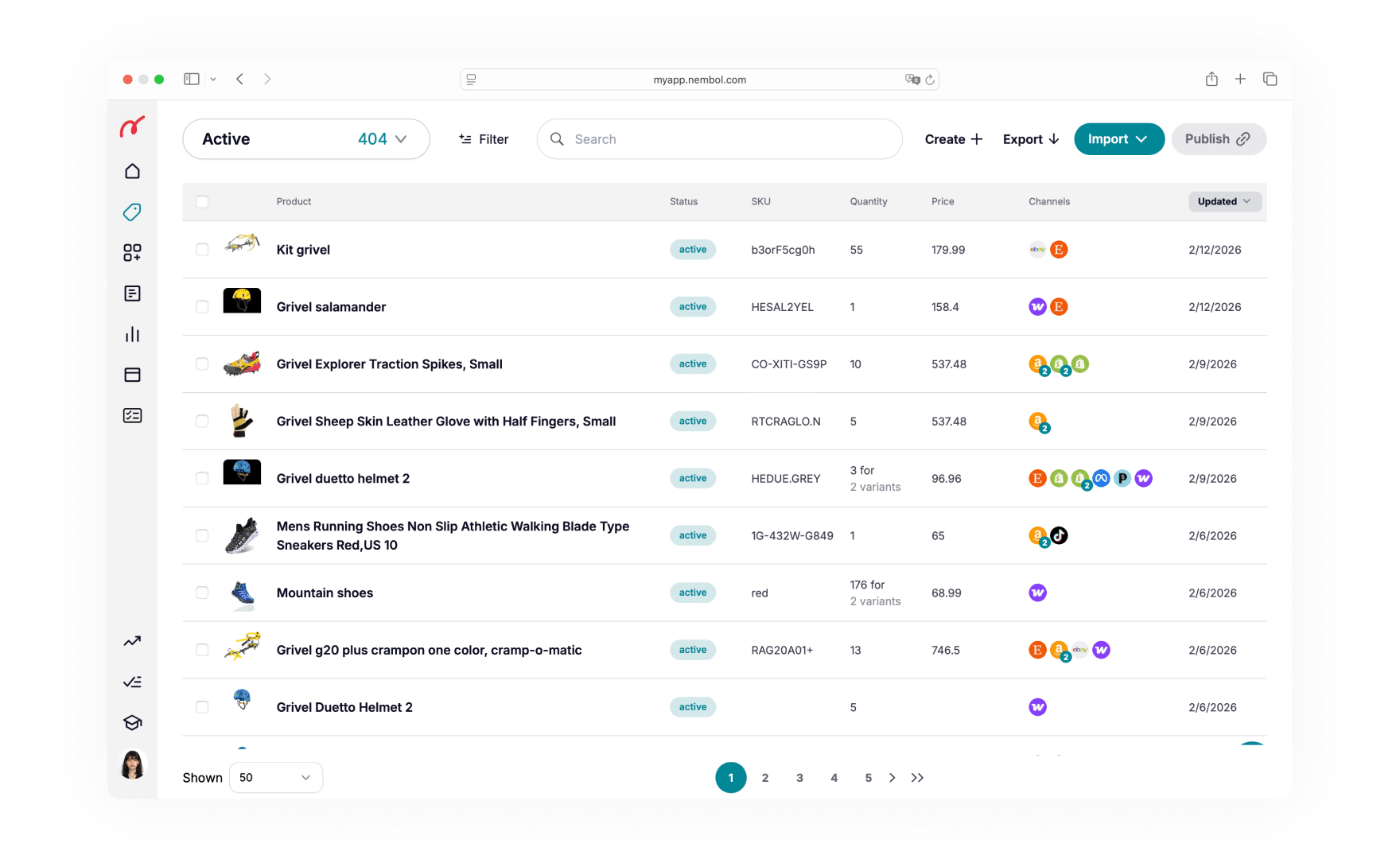
As a result, many businesses complement or extend their inventory management setup with more specialized tools. Solutions like Nembol focus specifically on connecting inventory and product data with multiple sales channels, enabling synchronization across marketplaces and ecommerce platforms.
In this model, inventory management is no longer limited to internal tracking. It becomes part of a broader multichannel workflow, where stock levels, product data, and listings are continuously aligned across all active sales channels.
As ecommerce operations expand, inventory management shifts beyond internal processes toward a structure that also supports external sales channels. ERP or legacy systems typically remain the operational core, while additional layers are introduced to extend product data across ecommerce environments.

From ERP to Multichannel
This creates a more connected setup where inventory and product information can move beyond internal use and be consistently aligned across multiple channels.
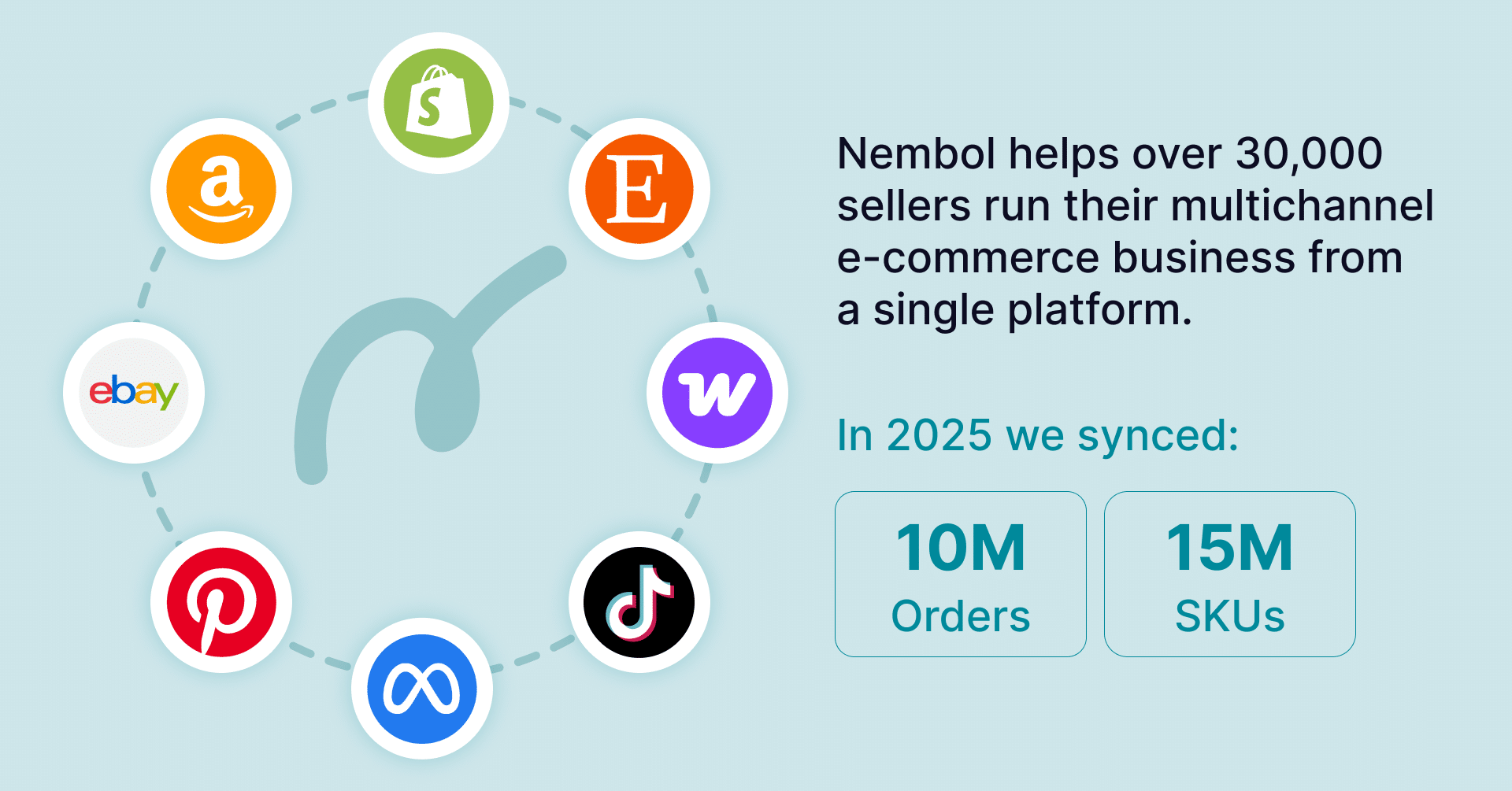
In this context, Nembol supports this transition by linking existing inventory systems with multiple sales channels like Amazon, eBay, Shopify, WooCommerce, and TikTok, enabling centralized product management and consistent distribution across ecommerce and marketplace ecosystems.
For a more detailed explanation of how this structure is built in practice, including the role of ERP, legacy tools, and multichannel ecommerce workflows, you can watch the full video here.
How Nembol works as a multichannel inventory management solution
As ecommerce operations expand across multiple sales channels, inventory management requires more than internal stock tracking. It becomes a continuous process of aligning product data, availability, and pricing across marketplaces, ecommerce platforms, and social commerce channels.
In this context, Nembol operates as a system that connects inventory data with external channels, allowing product information to be managed in one place and consistently reflected across all sales environments.

Real-time inventory synchronization
A core function of Nembol is real-time inventory synchronization across all connected sales channels. Whenever a sale occurs or a stock update is made, product quantities are automatically adjusted and reflected across marketplaces and ecommerce platforms.
This continuous synchronization helps keep product availability consistent wherever items are listed, reducing discrepancies between channels and ensuring that stock levels always reflect the actual situation. Even small delays in updates can otherwise result in overselling or products appearing available when they are not.
By centralizing this process, inventory changes are automatically propagated to all connected sales channels without the need for manual updates on each platform.
Out of stock alerts
When a product runs out of stock, Nembol automatically notifies the user and removes the product from all connected sales channels. This helps prevent situations where unavailable items remain visible or purchasable across different platforms.
At the same time, inventory changes are not lost at the catalog level. Product listings and their structure remain stored, so there is no need to recreate them from scratch once stock is restored.
When new inventory becomes available, quantities can be updated and the products can be reinstated across all channels directly from the system. This allows listings to return to active status quickly, preserving their existing configuration, structure, and historical setup without additional manual work.
Order management and transfer
In a multichannel setup, inventory and orders are tightly connected. Nembol collects orders from all connected channels and makes them visible in a single interface, allowing users to monitor sales without switching between platforms.
Nembol also enables order transfer to Shopify, centralizing fulfillment in one backend. Orders generated on channels such as Amazon, eBay, Etsy, or WooCommerce can be automatically routed to Shopify, provided that products are already connected across channels. This allows businesses to manage fulfillment from a single system instead of handling each channel separately.
In parallel, Nembol is preparing to extend its order and operations ecosystem with an upcoming integration for Amazon Multi-Channel Fulfillment (MCF), currently in beta, which will further connect order flows with external fulfillment infrastructure.
Centralized product editing
In addition to order management, a key capability of Nembol is the ability to update product data from a single interface.
Stock quantities, pricing, and other core product attributes can be modified once and then reflected across all connected channels, without the need to edit each platform separately. This reduces fragmentation between systems and helps maintain consistency across listings.
By bringing these functions into one control point, inventory and product updates become more efficient, especially when handling large catalogs or operating across multiple ecommerce platforms.
Product feed optimization to avoid overselling
Product feed optimization is not only about improving visibility or enhancing listing quality, but also about maintaining accurate product availability across all sales channels. When product data is not properly structured or updated, discrepancies between actual stock and listed availability can lead to overselling, stock conflicts, or incorrect product displays.
In this context, optimized product feeds ensure that inventory-related information such as stock levels, pricing, and product status is consistently aligned across platforms. This reduces the risk of selling unavailable products and helps maintain reliable synchronization between internal inventory and external listings.
Nembol supports this alignment by acting as a centralized system where product data and availability are managed and distributed across connected channels in a structured way.
Analytics
Nembol provides a unified analytics layer that aggregates data from all connected sales channels.
This allows users to monitor key metrics such as orders, revenue, and product performance from a single environment, without relying on separate dashboards for each platform. By consolidating this information, it becomes easier to identify trends, compare channel performance, and make more informed decisions on inventory distribution, pricing strategies, and product optimization.

Next: from inventory management to multichannel
Nembol can extend your inventory management system into a multichannel control hub.
Do you want to test? Pick one of the following options:
- Ask your software vendor or system integrator to contact us and discover how your inventory and product data can flow from your ERP or management system to Nembol and be distributed across multiple sales channels
- Ask your CIO to contact us to explore how our channel management software can integrate with your existing inventory infrastructure
- Try for free for up to 14 days, upload multiple CSV files, and test all commerce-grade features via our web interface.
Optimize your inventory data and keep it reliably aligned across all channels!