
Last update September 24, 2026
Overview
TikTok Shop has stopped being an experiment. It is now a sales channel with its own catalog rules, its own category attributes, its own certification requirements and its own order flow — and none of it maps cleanly onto the marketplaces you already sell on.
That is where the friction starts. Publishing a product to TikTok Shop means supplying weight and dimensions, matching a category, filling mandatory attributes, and in some categories uploading permits or certificates. Doing that by hand for twenty products is tedious. Doing it for two thousand, while keeping stock aligned with Shopify, Amazon and eBay, is not a workflow you can sustain.
TikTok Shop listing software closes that gap. It pulls your existing catalog from wherever it already lives, translates it into what TikTok Shop expects, publishes it in bulk, and then keeps quantities and orders moving between channels without you re-entering anything.
This article reviews the three tools that handle that job well in 2026, what each one actually supports according to its own documentation, and which type of seller each one fits. They are presented in no particular ranking order.
Why TikTok Shop listing software matters
Selling on TikTok Shop alongside other channels creates three recurring problems.
Catalog translation. TikTok Shop does not accept a product the way Shopify or Etsy does. Shipping weight and package dimensions are mandatory for most categories. Every variation needs its own SKU. Category attributes are enforced, and some of them block publication entirely if missing — since October 2024, TikTok Shop US listings classified as Hazmat must carry a full set of mandatory attributes covering classification, labelling, storage and transportation, or the listing is blocked and the seller’s Listing Seller Rating takes the hit. A tool that understands these requirements saves you from a publication queue full of rejections.
Overselling. TikTok Shop’s discovery mechanics can move a large volume of units in a short window. If your stock figure on TikTok is a static number you typed in three weeks ago, a viral video becomes a cancellation problem and a seller-performance penalty. Shared inventory across channels is the only real defence.
Order fragmentation. Orders arriving in TikTok Seller Center while the rest of your business runs through Shopify or a marketplace hub means two fulfilment processes, two sets of tracking numbers, and a reconciliation exercise at the end of every month.
A tool that solves only the first problem still leaves you with the other two. This is the main axis on which the three options below differ.
What makes the best TikTok Shop listing software?
There is no single answer, because the right tool depends on where your catalog lives today and where you intend to sell tomorrow. These are the criteria worth weighing before you compare feature lists.
- Source platform coverage. Can the tool pull products from wherever your catalog currently sits?
- Channel coverage beyond TikTok. If TikTok Shop is one of five or six channels you run, the question is not only whether a tool supports them all, but whether it supports them on one subscription and one shared catalog.
- TikTok-specific depth. Category attributes, certification documents, warehouse assignment and default shipping parameters are what separate a connector that publishes from one that publishes successfully.
- Market coverage, and what it costs. TikTok Shop operates in different regions with separate seller centers. Count the markets a tool supports, then check whether they are included in the plan or bought region by region — the two questions have very different answers depending on the vendor.
- Sync model. Real-time versus scheduled, which fields travel, and in which direction.
- Fulfilment method support. Several connectors sync only seller-shipped orders. If you use TikTok-fulfilled shipping, check this before subscribing.
- Pricing structure. Charging by order volume, by listing count, by connector or by catalog size produces very different bills as you grow. Ask specifically what happens to the invoice when you add a fourth channel, a second TikTok market, or a month of unusually high sales. This is the variable sellers underestimate most often.
The 3 best TikTok Shop listing tools in 2026
1. CedCommerce TikTok Shop — best for deep TikTok-specific control on a single platform
CedCommerce builds connectors as individual apps, one per platform-and-marketplace pair. A TikTok Shop connector exists for Shopify, WooCommerce, Adobe Commerce, PrestaShop, BigCommerce and Etsy, each sold and priced separately. The description below covers the Shopify connector, so confirm specifics if you sell from another platform.
PROS
- Attribute mapping at product and category-template level
- Product linking that matches existing TikTok listings instead of duplicating them, and recovers failed orders
- Returns, refunds, cancellations, bundles and sample orders
- Multi-warehouse on Advanced, plus in-app shipping config, price markup and per-region currency
- Widest market list here: US, UK and 13 EU markets
- Broadest marketplace catalogue reviewed: 50+ connectors, including Walmart, Rakuten, Shopee and SHEIN
- 24/7 support, dedicated manager from Standard up
CONS
- A separate subscription and dashboard per marketplace, with meters that do not pool — roughly $250/month across five apps. UniCon bundles them from $99 to $499/month, with no self-serve trial
- Order sync metered at 100–1,000/month by plan; above the cap the app stops fetching orders rather than charging more
- Product sync runs daily, capped at 100/day for new sellers. Near-real-time applies to inventory and price, not publication
- No TikTok Shipping fulfilment: labels come from Seller Center, encrypted addresses unhandled
- Region fixed at connection; entry plans cover one region, so multi-market needs the $89 tier
- Pricing and documented capability vary across the six connectors
Channels supported: TikTok Shop via a dedicated connector for Shopify, WooCommerce, Adobe Commerce, PrestaShop, BigCommerce or Etsy. Other marketplaces come as further apps — 50+ in total — or bundled into UniCon.
CedCommerce suits a seller whose catalog lives on one platform and who needs EU markets the others do not reach. The economics work while TikTok is your one marketplace and order volume sits inside a tier. They change shape once you add a third and fourth channel, because each arrives as another subscription with its own meter and its own stock figures — a trade-off examined in detail in Nembol vs CedCommerce.
2. Nembol — best for multichannel sellers
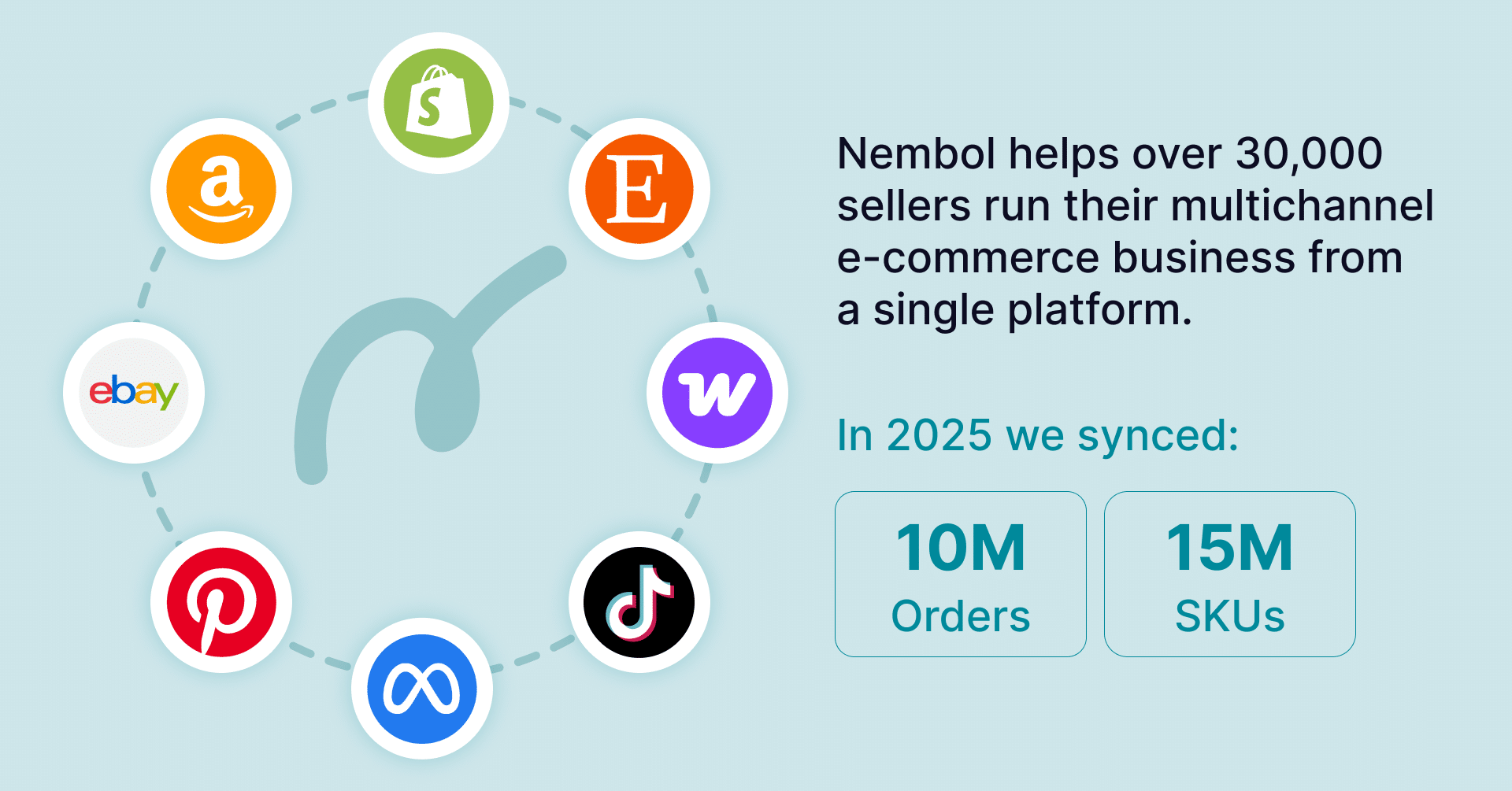
Nembol is a multichannel listing and inventory platform running since 2014, used by around 40,000 sellers across 65+ countries. It connected to TikTok Shop through the official APIs in February 2024 and has extended the integration since: UK in April 2024, category attributes and Hazmat in March 2025, France, Spain, Germany, Italy and Mexico in June 2025, certification documents in April 2026.
The distinction is architectural. TikTok Shop is not a separate product here; it is one of 16+ channels on the same catalog, the same inventory pool and the same subscription as Amazon, eBay, Etsy, Shopify, WooCommerce, Kaufland, OnBuy and the rest.
PROS
- Bulk publishing from any connected source: Shopify, WooCommerce, Etsy, Amazon, eBay, and more — or import products via CSV
- Imports existing TikTok listings, filtered by status and stock, retaining certification data
- Full category attributes including Hazmat, with bulk editing from Enterprise
- Certification documents managed in-app — the only one of the three to document this
- Default weight and dimensions on bulk publications, addressing the main cause of publication failures
- One stock pool across all channels: a TikTok sale decrements Amazon, eBay and Shopify at once
- TikTok orders routed for fulfilment into Shopify, WooCommerce, Square, Squarespace, Wix or Amazon MCF — whichever suits your operation — with no monthly cap
- Per-channel pricing rules, promotions, AI titles and descriptions, public API on Enterprise+
- Seven TikTok markets on every plan, with no region gating by tier
- Multiple accounts per channel (1/2/4/10 by plan), so TikTok US and UK run side by side at no extra cost
- All 16+ channels included at every tier, from the $39 entry plan. No channel to buy, no connector to add
- Built-in Storefront: a website generated from the same catalog that feeds TikTok Shop, on your own domain, with six themes, Stripe and PayPal checkout, discount codes and bundles — an owned destination for the audience TikTok content builds, and no transaction fees from Nembol
- Unlimited listings, orders and variants; 0% commission; 14-day trial, no card
CONS
- Manual stock edits in TikTok Seller Center are not pulled back — sync from TikTok is order-triggered
- Products with variations cannot span different warehouses
- Default weight and dimensions apply at publication, not retroactively to live listings.
Channels supported: TikTok Shop, Amazon, eBay, Etsy, Kaufland, OnBuy, Subito, Shopify, WooCommerce, Squarespace, Square, PrestaShop, Wix, Google Merchant Center, Faire, Instagram, Facebook, Pinterest, Tumblr and the Nembol Storefront. Temu coming soon.
Nembol fits the seller for whom TikTok Shop is one channel in a portfolio rather than a standalone project. Cost scales with catalog size and connected accounts, not with order volume or channel count, so a month where TikTok performs unusually well does not generate a higher bill.
3. LitCommerce — best for US, UK and Asia sellers with large catalogs
LitCommerce covers 15+ platforms and marketplaces. Its documentation lists seven web store platforms as TikTok sources — Shopify, Wix, WooCommerce, BigCommerce, Squarespace, Square and Shopline — alongside marketplaces including Amazon, eBay, Etsy, Walmart, Temu, Reverb and Faire, plus a file upload route with no store connected.
One point settles the shortlist for many readers: LitCommerce documents TikTok Shop support for the US, UK and Asia only, with other locations listed as coming soon. There is no EU coverage.
PROS
- Broad source coverage, plus a file-upload route that needs no storefront
- Bulk import, creation and editing, with a “Quick Publish” path and scheduled auto-publishing
- Smart listing rules, Templates and “Recipes” for reusable configurations
- Category auto-suggestion from product content
- Products land as drafts for review before publication
- Warehouse mapping between TikTok warehouses and store locations
- Unlimited monthly orders on all plans; live chat and email support
- Official TikTok Shop Service Partner
CONS
- No EU market coverage
- Sync runs on a 15-minute cycle for products, inventory, price and orders — the longest interval of the three
- Full sync needs “Shipped by Seller”; under Fulfillment by TikTok, customer detail visibility is restricted
- Multi-warehouse limited to TikTok US
- AI listing optimisation covers Etsy and eBay only, not TikTok Shop
- Priced on two axes at once: listing count and connected channels
- 7-day trial, short for a tool requiring catalog setup
Channels supported: TikTok Shop, Amazon, eBay, Etsy, Walmart, Temu, Reverb, Faire, Shopify, WooCommerce, Wix, BigCommerce, Squarespace, Square and Google Shopping.
LitCommerce works for sellers in its covered markets running a large catalog across many channels, who fulfil their own TikTok orders and can work with a scheduled sync cycle. Its dual-metered pricing is unpacked in Nembol vs LitCommerce, and LitCommerce alternatives .
Side-by-side comparison
* 🟢 Fully supported · 🟠 Partial, plan-dependent or undocumented · 🔴 Not supported. CedCommerce figures refer to its Shopify connector. Checked against vendor documentation in September 2026.
Market coverage and what it costs
* Markets as documented by each vendor, checked in September 2026. CedCommerce fixes the region when you connect the shop, and its free and entry plans cover one region only.
CedCommerce has the widest coverage of the three. If you sell into Poland, the Netherlands or Portugal, it is the only option here that supports you today. Read that alongside the pricing, though: region is fixed when you connect the shop, entry plans cover one region, and multi-market selling requires the $89 tier for the TikTok connector alone. Coverage is wide, but bought in increments.
Nembol covers seven markets and takes the opposite approach to access. All seven are on every plan, and multiple accounts per channel are included by tier, so a seller running TikTok Shop US and UK is already covered on the $49 Pro plan. It is also the only one of the three supporting Mexico.
LitCommerce is out of contention in Europe regardless of its feature set.
Pricing compared
$49/mo, 500 orders
$79/mo, 5,000 products
* List prices published by each vendor, checked in September 2026. CedCommerce figures refer to its Shopify connector.
What a real setup costs
* Built from list prices published by each vendor in September 2026. CedCommerce totals are estimates for the configurations described, not quoted bundle prices.
Try Nembol free for 14 days
No credit card required
Which one should you choose?
Choose CedCommerce if your catalog lives on one platform and you need EU markets the others do not reach. Budget for what that reach costs: multi-region moves the TikTok connector to $89, every additional marketplace is another app with its own meter, and UniCon starts at $99. Note also the daily product sync cycle.
Choose LitCommerce if you sell in the US, UK or Asia, run a large catalog across many channels, and fulfil your own TikTok orders. The absence of EU coverage is decisive for European sellers.
Choose Nembol if TikTok Shop is part of a multichannel operation rather than the whole of it. It is the only one of the three treating TikTok Shop as a peer to Amazon, eBay, Etsy and a dozen other channels on one catalog, one stock pool and one subscription — with the TikTok-specific depth publication requires. Its seven markets are fewer than CedCommerce’s but cover every major EU economy plus Mexico, included at every price point rather than gated by region or tier.
CedCommerce sells reach, priced per connector and per region. LitCommerce sells breadth within the markets it covers, priced per listing and per channel. Nembol sells an operating model — one catalog, one stock pool, every channel and every TikTok market included from $39 — priced on the one variable that does not move when business goes well.
Frequently asked questions
Do I need listing software to sell on TikTok Shop?
No. Seller Center allows manual product creation. Software becomes necessary when catalog size or multiple channels make manual entry unsustainable — typically past a few dozen SKUs, or the moment TikTok stops being your only channel.
Which platforms can I list to TikTok Shop from?
Nembol publishes to TikTok Shop from Shopify, WooCommerce, Etsy, Amazon, eBay, Wix, PrestaShop, Square, Squarespace or a CSV file, all within one account. LitCommerce covers seven web store platforms plus several marketplaces, and also accepts a file upload with no store attached. CedCommerce offers a connector for Shopify, WooCommerce, Adobe Commerce, PrestaShop, BigCommerce and Etsy, but each is a separate app with its own subscription.
Can I sell on TikTok Shop and other marketplaces with one subscription?
With Nembol, yes: all 16+ channels are included on every plan, including the $39 entry tier, so adding Amazon, eBay, Etsy or Kaufland alongside TikTok Shop costs nothing extra. LitCommerce includes multiple channels but counts them in the price. CedCommerce sells a separate app per marketplace, or bundles them into UniCon from $99/month.
Can I import products I have already published on TikTok Shop?
Yes, with all three. Nembol imports existing TikTok listings filtered by product status and stock quantity, and retains certification data on import. LitCommerce links products by SKU search. CedCommerce matches listings to your store products through product linking from its Standard plan, then recovers orders that had previously failed.
Will my stock stay aligned across channels?
Nembol maintains a single stock pool shared by all connected channels, so a TikTok sale decrements Amazon, eBay and Shopify in the same movement. LitCommerce syncs on a 15-minute cycle. CedCommerce syncs near real-time between your store and TikTok Shop, but each marketplace connector is a separate app and stock is not pooled across them.
What happens if I exceed my plan's order limit?
Nembol has no order limits on any plan, so a strong month changes your revenue and not your invoice. LitCommerce also allows unlimited monthly orders. CedCommerce meters orders by tier — 100, 500 or 1,000 per month — and above the cap the app stops fetching orders into your store until you upgrade, which makes it a fulfilment problem rather than a billing one.
Can I run TikTok Shop US and UK at the same time?
With Nembol, yes: plans include multiple accounts per channel — one on Basic, two on Pro, four on Enterprise, ten on Enterprise+ — so a second TikTok market needs no upgrade beyond the plan you are already on. With CedCommerce the region is fixed when you connect the shop, and multi-region selling requires the $89 Advanced tier. LitCommerce covers the US and UK but not the EU.
Which TikTok markets can I sell in?
Nembol covers seven markets on every plan — US, UK, France, Germany, Italy, Spain and Mexico — with no region gating by tier, and is the only one of the three supporting Mexico. CedCommerce documents the widest list at 15 markets, US, UK and 13 EU countries, though region is fixed at connection and entry plans cover one region only. LitCommerce covers the US, UK and Asia, with no EU support at present.
Can these tools handle TikTok-fulfilled orders?
Not reliably, in any of the three. Nembol does not document platform-shipped fulfilment. LitCommerce requires the “Shipped by Seller” method for full sync, and restricts customer detail visibility under Fulfillment by TikTok. CedCommerce states that TikTok Shipping labels must be generated inside Seller Center. If platform-shipped fulfilment is central to your operation, confirm current behaviour with the vendor directly.