
Overview
Fulfillment is the joint definition of the set of e-commerce operations that go from picking-and-packing products, to shipping and managing returns.
What are Amazon’s fulfillment services?
Amazon is not just one of the largest online marketplaces in the world, it is also a major logistics powerhouse, and it offers any seller the option to host their products at Amazon’s warehouses, so that Amazon can pick, pack and ship them upon request.
Millions of sellers around the globe rely on Amazon to deliver quickly, manage inventory efficiently, and scale their businesses without needing to operate complex warehouse operations.
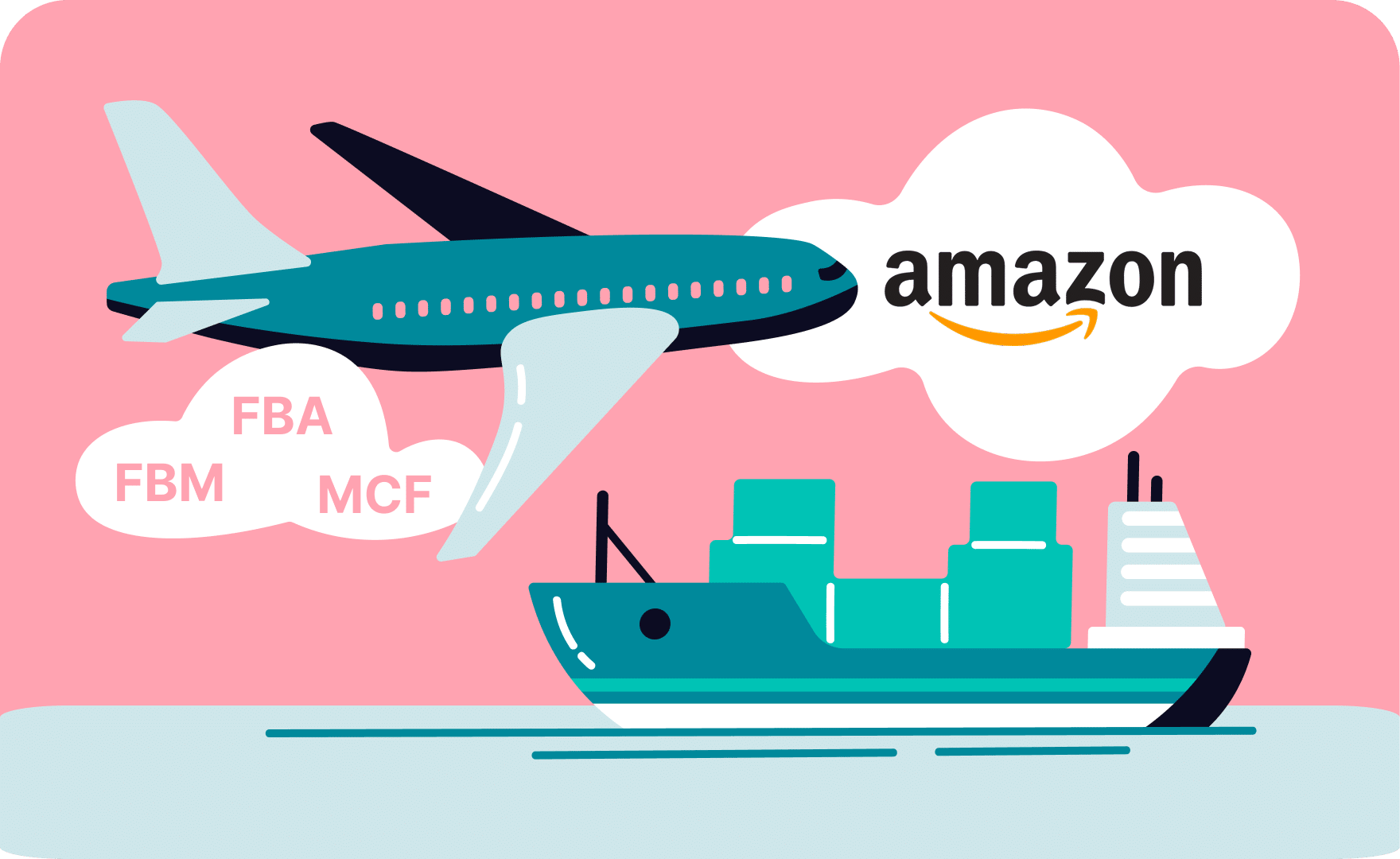
To support different business models, Amazon offers multiple fulfillment options.
- FBM — Fulfilled by Merchant — orders are received on Amazon Marketplace, the merchant ships from its warehouse. Gives sellers full control over fulfillment and service levels.
- FBA — Fulfillment by Amazon — orders are received on Amazon Marketplace, Amazon ships them from its warehouse on behalf of the seller. Sellers outsource storage and shipping to Amazon.
- MCF — Multi-Channel Fulfillment — orders are received on seller’s e-commerce venues outside of Amazon, Amazon ships them from its warehouse on behalf of the seller.
Let’s take a closer look and explore the pros and cons of each.
What is FBM on Amazon
Fulfilled by Merchant (FBM) is Amazon’s fulfillment model where sellers manage the entire order process themselves.
The seller is responsible for:
- Storing inventory
- Picking products from shelf
- Packing orders
- Shipping
- Handling customer service and returns.
FBM gives sellers full control over their logistics operations. This option is often chosen by businesses that already have their own warehouse, use third-party logistics providers, or sell products that are not suitable for Amazon’s fulfillment network due to size, handling requirements, or cost structure.
With FBM, sellers benefit from Amazon’s marketplace visibility, but fulfillment is handled independently.
FBM is best for:
- Businesses with existing warehouses and fulfillment teams
- Sellers who want full control over stock, packaging and shipping
- Companies with specialized or custom products not ideal for Amazon Fulfillment
How does Amazon FBM work
To use FBM, sellers must have an active Amazon Seller account and list their products on the Amazon marketplace. When a customer places an order, the seller — not Amazon — is responsible for every step of the fulfillment process.
The seller manages:
- Shipping methods and negotiation with carriers
- Delivery timelines
- Customer communication
- Returns and refunds
How to work with FBM:
- Store inventory in your own warehouse or with a logistics partner
- Receive an order on Amazon
- Pick and Pack
- Ship the order directly to the customer
What is FBA on Amazon
Fulfillment by Amazon (FBA) is designed for sellers who want to store products in Amazon fulfillment centers and have Amazon handle storage, shipping, customer service, and returns for Amazon marketplace orders.
FBA allows sellers to leverage Amazon’s sophisticated logistics network and offer fast, reliable delivery to customers. Products fulfilled through FBA are often eligible for Prime shipping, which can improve visibility, sales, and customer trust.
FBA is best for:
- Businesses focused on Amazon
- Sellers who want or need to outsource storage and shipping entirely
- Businesses aiming for fast, Prime-eligible delivery
- Sellers who want Amazon to handle returns and customer service
How does Amazon FBA work
The FBA process is designed to be simple and scalable for both individual sellers and businesses.
- Send your inventory to Amazon: Prepare products according to Amazon’s packaging and labeling requirements and ship them to Amazon fulfillment centers.
- Storage and availability: Amazon stores the inventory and makes it available for purchase on the Amazon marketplaces.
- Order fulfillment: When a customer places an order, Amazon handles the picking, packing, and shipping of the product, often with fast options like Prime delivery.
- Customer service and returns: Amazon manages all post-purchase operations, including customer inquiries, refunds, and returns.
Please note: Fulfillment by Amazon (FBA) can be used only for orders placed on the Amazon marketplace. It does not fulfill orders from other sales channels.
If a seller does not sell on Amazon, or when it expands beyond Amazon and starts selling on platforms like eBay, WooCommerce, their store on Shopify, or other e-commerce channels, Amazon Multi-Channel Fulfillment (MCF) is required. Nembol is the Amazon official third-party integration which helps you connect your non-Amazon and have Amazon shipping them.
What is MCF on Amazon
Amazon Multi-Channel Fulfillment (MCF) is a fulfillment solution that allows sellers to use Amazon’s world-class logistics network to manage and ship orders from any sales channel, not just Amazon’s own marketplace.
This means sellers can ask Amazon to store inventory inside Amazon fulfillment centers, and have Amazon shipping directly to customers who order from their own ecommerce site on popular platforms such as WooCommerce or Shopify, other marketplaces like eBay, or even social media stores.
MCF is particularly valuable for sellers who operate across multiple channels but want a centralized, reliable fulfillment system. By using Amazon MCF, sellers can reduce the complexity of managing multiple warehouses, ensure fast and trackable delivery, and provide a professional, consistent shipping experience for customers, without having to invest heavily in their own logistics infrastructure.
Benefits of using Amazon MCF:
- Single inventory pool: One stock can serve multiple sales channels, helping prevent overselling and stockouts.
- Fast and reliable shipping: Orders are fulfilled from Amazon’s network of fulfillment centers, offering predictable delivery times.
- Scalable solution: Sellers can easily handle growing order volumes without adding warehouse space or staff.
- Seamless integration: MCF can be connected to e-commerce platforms and marketplaces for automated order routing. Nembol’s Amazon MCF integration makes this process possible.
By leveraging MCF, sellers gain access to Amazon’s logistics expertise and infrastructure while maintaining control over where and how their products are sold.
MCF is best for:
- Businesses that want to use Amazon logistics without selling on Amazon
- Amazon sellers receiving orders also on Shopify, eBay, WooCommerce, or other platforms who want to keep Amazon as their fulfillment hub
- Companies needing synced inventory across multiple channels
- Sellers seeking reliable, fast shipping for non-Amazon orders
How does Amazon MCF work
To use Amazon Multi-Channel Fulfillment (MCF), sellers must have an active Amazon Seller account, although they may not use it for selling, and must send inventory to Amazon fulfillment centers in advance. This inventory will then be used to fulfill their orders from external sales channels, such as e-commerce websites, social commerce platforms, or third-party marketplaces, including marketplaces directly competing against Amazon marketplace, such as eBay.
MCF can be used regardless of whether you sell on Amazon’s marketplace or not.
There are two main ways to get started:
- If you already sell on Amazon, your products are already stored in Amazon fulfillment centers, so you can immediately use that inventory to place MCF orders. No additional registration is required. Each time you receive an order, simply log in to Seller Central and manually create an MCF order for your external sales. — Instead of going manual, you can use Nembol software to automate the process, eliminating errors, and easing larger volumes.
- If you’re new to Amazon, you must create a Seller account, sign up for fulfillment services, and start using MCF to store inventory and ship orders through Amazon’s logistics network. Your products must have SKU codes — no ASIN nor Amazon listing are required. You can connect Nembol to automatically transfer and fulfill orders from eBay, Shopify, WooCommerce, and other channels via Amazon. Once an MCF order is submitted, Amazon handles the picking, packing, and shipping. The package is delivered directly to the customer, with tracking information automatically available for both the seller and the buyer.
Note: Returns can also be sent back to Amazon’s fulfillment centers, allowing eligible products to be reintegrated into available inventory. Since these orders originate outside of Amazon’s marketplace, customer communication and support remain the seller’s responsibility.

Share your Amazon listings on additional sales channels
Start a 14-day trial.
No credit card required.

What is the difference between Amazon MCF and FBA
Many industry operators use the acronym “FBA” to indicate both MCF and FBA services, generating some confusion, indeed harmless.
While both Amazon MCF and FBA use the same fulfillment network, they serve different purposes and target different sales scenarios. Understanding the distinctions helps sellers and businesses choose the right solution for their needs.
The main differences can be summarized in the table below:

What is the cost difference between FBA and MCF
| Cost element | FBA | MCF |
| Monthly subscription | $39.99 / month (Professional plan)
$0.99 per unit (Individual plan) |
Same as FBA |
| Fulfillment fee – Small standard (≤16 oz) | ~$3.06–$3.65 per unit (non-apparel example range) (Seller Central rate card) |
1-unit: $7.34–$8.66
4+ units: $3.64–$4.38 |
| Fulfillment fee – Large standard (≤16 oz) | ~$3.68–$8.93 per unit depending on weight & tier | 1-unit: $7.56–$8.93
4+ units: $4.00–$4.70 |
| Fulfillment fee – Large standard (1–3 lb) | In FBA rate card: increases with weight (e.g., ~$4.99–$6.92+ ranges) | 1-unit: $10.64–$11.75
4+ units: $5.25–$5.95 |
| Fulfillment fee – Bulky / Extra large | Significantly higher in FBA for oversize/extra-large (e.g., ~$9.61+ to $194.95+ depending on size) | Bulky (up to 30 lbs): ~$18.08 + $0.70/lb+
Extra large (up to 50 lbs): ~$32.17 + $0.62/lb+ |
| Storage fees | ~$0.78/cu ft Jan–Sep
~$2.40/cu ft Oct–Dec |
Same as FBA |
| Multi-unit pricing effects | Not applicable | Fees decrease per unit on orders with multiple items (e.g., 2, 3, or 4+ units have lower per-unit rates) |
| Additional potential fees | Special services, long-term storage, returns, inbound placement | Lithium battery surcharge, remote area delivery surcharge, blocked Amazon Logistics surcharge |
Both Fulfillment by Amazon (FBA) and Multi-Channel Fulfillment (MCF) apply a per-unit fulfillment fee based on size tier and shipping weight, plus monthly storage fees calculated on the cubic footage your inventory occupies in Amazon fulfillment centers. The subscription cost is the same for both programs, as it depends on the selling plan rather than the fulfillment method.
One of the most relevant cost variables to consider is seasonality. Storage fees increase significantly during the October, December peak period compared to January, September. This means that inventory levels, sell-through rate, and replenishment timing directly affect overall cost efficiency. Holding excess stock during peak months can materially increase per-unit storage cost, especially for bulky or slow-moving items.
At the fulfillment level, FBA fees follow a structured rate card that increases progressively with weight and size tier, with particularly higher costs for bulky and extra-large items. MCF uses a similar size- and weight-based structure, but per-unit fees are generally higher for single-unit external orders, while multi-unit orders benefit from reduced per-unit rates.
For larger and heavier products, both programs show significant fee escalation due to dimensional weight calculations.
Nembol’s Amazon MCF Integration
Nembol added integration with Amazon Multi-Channel Fulfillment.
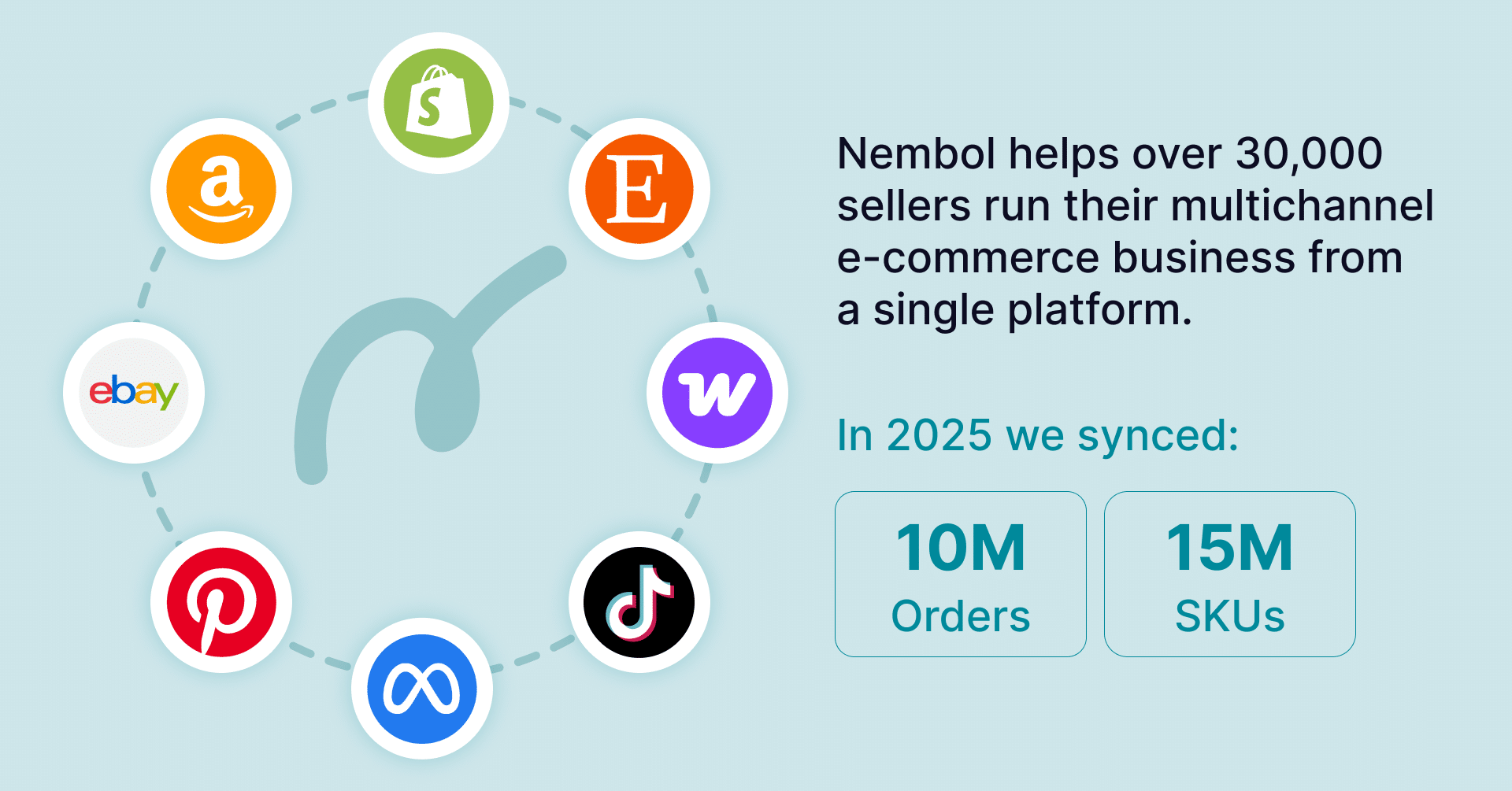
Your orders from eBay, Shopify, or WooCommerce can now be sent directly to Amazon fulfillment centers (TikTok Commerce orders coming soon). Sellers can manage multi-channel fulfillment through Amazon’s logistics network from a single platform — no need to maintain separate software to connect your e-commerce and your marketplaces.
Requirements:
- Active Amazon Seller account
- Sell on eBay, Shopify, or WooCommerce
- Products have SKU codes
Important: You do not need to sell on Amazon or create Amazon listings. This Nembol feature simply transfers your eBay, Shopify, or WooCommerce orders for shipment via Amazon MCF.
Supported channels:
- eBay
- Shopify
- WooCommerce
- TikTok Commerce coming soon
Want to connect MCF? Contact us