

Overview
In marketplace-driven ecommerce, product visibility and sales performance depend heavily on how product data is structured, maintained, and distributed. Each platform, from marketplaces to advertising channels, relies on product feeds to ingest catalog information and generate listings, shopping results, and product ads.
Product feed management provides the framework for handling this process in a controlled and scalable way. By organizing and maintaining product data before it is distributed to external platforms, it ensures that listings remain accurate, consistent, and aligned with the requirements of each marketplace.
For brands, businesses, and individual sellers operating across multiple channels, effective feed management becomes a key component of multichannel strategy. It enables product catalogs to be maintained centrally while supporting consistent listings across diverse ecosystems such as Amazon, Google, and social commerce platforms.
What is Product Feed Management for marketplaces
Product feed management for marketplaces refers to the process of structuring and maintaining catalog data so that it can be distributed and interpreted correctly across different selling platforms.
Product feeds contain the structured information that defines a listing: identifiers, titles, descriptions, prices, images, availability, and other attributes required to display and sell products online. Because each marketplace processes product data differently, the same catalog often needs to be adapted to multiple formats and attribute structures.
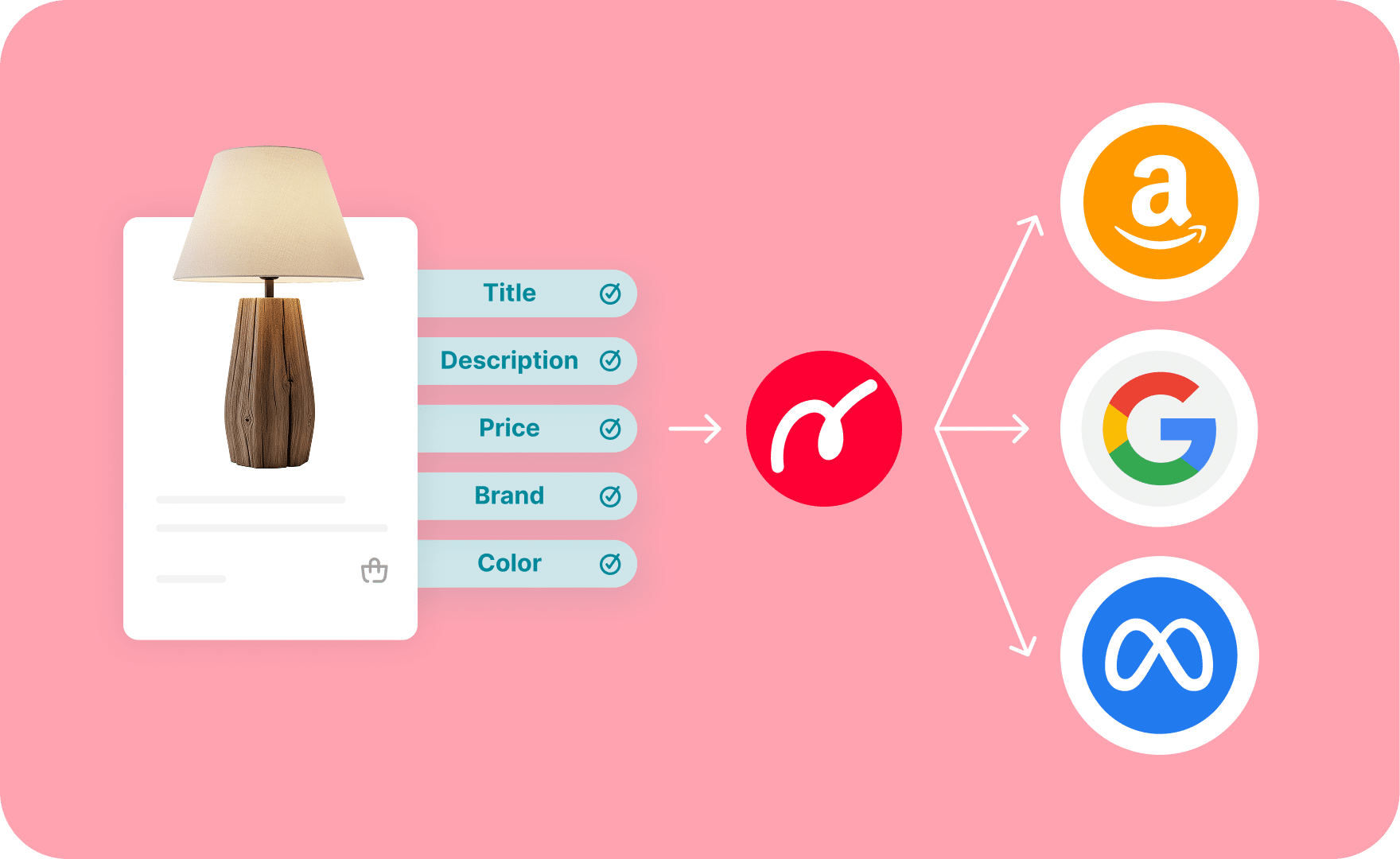
Product feed management introduces a controlled workflow for handling these differences. Instead of maintaining listings separately on every platform, sellers manage product information within a centralized catalog and distribute it through feeds configured for each marketplace.
Benefits of Product Feed Management for marketplaces
As sellers expand across multiple marketplaces, managing product data manually becomes increasingly complex. Differences in platform requirements, frequent catalog updates, and large product assortments can quickly lead to inconsistencies between listings.
Product feed management addresses these challenges by introducing a centralized structure for maintaining and distributing catalog data.
Its main benefits include:
- Consistent product information across marketplaces
Centralized feeds help maintain alignment between titles, pricing, stock levels, and product attributes across all channels - Improved product discoverability
Well-structured product data helps platforms correctly categorize and surface listings in search results and product catalogs - More efficient catalog operations
Managing product data through a single feed reduces the need to update listings manually on each marketplace - Scalable multichannel distribution
New products and updates can be propagated across multiple platforms without duplicating listing workflows - Fewer listing errors and rejections
Structured feeds reduce the risk of missing attributes or incorrect data that may prevent products from being published. - Greater control over product data quality
Centralized management makes it easier to monitor catalog completeness and maintain consistent information across channels.
Product Feed Management tool for marketplaces
Product feed management can be handled through a range of tools and platforms designed to structure, maintain, and distribute catalog data across multiple marketplaces. These solutions become essential in complex environments where each channel enforces different requirements for product attributes, formatting, and update frequency.
In this scenario, feed management tools serve as a central operational layer, helping businesses maintain data consistency, accelerate updates, reduce listing fragmentation, and keep tighter control over overall catalog quality.
A practical example in multichannel ecommerce is Nembol, a platform built to manage product catalogs across multiple marketplaces from a single interface. It allows sellers, brands, and larger organizations to streamline how product data is structured and distributed, while automatically adapting listings to meet the specific requirements of channels like Amazon, Google Merchant Center, and Meta Catalog. This kind of centralized approach becomes particularly valuable when optimizing and synchronizing product feeds at scale, where consistency and speed directly impact visibility and performance.
How to optimize products feed on Amazon
Amazon requires product data to follow a structured set of rules defined in its Seller Central product data specifications. Listings are built from attribute-based catalog information, meaning each product must include a complete and accurate set of fields to be correctly indexed and displayed within the marketplace.
At a minimum, Amazon product feeds must include identifiers such as GTIN, UPC or EAN (where applicable), product title, brand, price, availability, and at least one product image. Depending on the category, additional attributes like size, color, material, and technical specifications may also be required.
Product titles must follow Amazon’s formatting guidelines, prioritizing clarity and structured keyword relevance while avoiding promotional language. Bullet points and descriptions should provide structured, factual information aligned with category requirements. Pricing and inventory must remain accurate to avoid listing suppression or reduced visibility.
Beyond technical compliance, Amazon SEO plays a critical role in improving product discoverability and overall listing performance. Well-structured product data, especially in titles, attributes, and descriptions, directly influences how products are indexed and ranked within Amazon’s search system. For a deeper breakdown of optimization strategies, you can refer to our dedicated guide on Amazon listing optimization.
In this context, feed quality directly affects listing compliance, discoverability, and overall performance within Amazon search and catalog systems.
Nembol can support Amazon product feed optimization:
- Maintaining a single catalog where titles, descriptions, pricing, and attributes are structured and aligned with Amazon requirements
- Updating only specific inventory fields such as quantity, price, barcode, and ASIN using SKU-based matching. The system allows targeted edits without affecting other product attributes, ensuring that unchanged fields remain intact across the catalog
- Supporting the creation of optimized product titles and descriptions through AI-assisted tools, helping improve structure and keyword relevance while allowing final adjustments directly within Amazon where stricter listing controls apply
- Defining pricing rules that keeps Amazon listings aligned with consistent pricing strategies across channels
- Keeping stock levels and product information updated to reduce discrepancies and listing issues through continuous synchronization
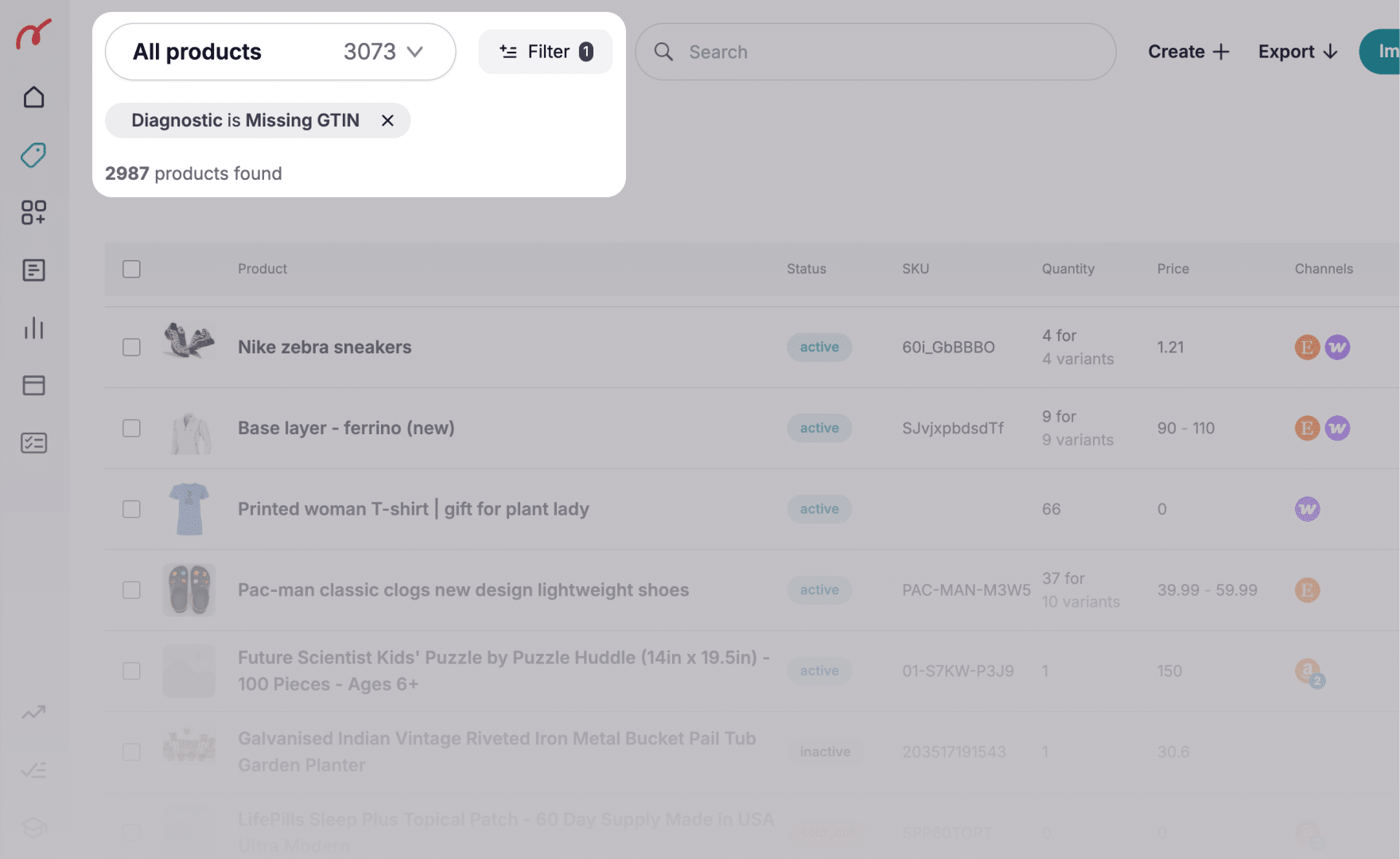
- Detecting missing or incomplete product data such as missing GTINs, incomplete attributes, or inconsistent catalog information using Nembol Checkup, enabling structured correction of issues before they impact Amazon feed quality or listing performance
How to create data feed for Google Merchant Center
Google Merchant Center relies on structured product data feeds to display products across Google Shopping surfaces, including Search, Shopping ads, and free listings. Product data is evaluated based on a strict set of attribute requirements defined in Google’s product data specification, which determines how listings are indexed, matched, and shown to users.
At a minimum, a Google Merchant Center product feed must include required attributes such as id, title, description, link, image_link, price, availability, and condition. In many cases, GTIN and brand are also required to ensure proper product matching and avoid disapproval or limited visibility. Each attribute must follow precise formatting rules, as incomplete or inconsistent data can lead to item disapprovals or reduced performance in Shopping results.
Product titles and descriptions play a critical role in how products are matched to user search queries. Google recommends using clear, descriptive titles that accurately reflect the product, while avoiding misleading or irrelevant content. Product images must meet specific quality standards, as they directly influence both approval and click-through performance.
Beyond structural compliance, Google Shopping performance is strongly influenced by feed quality and data completeness, since product data directly affects eligibility, relevance, and ad performance across Google surfaces.
In this context, feed accuracy and completeness are essential not only for approval but also for maximizing visibility within Google’s ecosystem.
Nembol can support Google Merchant Center feed optimization:
- Maintaining a central catalog where titles, descriptions, pricing, and attributes are structured and aligned with Google Merchant Center requirements
- Ensuring product identifiers (such as GTIN) are correctly formatted to improve product matching and reduce disapprovals
- Updating inventory and pricing data in real time to keep product information consistent across Google Shopping listings
- Generating optimized product titles and descriptions aligned with Google’s structured data and search relevance principles through AI-assisted tools
- Applying pricing rules to maintain consistent and competitive pricing across channels connected to Google Merchant Center
- Synchronizing product data continuously to reduce mismatches between feed data and landing page information
- Detecting missing or incomplete product attributes using Nembol Checkup, enabling structured correction before feed submission or updates.

How to optimize Facebook product feed (Meta catalog)
Meta product feeds are used within the Meta ecosystem to power dynamic ads, product catalogs, and shopping experiences across Facebook and Instagram. Product data is managed through Meta Commerce Manager, where catalog information is structured and used to match users with relevant products across different placements.
A Meta product feed must include a defined set of attributes such as id, title, description, availability, condition, price, link, and image_link. These fields allow Meta to build and maintain a product catalog that can be used for advertising and on-platform shopping experiences. In addition, product sets can be created to group items for campaign targeting and dynamic ad delivery.
Unlike marketplace-focused platforms, Meta emphasizes advertising performance and catalog relevance, meaning product data must be structured not only for completeness but also for engagement and conversion potential. High-quality images, clear product titles, and accurate availability data are essential for maintaining ad delivery consistency and reducing catalog errors.
Frequent updates are critical in this context, especially for pricing and inventory. In particular, out-of-stock products can negatively impact both ad performance and user experience, as users may be directed to unavailable items. Keeping availability data aligned with real stock levels is therefore essential to avoid wasted ad spend and catalog inefficiencies.
Overall, feed quality directly influences how effectively products are matched to user interests and how efficiently catalogs perform within Meta’s advertising system.
Nembol can support Meta product feed optimization:
- Maintaining a centralized product catalog with consistent titles, descriptions, pricing, attributes, and availability status aligned for Meta Commerce Manager
- Ensuring inventory levels are continuously synchronized to reduce the risk of out-of-stock products appearing in ads or catalog listings
- Synchronizing pricing and product data updates to prevent mismatches between ads and landing pages
- Applying structured bulk updates to large catalogs without manual product-by-product editing
- Supporting continuous data updates so catalog changes are reflected in real time across Meta environments
- Identifying missing or incomplete product attributes through Nembol Checkup, enabling faster correction before impacting catalog performance.

How to sync product feeds across marketplaces
Managing product data across multiple marketplaces is not only a matter of synchronization, but also of maintaining a consistent structure as catalogs expand across different sales environments. Platforms such as Amazon, Google Merchant Center, and Meta rely on distinct product data models, which means that information must remain aligned while still being adapted to each channel’s specific requirements.
In this context, synchronization goes beyond simple updates of inventory or pricing. It becomes an ongoing process that ensures product attributes, availability, and catalog structure remain consistent across all active channels. Without this alignment, discrepancies can emerge between platforms, leading to outdated listings, stock mismatches, or fragmented product data.
Nembol addresses this challenge by combining product feed management, synchronization, and multichannel publishing within a single workflow. Instead of treating each channel separately, product data is managed from a centralized catalog and distributed across multiple destinations in a structured and controlled way.
This approach allows product information to be continuously synchronized across marketplaces such as Amazon, Google, and Meta, while also extending distribution to additional ecommerce and social commerce channels, including platforms like Shopify, WooCommerce, Etsy, and TikTok Shop.
In this way, synchronization is directly connected to multichannel expansion, enabling products to be published and maintained consistently across a broader ecosystem of sales channels.
Next: feed products from your company’s management system
Nembol can be the feed-management hub of your own Enterprise Management Systems.
Do you want to test? Pick one of the following options:
- Ask you Software vendor, or system integrator to contact us and discover how your catalog can flow from your company’s management system to Nembol and be feed to multiple online channels
- Ask your CIO to contact us to explore how our state-of-the-art channel management software can be integrated with your company’s systems
- Try for free for up to 14 days, during which you can use our commerce-grade features to upload multiple CSV files and test all functionalities via our web interface.
Optimize your product catalog and reliably share it!